

AI CERTS
3 hours ago
Nvidia Groq integration reshapes AI inference
Deal Overview And Context
Groq’s newsroom post confirmed three key facts. Firstly, Nvidia licensed Groq’s LPU-based inference IP. Secondly, Jonathan Ross, Sunny Madra, and roughly 90% of staff will join Nvidia. Thirdly, GroqCloud continues under new CEO Simon Edwards. Meanwhile, widespread media reports, citing investors, valued the arrangement near US$20 billion, though neither party publicly disclosed terms.
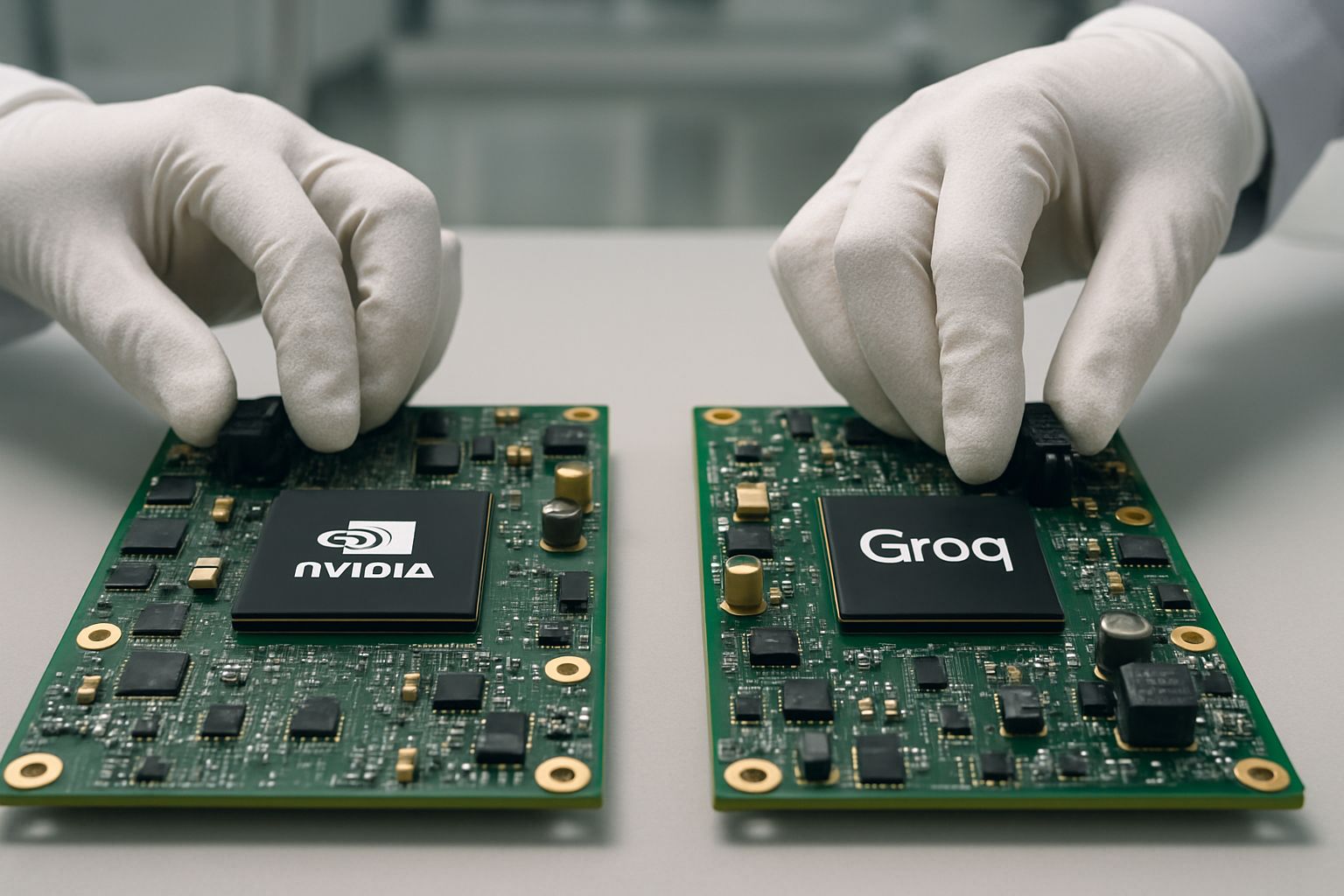
Moreover, Nvidia’s internal memo stressed that the company is “not acquiring Groq” but integrating the people and patents. In contrast, many commentators call the structure an “acquihire plus asset deal.” Nonetheless, the Nvidia Groq integration places critical inference expertise inside the dominant AI accelerator vendor.
These confirmations close months of speculation about Groq’s fundraising path. September’s $750 million round valued Groq at $6.9 billion. Subsequently, investors receive a swift exit. Axios reports that 85% of payouts arrive immediately, with unvested shares converting to Nvidia stock.
The section underscores the transaction’s shape and scale. Meanwhile, the next section explores the licensed technology itself.
Technology Behind The License
Groq’s Language Processing Unit differs sharply from mainstream GPU designs. Instead of external HBM, the LPU packs dense on-chip SRAM. Consequently, inference latency drops because memory fetches stay on die. However, model size per device remains limited by silicon area. Nevertheless, workloads prioritizing real-time responsiveness—voice assistants, trading bots, and autonomous systems—benefit.
Furthermore, deterministic single-thread execution simplifies software scheduling. Engineers can predict worst-case latencies, a prized attribute for safety-critical deployments. Nvidia gains immediate access to this architecture, plus the engineering team that created it. That talent accelerates potential roadmap synergies with Nvidia’s Grace Hopper superchips and future Grace Blackwell lines.
• Key technical differentiators:
- On-chip SRAM reduces external memory trips.
- Deterministic pipelines enable millisecond-class tail latencies.
- LPU ISA focuses on massive parallel scalar operations.
- GroqCloud software abstracts compilation for developers.
Groq’s design solves specific inference pain points. Therefore, folding these ideas into Nvidia’s CUDA ecosystem could multiply adoption. Engineers will watch how quickly CUDA kernels gain optional deterministic modes.
The technology analysis highlights why Nvidia pursued the license. However, motives extend beyond pure silicon advantages.
Strategic Motives For Nvidia
Nvidia dominates training workloads, yet inference volume is exploding faster. Moreover, hyperscalers demand energy-efficient, low-cost inference solutions. By importing Groq’s architecture and Leadership, Nvidia hedges against market shifts that devalue GPU generality.
Additionally, absorbing Groq’s talent pre-empts rivals. AMD, Cerebras, and cloud-native ASIC teams now face a strengthened incumbent. Consequently, Nvidia can offer both high-capacity training GPUs and ultra-low-latency inference accelerators under one software roof.
Integrating dissimilar chipsets remains challenging. Nevertheless, Nvidia’s $4-trillion market cap supplies resources for iterative experimentation. The company also acquires deeper relationships with Groq’s enterprise clients, potentially upselling complementary products.
This strategic play addresses market, competitive, and technology goals. Yet, every move invites scrutiny from regulators and competitors.
Impacts On AI Market
Industry stakeholders quickly assessed ripple effects. Hyperscalers evaluating Groq hardware now question long-term independence. Meanwhile, alternative inference startups pitch themselves as neutral partners. Furthermore, customers worry about pricing power as Nvidia consolidates yet another niche.
Market researchers outline three immediate impacts:
- Capital flows toward companies offering diversified chipsets rather than single-technology bets.
- Cloud providers renegotiate supply contracts, leveraging uncertainty to secure better terms.
- Regulators study “license plus staff” structures as potential merger circumventions.
Consequently, engineering leaders must reassess vendor roadmaps and hedge accordingly. Meanwhile, independent validation labs will benchmark LPU integration inside Nvidia data paths once prototypes emerge.
The market view leads naturally to regulatory considerations, detailed next.
Antitrust And Regulatory Risks
Bernstein analyst Stacy Rasgon warns that antitrust scrutiny remains plausible. Although the deal is not a formal merger, staff transfers weaken Groq’s competitive stance. Moreover, the non-exclusive license could appear symbolic if Groq lacks core talent to innovate independently.
Therefore, agencies may examine intent and practical effects. In contrast, Nvidia argues that Groq can still license IP to others, preserving competition. Nevertheless, precedent from Meta-Within or Illumina-Grail shows regulators challenging creative deal structures.
Professionals can stay prepared by deepening compliance skills. For example, security teams may pursue the AI Ethical Hacker™ certification to understand trust and governance in evolving AI stacks.
Regulatory uncertainty shapes investment and deployment decisions. However, internal technical considerations also matter, especially for Groq’s existing customers.
Future For GroqCloud Service
Groq insists its cloud service remains operational. Simon Edwards now leads with a trimmed workforce. Additionally, the non-exclusive arrangement allows Groq to license future designs elsewhere. Nevertheless, observers question whether reduced engineering depth hampers roadmap delivery.
Meanwhile, Nvidia may redirect internal builds to supply GroqCloud hardware, ensuring short-term continuity. Consequently, customers receive reassurance. Yet, long-term differentiation could blur if GroqCloud becomes another Nvidia-backed offering.
Groq’s survival will depend on attracting fresh talent and carving niches where deterministic latency outweighs integrated GPU solutions. Therefore, watch recruiting trends and product updates during 2026.
The GroqCloud outlook ties back to practical guidance for enterprise leaders, covered next.
Key Takeaways For Leaders
Executives overseeing AI roadmaps should extract four lessons. Firstly, vendor stability can shift overnight, so diversify hardware exposure. Secondly, architectures optimized for inference will gain prominence as usage grows. Thirdly, regulatory landscapes remain fluid; compliance expertise is vital. Finally, strategic acquisitions increasingly target Leadership and engineering excellence rather than company control.
Action items include:
- Audit current inference workloads for latency sensitivity.
- Model cost scenarios using alternative chipsets.
- Monitor regulatory filings related to the Nvidia Groq integration.
- Upskill teams with certifications such as the AI Ethical Hacker™ program.
These steps prepare organizations for rapid ecosystem shifts. Moreover, they align technical planning with governance obligations under emerging AI regulations.
The key takeaways conclude our analysis. However, the story continues to evolve as integration progresses.
Overall, the Nvidia Groq integration demonstrates how quickly AI hardware dynamics can change. Therefore, ongoing vigilance remains essential.
Conclusion
Groq’s leadership migration and IP license mark a watershed moment for inference accelerators. Moreover, Nvidia gains low-latency architecture, seasoned Leadership, and coveted talent. Customers must reassess roadmaps, diversify chipsets, and build governance muscle. Consequently, professionals should track regulatory developments and embrace continuous education. Furthermore, certifications like the AI Ethical Hacker™ course enhance readiness for evolving AI infrastructures. Stay informed, evaluate options, and position your organization ahead of the next seismic shift.


