

AI CERTS
2 hours ago
Nvidia China Export Clears Way for H200 Sales With 25% Cut
Meanwhile, Nvidia China Export headlines now dominate boardrooms from Santa Clara to Shenzhen. This article unpacks the policy shift, quantifies market demand, and outlines the geopolitical aftershocks. Additionally, it explores enforcement puzzles and strategic implications for cross-border trade in high-end computing. Readers will find concise data, balanced analysis, and actionable certification guidance. Therefore, technology leaders can navigate the evolving landscape with confidence.
Policy Shift Explained Briefly
Nvidia China Export policy emerged from bilateral talks between the White House and Beijing. In contrast, earlier rules had barred any chip surpassing restricted throughput metrics. Subsequently, the new licence permits only the H200 product, excluding newer Blackwell and Rubin families. Trump framed the decision as a pragmatic balance between commerce and security.
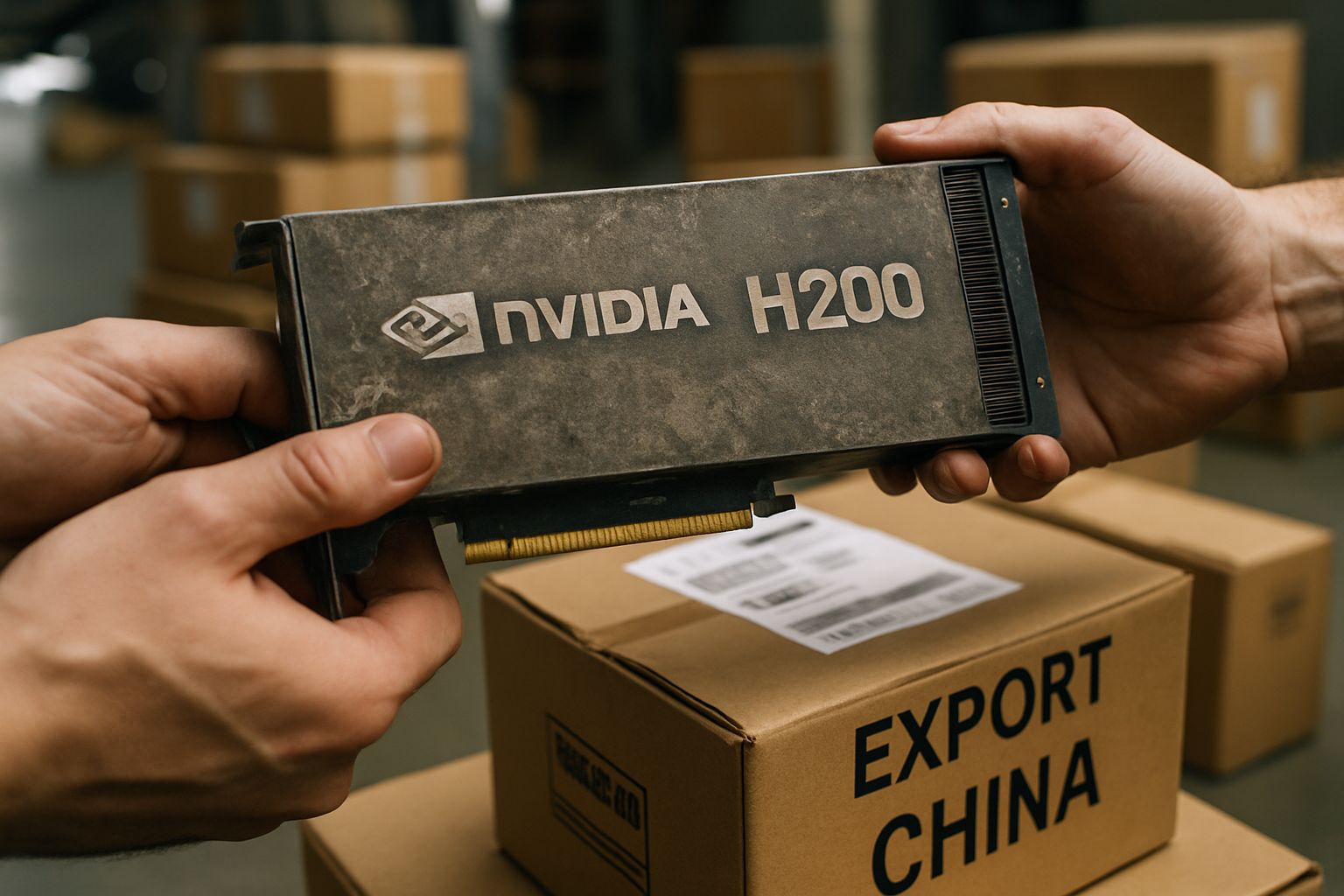
Commerce Department officials must now draft licence conditions, end-user screening procedures, and revenue collection methods. Nevertheless, the 25% cut remains legally ambiguous because Congress never authorised such a levy. Experts expect a fee structure under the International Emergency Economic Powers Act to appear.
The scope is narrow yet unprecedented. Consequently, execution details will decide whether the initiative endures. Meanwhile, surging Chinese demand raises fresh commercial questions.
Market Demand Surge Details
Reuters reports Chinese cloud leaders have ordered more than two million H200 units for 2026. Moreover, Nvidia holds only 700,000 units in inventory, forcing quick manufacturing negotiations with TSMC. In contrast, initial shipments may cover merely 40,000 to 80,000 chips before the Lunar New Year.
Analysts cite a 2-3× performance advantage over domestic silicon, justifying steep per-chip prices near $27,000. Furthermore, the 25% cut inflates final invoices but buyers appear unfazed given strategic urgency. Consequently, Nvidia China Export volumes could reach record highs if approvals flow smoothly.
- Reported 2026 orders: 2,000,000 chips
- Current Nvidia stock: 700,000 chips
- Expected initial modules: 5,000–10,000
- Average unit price: US$27,000
- U.S. revenue share: 25% cut per sale
These figures spotlight enormous revenue potential. However, supply constraints and regulatory friction could cap actual deliveries. The next section examines security backlash shaping that friction.
Security Concerns Raised Loudly
Defense officials warn that exporting advanced accelerators may accelerate adversary military algorithms. Consequently, some lawmakers, including Senator Warren, label the decision reckless. Chris McGuire at CFR predicts the move will add massive compute to Chinese frontier model teams. Officials insist the Nvidia China Export licence vetting will filter military-linked entities.
Meanwhile, DOJ has highlighted Operation Gatekeeper, which uncovered smuggling of restricted GPUs. Therefore, enforcement agencies demand strict end-use verification and tamper-proof telemetry. Nevertheless, practical monitoring inside China remains difficult, raising diversion risks. Critics note that H200 still outperforms many export-limited rivals despite being a generation behind.
Security critiques underscore unresolved oversight gaps. Moreover, those gaps influence economic calculations for all stakeholders. The following section quantifies those economic stakes.
Economic Upside Detailed Analysis
Nvidia forecasts billions in incremental revenue if the licence window remains open through 2026. Additionally, the company insists U.S. customers will not face shortages. Investors consequently drove Nvidia shares to new highs after the Nvidia China Export announcement.
Trade associations argue that selling a generation-behind chip protects U.S. market leadership. Furthermore, the 25% cut funnels public revenue without raising domestic taxes. In contrast, failure to engage the Chinese market could motivate buyers to fund local competitors.
Revenue Flow Mechanics Explained
Under current drafts, the 25% cut may operate like a variable royalty paid at shipment. However, lawyers caution that enforcing the fee on Nvidia China Export deals requires clear statutory authority. Meanwhile, Chinese purchasers seek contract language shielding them from unexpected retroactive claims.
Economic upside therefore depends on balanced regulation. However, many procedural uncertainties still loom. We now explore those regulatory hurdles.
Regulatory Path Ahead Unfolds
Commerce must publish precise criteria defining approved customers within weeks. Meanwhile, Beijing could impose import conditions, such as bundling domestic accelerators or volume caps. Consequently, Nvidia may face dual compliance regimes on each shipment. Therefore, every Nvidia China Export application will face bilateral scrutiny before approval.
TSMC capacity negotiations add another variable because wafer slots remain tight. Moreover, HBM3e memory supply determines how fast extra H200 inventory can materialise. Therefore, execution timing will hinge on supply chain alignment.
Uncertain rules could delay projected sales. Nevertheless, proactive planning may mitigate disruptions. Next, we assess strategic outcomes beyond 2026.
Strategic Outlook For 2026
Policy analysts expect iterative tightening as political cycles evolve. However, continuous Nvidia China Export revenue could soften future restrictions. Industry leaders therefore prepare parallel roadmaps for with- and without-China scenarios.
In contrast, Chinese firms hedge by investing in indigenous architectures while awaiting licensed imports. Licensed Nvidia China Export volumes could influence domestic R&D budgeting in Shanghai and Shenzhen. Furthermore, global trade patterns may shift as allied nations watch U.S. enforcement signals. Professionals can enhance resilience through strategic education, including the AI Project Manager™ certification.
Strategic forecasting remains fluid amid shifting policies. Consequently, leaders must monitor legal updates regularly. The conclusion distills practical guidance.
Concluding
NVIDIA China Export policy opens a lucrative yet complex gateway into the world’s second-largest AI market. However, security objections, supply constraints, and legal ambiguities temper exuberance. Therefore, executives should track Commerce licences, Beijing approvals, and TSMC capacity in real time. Moreover, balanced engagement could deliver revenue windfalls while preserving national interests. In contrast, missteps might accelerate domestic Chinese innovation and erode U.S. advantage. Consequently, informed decision-making will define winners and losers in this evolving trade arena. Professionals can broaden skills via the AI Project Manager™ certification. Act now to stay competitive in the dynamic Nvidia China Export landscape.


