

AI CERTs
2 hours ago
Nvidia CEO China Visit Signals H200 Opportunity
Shanghai’s waterfront skyline hosted an unannounced visitor last week. Nvidia CEO China headlines ignited when Jensen Huang quietly toured the company’s Pudong office. Moreover, his January arrival marked the first on-site scouting mission since Washington eased export curbs on the prized H200 accelerator. Observers saw the trip as a litmus test for renewed semiconductor commerce between the two superpowers. However, Beijing’s reported customs block on H200 imports still clouds near-term shipments. The following analysis dissects the regulatory resets, commercial stakes, and geopolitical friction shaping the road ahead.
Nvidia CEO China Visit
Huang landed in Shanghai around January 23, according to South China Morning Post photographs. Subsequently, staff social posts showed him greeting engineers and filming Lunar New Year messages. Reuters added that he plans stops in Beijing and Shenzhen. Nevertheless, Nvidia declined comment on any meetings with Chinese officials. Huang’s own CES statement offered the real indicator: “It’s just going to be purchase orders.” Therefore, analysts monitored logistics trackers for the first cleared consignments.
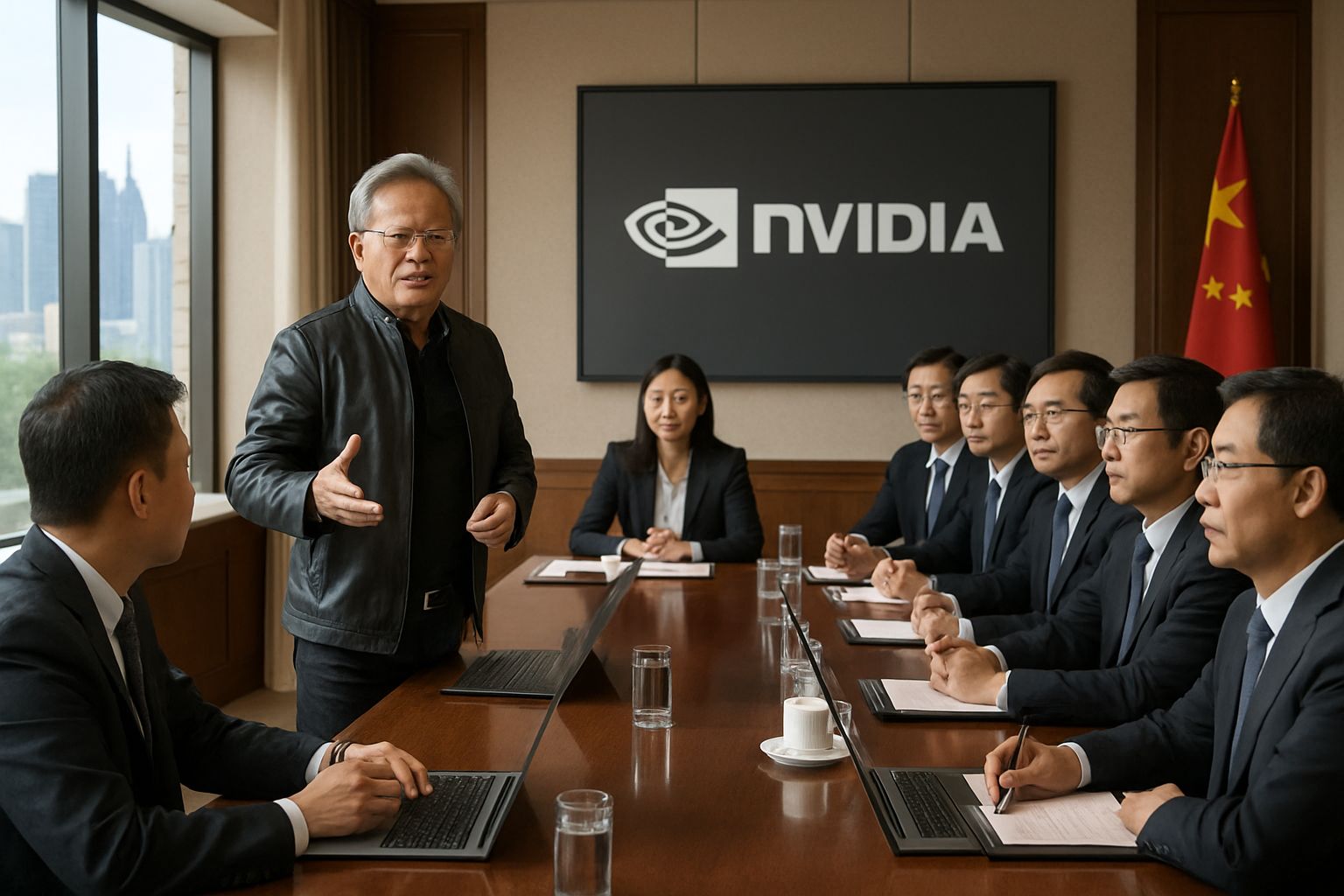
These early appearances rebuilt morale inside Nvidia’s China team. However, external observers waited for concrete deal signals. The section underscores symbolic value yet highlights absent transactional proof. Consequently, attention shifts to policy dynamics.
Regulatory Landscape Rapid Shifts
The policy backdrop changed fast. On December 8, 2025, the White House reopened a narrow export lane for H200 and took a 25 percent revenue slice. Furthermore, the Commerce Department’s Bureau of Industry and Security published its final rule on January 15. The rule moved advanced-chip licenses from presumed denial to case-by-case review. Applicants must guarantee U.S. supply, certify non-diversion, and submit third-party testing.
In contrast, Chinese customs reportedly told agents on January 14 that H200 units were “not permitted.” Analysts interpreted the guidance as a temporary defensive move while Beijing assessed Washington’s revenue-share mechanism. Meanwhile, Nvidia’s finance chief told investors that U.S. officials were “working feverishly” on license paperwork.
- License review policy effective: 15 January 2026
- U.S. revenue share: 25 percent of China receipts
- Initial planned shipment: 5,000–10,000 modules
- Estimated full demand: 1.5 million units worth ≈ $30 billion
Regulators created both opportunity and complexity. Consequently, companies must navigate dual approval channels. These requirements feed directly into Chinese market calculations.
Evolving Chinese Market Dynamics
China’s cloud titans—Alibaba, Tencent, Baidu, and ByteDance—drive massive compute demand for generative AI. Moreover, local analysts project H200 Orders could reach 1.5 million units if fully cleared. That volume would generate nearly $30 billion in gross sales, although 25 percent would flow back to Washington.
However, market appetite collides with import barriers. Domestic regulators fear over-reliance on foreign accelerators. Consequently, they push state entities toward homegrown GPU projects. Nevertheless, performance gaps persist, and developers view the H200 as indispensable for transformer workloads.
Strong demand meets administrative caution. Therefore, purchase orders remain pending until customs policy shifts. The next section unpacks what Huang hopes to achieve on the ground.
CEO Trip Objectives Unpacked
Insiders outline three goals. Firstly, Huang wants face-to-face reassurance with Chinese cloud clients. Secondly, he must brief employees on compliance procedures demanded by BIS. Thirdly, he seeks signals from regulators that H200 Orders will pass customs.
Additionally, the itinerary reportedly features Lunar New Year town-halls. Those gatherings double as morale boosters after months of uncertainty. Moreover, Huang’s presence illustrates commitment despite export-control turbulence. However, observers doubt he will secure immediate greenlights, given official silence.
These objectives promote relationship maintenance rather than instant sales. Consequently, the financial upside remains speculative until licenses and imports align.
Broader Business Stakes Analyzed
Nvidia’s core growth narrative depends on hyperscale acceleration. In contrast, the China slice of that narrative shrank after 2022 export restrictions. Reopening even a limited window for H200 Orders would revive a double-digit percentage of potential revenue.
Moreover, analysts highlight supply-allocation dilemmas. BIS demands proof that China shipments will not divert capacity from domestic customers. Therefore, Nvidia must balance lucrative Chinese bids against U.S. cloud demand.
Professionals can deepen policy literacy through the AI Government Specialist™ certification. The program covers export-control frameworks and procurement strategy.
The stakes involve revenue, capacity, and diplomacy. Consequently, each approved container influences Nvidia’s quarterly outlook and investor sentiment.
Lingering Security Concerns Persist
Critics argue that advanced accelerators bolster China’s defense capabilities. Moreover, think-tank papers warn about widening military AI applications. Nevertheless, the BIS rule intentionally excludes Nvidia’s upcoming Blackwell line, preserving a technological gap.
U.S. lawmakers seek tighter oversight and even license revocation triggers. In contrast, industry groups caution against blanket bans that could backfire commercially. Meanwhile, Chinese authorities wield customs controls as leverage, reminding exporters that Beijing holds its own veto.
Security debates therefore intersect with supply chains. Subsequently, final policy equilibria remain fluid.
Outlook And Next Steps
Short-term forecasts hinge on two checkpoints. Firstly, BIS must issue the inaugural batch of case-by-case licenses. Secondly, Chinese customs must lift its verbal blockade. Moreover, early H200 Orders, if cleared, will serve as proof of concept for the revised regime.
Meanwhile, investors track shipping manifests and trademark filings. Additionally, journalists file FOIA requests for license data. Verification efforts will clarify whether symbolic visits evolve into tangible revenue.
Licenses and customs decisions will determine momentum. Consequently, stakeholders await concrete purchase orders before revising earnings models.
The outlined developments reinforce an uncertain yet critical corridor for Nvidia. However, strategic engagement and compliance mastery can mitigate risk.
That complexity will reward professionals equipped with specialized policy knowledge. Therefore, consider the AI Government Specialist™ certification to stay ahead.
Conclusion
Nvidia CEO China diplomacy signals cautious optimism amid regulatory flux. Moreover, BIS licensing, customs directives, and H200 Orders will dictate revenue realization. Nevertheless, security concerns persist, and supply balancing remains delicate. Consequently, industry leaders should watch for the first confirmed shipments. Professionals aiming to navigate similar cross-border challenges should explore advanced certifications and remain vigilant for forthcoming policy updates.
Equip yourself with export-control expertise today, and stay prepared for the next semiconductor policy shift.


