

AI CERTS
2 months ago
Nvidia Blackwell and the Chip Demand Forecast Crunch
However, the story is not only about scarcity. Blackwell’s benchmark dominance fuels hype and lifts Nvidia’s strategic position. Moreover, hyperscalers allocate billions, betting on efficient training and inference gains. This article unpacks drivers, constraints, metrics, and risks behind the ongoing frenzy.
Market Demand Drivers Overview
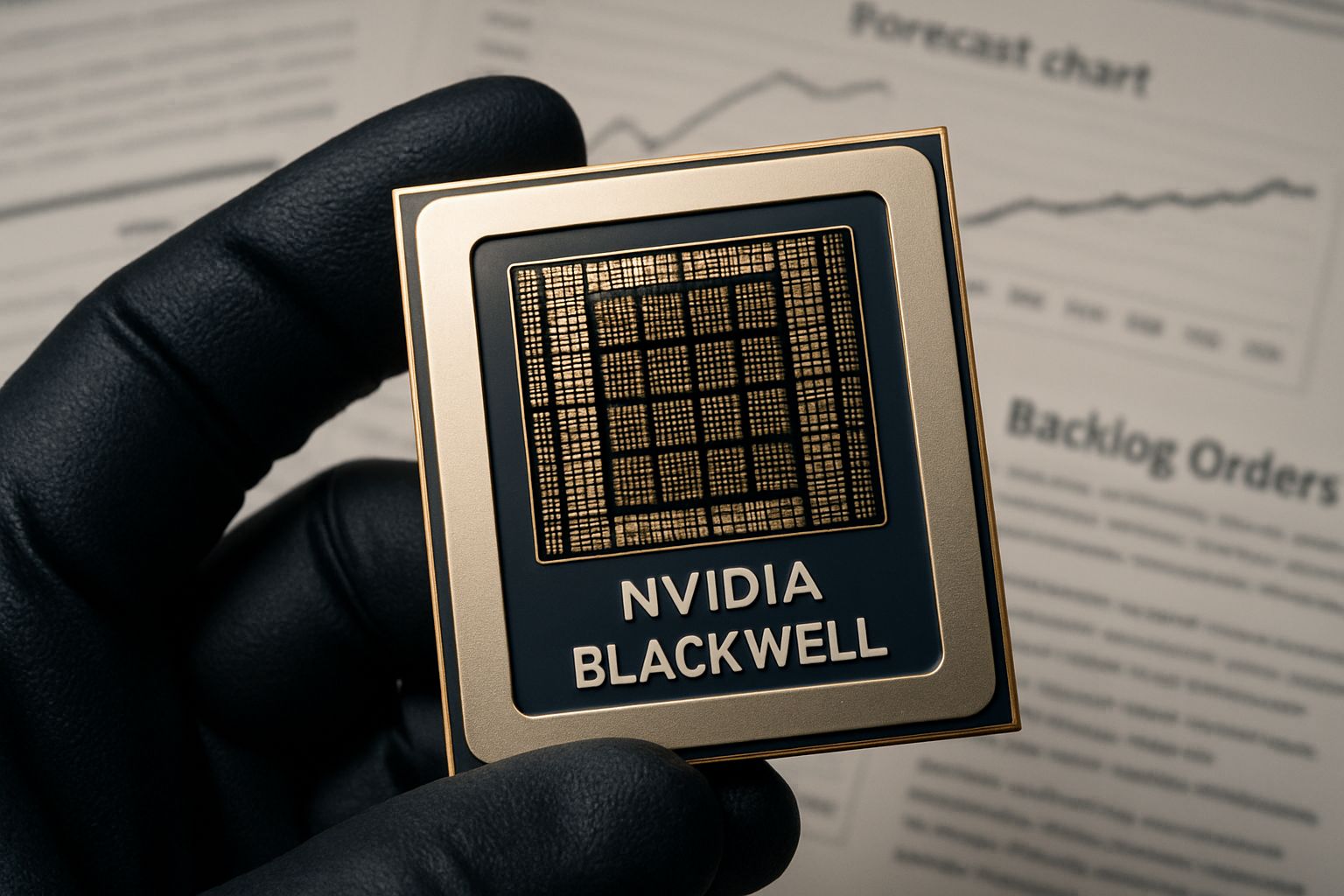
Generative AI exploded during 2024 and 2025. Therefore, hyperscalers ordered Blackwell systems in unprecedented volumes. Morgan Stanley reported customers requesting 100,000-unit blocks, forcing a deep enterprise backlog. Additionally, management revealed a staggering $500 billion booking pipeline through 2026. That figure underpins today’s elevated Chip Demand Forecast.
Major cloud providers—Microsoft, Amazon, Google, Oracle, and Meta—consume most allocations. Nevertheless, startups like xAI and Anthropic also secure capacity, often through larger partners. Demand concentrates, yet remains diverse across training, inference, and service resale.
These demand catalysts validate Nvidia’s architectural bets. Consequently, Blackwell Ultra racks promise lower cost-per-token and faster model turnaround. Customers see rapid productivity improvements, particularly for large LLMs.
Key takeaways: Blackwell’s performance leap drives multi-year orders, and the enterprise backlog keeps lengthening. In contrast, supply complexities limit near-term relief.
Next, we examine how supply constraints intensify the gpu shortage.
Major Hyperscaler Buying Patterns
Reuters noted four customers delivered 61 percent of Nvidia’s recent data-center revenue. Meanwhile, these firms pre-pay to secure future slots. Such behavior removes float capacity, locking smaller buyers out. Consequently, channel partners scramble for leftovers, widening the gpu shortage.
Furthermore, bulk agreements often include service credits and co-development clauses. Therefore, contract structures complicate visibility for independent analysts tracking Chip Demand Forecast accuracy.
Summary: Concentrated purchases inflate headline figures while masking granular unit flows. Nevertheless, they amplify backlog risk if any giant pauses spending. Now, let’s review the supply side hurdles.
Key Supply Chain Constraints
TSMC’s CoWoS packaging lines run near capacity. Moreover, Micron, SK Hynix, and Samsung battle tight HBM3e inventory. Consequently, board assembly stalls when memory arrives late. Industry insiders now expect constraints to extend into 2026, affecting every Chip Demand Forecast revision.
DatacenterDynamics reported rack redesigns after overheating events. Subsequently, engineers tweaked airflow and power delivery, causing shipment slips. Tom’s Hardware also relayed rumors that Nvidia might stop bundling VRAM, which could shift cost burdens onto integrators. However, Nvidia has not confirmed that change.
Power availability represents another bottleneck. Large campuses require hundreds of megawatts, and grid upgrades lag. Therefore, even when GPUs ship, customer sites may lack sufficient power, elongating the enterprise backlog.
Takeaways: Memory, packaging, and power collectively sustain the gpu shortage. Consequently, suppliers and buyers must coordinate long-range planning. Next, we quantify Blackwell’s financial impact.
Key Technology Performance Highlights
Nvidia submitted GB300 NVL72 racks to MLPerf. Results showed 45 percent higher inference throughput than GB200. Moreover, training benchmarks reported four-times faster Llama-3.1 pretraining. These gains justify the elevated Chip Demand Forecast by lowering operational costs.
Blackwell introduces NVFP4, enabling accurate 4-bit workflows. Consequently, memory footprints shrink, and throughput rises. Therefore, customers can train larger models without proportionally larger clusters, easing some infrastructure stress.
Summary: Performance leadership increases urgency to procure units, reinforcing demand despite supply limits. Subsequently, we inspect the dollars involved.
Critical Financial Metrics Snapshot
Nvidia posted Q3 FY2026 revenue of $57 billion, with $51.2 billion from data-center products. Gross margin reached 73 percent. Moreover, management guided Q4 revenue to $65 billion. These numbers exceeded Wall Street Chip Demand Forecast assumptions.
The firm’s stock reacted positively, yet analysts warned of concentration risks. Stifel’s Ruben Roy highlighted that four hyperscalers dominate orders. Consequently, a spending pause could dent future revenue growth and shake stock sentiment.
Nevertheless, the $500 billion booking figure offers visibility. However, questions remain about how Nvidia defines “bookings” versus contractual obligations. Therefore, careful reading is vital when projecting multi-year revenue trajectories.
- Q3 FY26 revenue: $57 billion
- Data-center share: 90 percent
- $500 billion bookings through 2026
- Gross margin: 73 percent GAAP
- Four customers: 61 percent share
Section takeaway: Financial momentum is undeniable, yet dependency on few buyers could amplify volatility. Meanwhile, strategic moves aim to mitigate those risks.
The following outlook section explores planned capacity expansions.
Primary Risk Factors Summarized
Memory shortages, power delays, and customer concentration top the list. Additionally, an AI investment bubble could emerge if utilization rates lag. Nevertheless, diversified product lines and service revenue streams may soften shocks.
Summary: Recognizing threats helps refine any Chip Demand Forecast. Consequently, leaders adjust procurement and deployment timelines accordingly. Next, we discuss future scenarios.
Strategic Market Outlook 2026
Management expects demand to outrun supply until late 2026. Therefore, Nvidia partners with TSMC to expand CoWoS lanes. Micron and SK Hynix also pledge fresh HBM3e capacity. However, ramp timelines remain tight, preserving the current gpu shortage.
Furthermore, hyperscalers invest in on-site power generation to accelerate cluster rollouts. Consequently, infrastructure readiness may improve by mid-2026, easing enterprise backlog accumulation.
Industry analysts model three scenarios:
- Baseline: Gradual relief, 15 percent annual revenue growth
- Optimistic: Rapid supply expansion, 25 percent growth
- Pessimistic: Extended shortages, flat revenue after 2025 highs
Professionals can enhance their expertise with the AI Architect Certification to navigate these possibilities. Such credentials bolster planning credibility when presenting Chip Demand Forecast updates to leadership.
Takeaway: Strategic actions may rebalance supply and demand, yet timing remains uncertain. Consequently, stakeholders must track metrics continuously.
The conclusion distills lessons and offers next steps.
Conclusion
Nvidia’s Blackwell saga blends breakthrough engineering with constrained logistics. Moreover, the Chip Demand Forecast reflects record appetite balanced against practical limits. Supply chain bottlenecks, customer concentration, and power challenges will dominate 2026 planning. Nevertheless, strong performance gains and massive bookings underpin resilient revenue expectations.
Therefore, technology leaders should monitor memory supply, packaging expansions, and hyperscaler investment rhythms. Additionally, pursuing advanced credentials like the linked certification strengthens strategic positioning. Act now to refine forecasts, secure allocation, and convert AI ambition into lasting value.


