

AI CERTs
3 months ago
NTT DATA Dominates AI-Ready Datacenter Services Market
Generative AI fever is redrawing datacenter blueprints worldwide. Consequently, operators scramble for capacity able to feed power-hungry GPUs. Against this backdrop, NTT DATA has staked a bold claim. The company promotes AI-Ready Datacenter Services as its next growth engine. Moreover, a multi-billion expansion program underpins that claim. Industry analysts recently granted leadership status through an IDC MarketScape citation. Meanwhile, hyperscale leasing surpassed 130 megawatts across four United States campuses. Such deals reveal shifting procurement patterns among cloud and AI giants. This article dissects the market forces, technologies, and risks shaping NTT’s trajectory. It also explores how peers and customers can capitalize on similar trends. Furthermore, we highlight emerging standards and essential certifications for responsible deployment. Readers will gain actionable insights for navigating the accelerating infrastructure race.
Global Market Momentum Snapshot
AI workloads are ballooning faster than earlier cloud cycles. Precedence Research values the AI data-center segment at roughly $17.5 billion for 2025. Furthermore, forecasts suggest growth toward $165 billion by 2034, a 28 percent compound rate.
AI Demand Growth Rates
AI spending accelerates hardware refresh cycles, condensing planning horizons. Furthermore, generative models require larger clusters than earlier analytics workloads. Consequently, procurement teams place multiyear orders to secure supply.
Other firms project similar trajectories, albeit with methodological variance. Nevertheless, the takeaway remains identical: demand is unprecedented and global. Consequently, operators advertising AI-Ready Datacenter Services gain early mindshare among hyperscalers. High-Density Compute racks now average 10-30 kW, with some exceeding 50 kW. Meanwhile, Liquid Cooling Infrastructure adoption is climbing as thermal limits surface. Uptime Institute says one-third of operators already run AI training or inference. Sustained double-digit growth appears inevitable given these converging signals. These metrics underscore an AI-Ready Datacenter Services capacity gap. Therefore, understanding NTT’s strategy offers a preview of future industry moves.
NTT Strategic Moves Explained
NTT DATA accelerated expansion through coordinated land, capital, and partnership maneuvers. May 2025 saw land acquisitions across seven strategic markets, unlocking nearly a gigawatt. Subsequently, the firm committed more than $10 billion toward new capacity by 2027. In December, NTT revealed hyperscale agreements totaling 130 MW across Chicago, Dallas, Phoenix, and Virginia. IDC later recognized NTT as a Leader in worldwide colocation services. Consequently, media outlets labeled the company a frontrunner for AI-Ready Datacenter Services. High-Density Compute requirements heavily influenced these announcements, according to executive commentary. Moreover, partnerships with Cisco and Microsoft extend reach into software defined infrastructure and cloud integration.
Capital Investment Timeline Overview
The investment cadence follows a clear timeline. May 2025 began landbanking. June introduced Cisco-driven AI infrastructure services. August launched the Microsoft Cloud unit. December combined hyperscale leases and a global AI report. January 2026 delivered IDC validation, reinforcing market confidence. Together, these milestones advance AI-Ready Datacenter Services leadership. However, strategy also involves mastering thermal challenges, which we examine next.
Critical Cooling Innovation Imperative
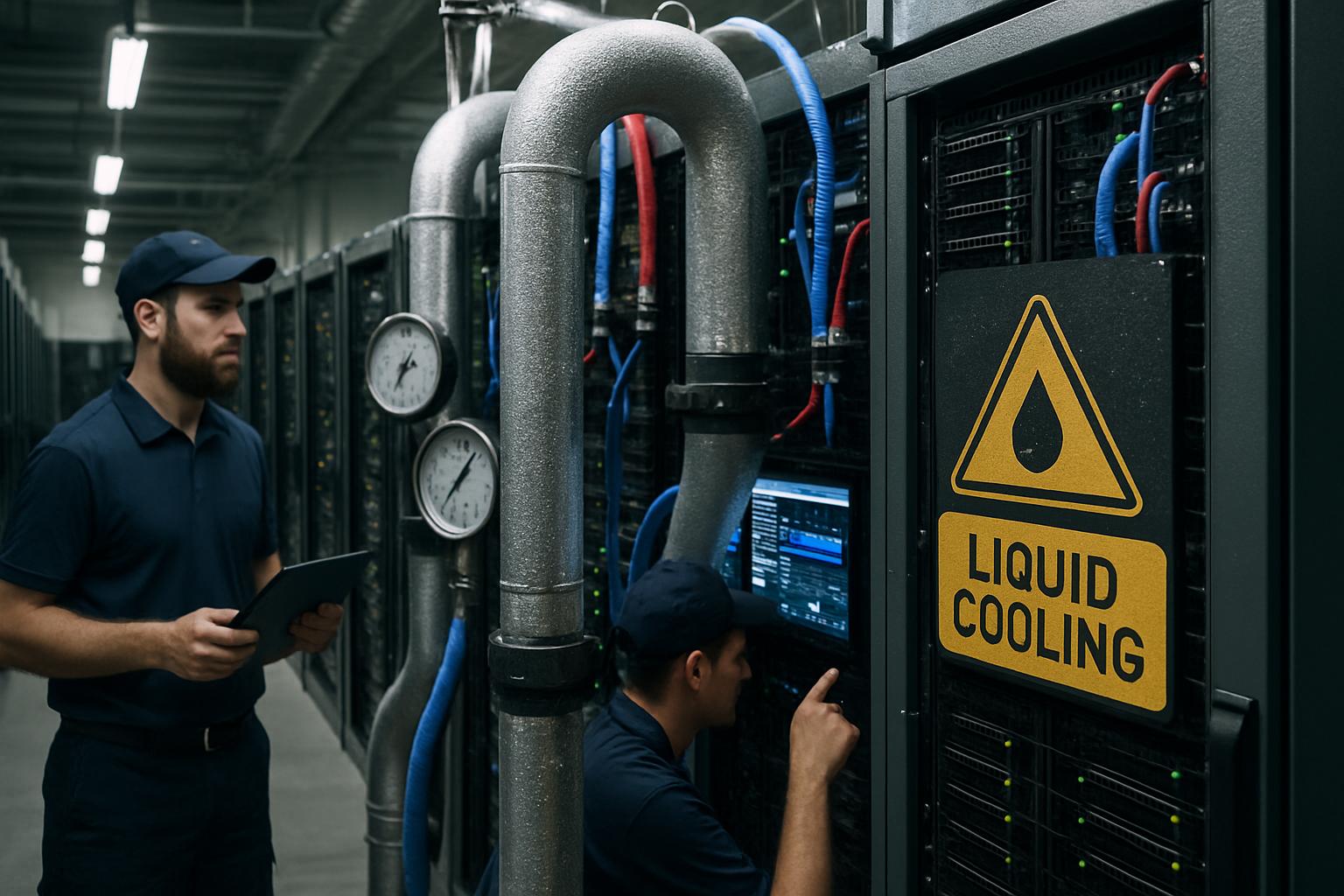
GPU clusters generate heat far beyond traditional CPU racks. Therefore, efficient removal of that heat dictates facility viability. NTT promotes immersion and direct-to-chip technologies inside new halls. Such approaches form the backbone of its Liquid Cooling Infrastructure roadmap. Additionally, advanced controls aim for PUE targets below 1.2. NTT even pilots heat reuse to warm nearby communities, bolstering sustainability credentials. Cooling innovations make AI-Ready Datacenter Services both necessity and differentiator.
Liquid Cooling Adoption Curve
Industry surveys indicate adoption is accelerating yet uneven. Uptime reports only a minority operate racks above 30 kW today. Nevertheless, nearly all planned AI halls assume Liquid Cooling Infrastructure by default. Moreover, suppliers like Schneider Electric and Vertiv are scaling component pipelines. Consequently, deployment timelines can still exceed 18 months due to equipment lead times. Operators that pre-secure parts gain decisive schedule advantages. In contrast, power availability introduces an even tougher constraint.
Power And Grid Constraints
Electrical infrastructure has become the true gating factor for hyperscale campuses. Reuters warns national grids may face double-digit consumption shares from AI centers by decade’s end. Consequently, utilities demand longer planning cycles and hefty interconnection deposits. NTT secures on-site substations to de-risk grid delays. High-Density Compute footprints exacerbate amperage requirements, pushing some sites toward 400 MW plateau. Meanwhile, renewable sourcing commitments complicate procurement because green power contracts can lag build schedules. Therefore, holistic energy strategy becomes indispensable to AI-Ready Datacenter Services success. Subsequently, projects without megawatt-scale commitments risk indefinite deferment. Grid realities can derail AI-Ready Datacenter Services without proactive utility engagement. Nevertheless, competitive pressure keeps investment flowing, as the next section illustrates.
Evolving Competitive Field Dynamics
NTT is not alone pursuing hyperscale AI clients. Equinix, Digital Realty, and CyrusOne also market AI-specific halls worldwide. Moreover, specialized GPU clouds like CoreWeave chase enterprise inference demand. Competitive differentiation now hinges on integrated services, sustainability, and speed to power. Consequently, operators tout AI-Ready Datacenter Services to capture wallet share beyond basic space. Partnership ecosystems provide further leverage. NTT’s collaborations with Cisco and Microsoft exemplify platform breadth. Liquid Cooling Infrastructure support remains a crucial checklist item for procurement teams.
- Land and power availability timelines
- Demonstrated High-Density Compute benchmarks
- Liquid Cooling Infrastructure readiness
- Sustainability metrics and heat reuse plans
These factors define procurement scoring among hyperscalers. Therefore, execution speed often outweighs initial pricing advantages. Understanding opportunity trajectories helps investors and engineers anticipate next steps.
Expansive Opportunity Outlook Ahead
Analysts expect AI capacity to outstrip supply through at least 2028. Consequently, operators with shovel-ready land wield material bargaining power. NTT projects opening ten additional campuses within two years. Each site will ship with native Liquid Cooling Infrastructure and modular power blocks. High-Density Compute clusters will dominate white-space design assumptions. Moreover, market consolidation appears likely as smaller providers struggle with capital intensity. AI-Ready Datacenter Services thus remain central to long-term enterprise cloud strategies. Professionals can deepen oversight capabilities through the AI Ethics for Business™ certification. In contrast, regulatory harmonization will dictate deployment velocity across regions. Opportunity persists, yet careful planning remains vital. Therefore, concluding insights consolidate actionable priorities.
Conclusion And Next Actions
NTT DATA’s progress underscores how speed and scale now define infrastructure competitiveness. Moreover, IDC validation and 130 MW of leases confirm tangible traction, not mere marketing. However, power provisioning, supply chain delays, and evolving policy could slow deployments. Organizations evaluating AI-Ready Datacenter Services must vet grid timelines and cooling roadmaps rigorously. They should also benchmark High-Density Compute requirements against vendor guarantees. Consequently, early contractual alignment with utilities and builders becomes strategic priority. Finally, professionals should pursue the earlier mentioned certification to strengthen ethical oversight within AI programs. Timely action will secure resilient capacity for the next innovation wave.


