

AI CERTS
2 hours ago
Neural Signal Interpretation: Filming the Mouse Brain in Action
Both advances emerged from massive collaborations harnessing Biotech optics, electron microscopes, and deep learning models. Moreover, public data releases promise rapid replication across the Science community. Industry leaders see powerful Mapping opportunities for drug discovery and next-generation AI design. Nevertheless, ethical debates grow louder as decoding methods improve.
This article unpacks the datasets, models, and implications for professionals watching the field. Subsequently, readers will find certifications and resources to deepen their expertise.
Mouse Cortex Data Breakthroughs
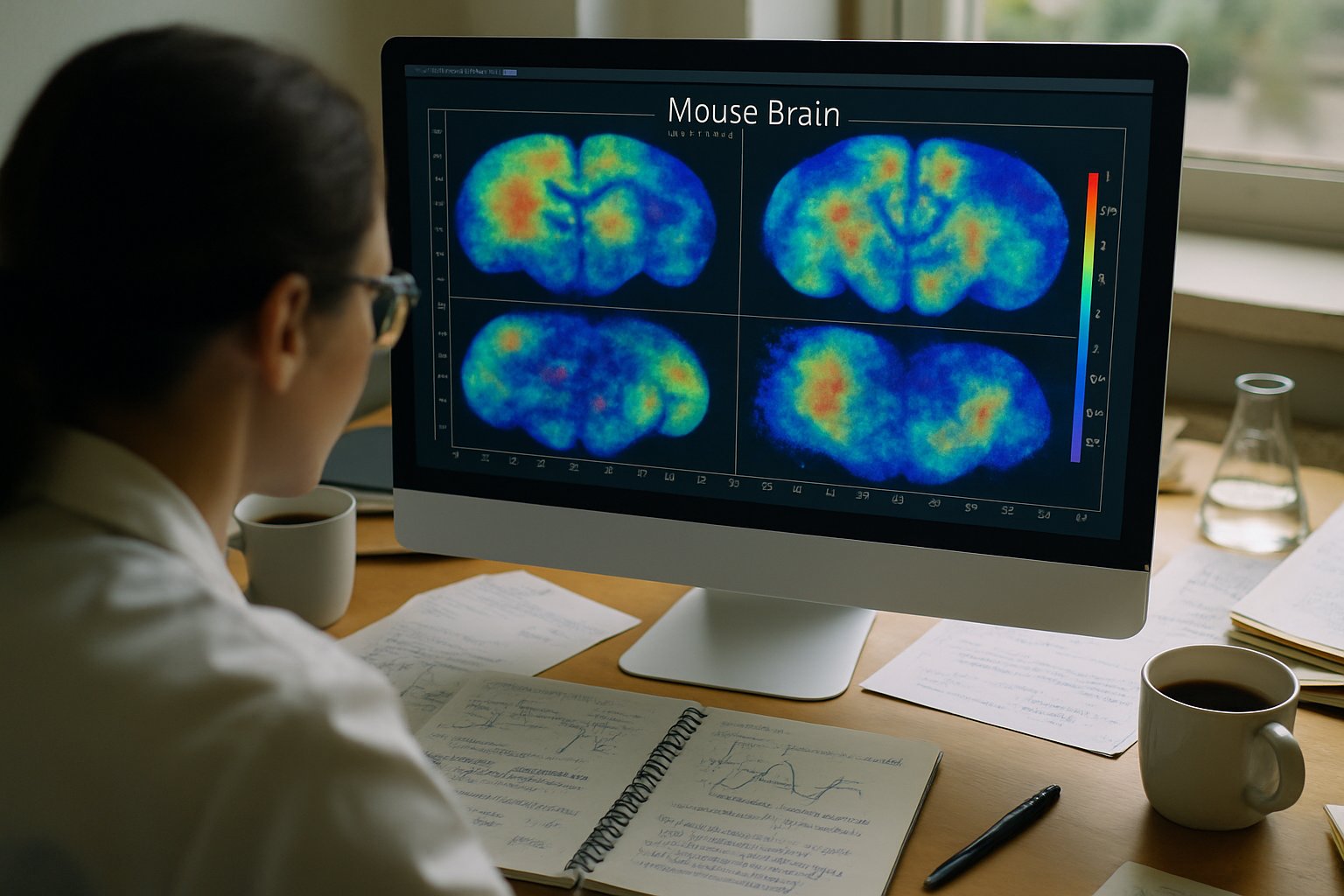
April 2025 saw the MICrONS consortium publish an unprecedented multi-paper special issue in Nature. Furthermore, the team matched dense two-photon recordings from about 75,000 neurons with nanometre-resolution electron micrographs. The resulting cube measured nearly one cubic millimetre yet contained roughly 523 million synapses.
Consequently, scientists achieved the largest mammalian functional connectome ever released. Researchers describe this achievement as a foundation for scalable Neural Signal Interpretation across species. For busy professionals, the following figures capture the scope:
- 1. Volume size: 1.2 × 1.1 × 0.5 mm visual cortex tissue.
- 2. Imaged neurons: approximately 75,000 across multiple visual areas.
- 3. Traced synapses: about 523,000,000 with extensive proofreading.
- 4. Dataset availability: fully open through MICrONS explorer portals.
In contrast, earlier mouse connectomes covered mere thousands of cells without functional alignment. These statistics underline a qualitative leap. Large, open datasets democratize rigorous comparisons between structure and function. Consequently, the stage is set for direct movie reconstruction from activity, discussed next.
Movie Reconstructions Advance Understanding
March 2026 delivered the complementary breakthrough: decoding ten-second, 30 Hz movies from mouse V1. Joel Bauer and colleagues used the winning Sensorium dynamic neural encoding ensemble named DwiseNeuro. Moreover, they inverted the model with backpropagation, optimizing pixels until predicted activity matched recordings. The approach doubled previous pixel-level correlation, reaching 0.57 within a selective evaluation mask. Therefore, Neural Signal Interpretation moved from static pictures to dynamic scenes.
Reconstruction quality remains grainy, yet observers can clearly identify coarse motion and luminance patterns. Bauer emphasized that privacy issues loom once human data reach comparable scales. Nevertheless, the technique already guides Biotech firms exploring visual prosthetics. These results validate model-centric Mapping strategies and highlight tight Science-engineering feedback loops. Dynamic decoding complements the structural atlas revealed by MICrONS. Subsequently, integrated analyses will correlate connectivity motifs with specific reconstruction errors.
Tools Driving Neural Progress
Cutting-edge instruments underpin the recent surge in data volume and fidelity. Two-photon microscopes record thousands of cortical neurons with single-cell resolution in awake animals. Meanwhile, serial electron microscopes map every synapse at nanometre scale. Additionally, cloud compute clusters and self-supervised segmentation models accelerate tissue reconstruction pipelines.
On the decoding side, differentiable neural encoding networks translate movies into predicted calcium traces. Consequently, engineers can reverse that translation for Neural Signal Interpretation during reconstruction. The following toolchain illustrates the typical workflow:
- 1. GCaMP8 indicators convert action potentials into fluorescent calcium signals.
- 2. Resonant-scanner mesoscopes capture activity across several visual areas simultaneously.
- 3. Automated tape-collection ultramicrotomes feed thousands of sections to SEM arrays.
- 4. DNEM ensembles leverage behavioral covariates, such as running speed and pupil dilation.
- 5. Backpropagation routines refine candidate frames until population misfit falls below thresholds.
In contrast to past manual work, this pipeline scales to petabyte recordings. These instruments collectively expand Biotech capabilities and empower open Science collaborations. Consequently, sustained hardware investment remains vital, as discussed next. Advanced tools make large-scale experiments feasible and reproducible. However, they also introduce cost and data-management challenges tackled in the next section.
Opportunities And Emerging Challenges
Large structure-function datasets unlock hypotheses once impossible to test. For example, clinicians could compare diseased circuits against the MICrONS healthy template. Moreover, AI researchers mine the graphs to refine biologically grounded architectures. Similarly, pharma Biotech firms evaluate synaptic motifs as potential drug targets. Nevertheless, scale brings heavy storage, compute, and annotation bills.
Nature editors noted months of human proofreading even after automated segmentation. Ethical oversight also intensifies because Neural Signal Interpretation could expose private visual experiences. In contrast, standard fMRI lacks such granular predictive power. Consequently, funding agencies weigh access requirements, consent frameworks, and cybersecurity investments. Key considerations cluster around the following questions:
- Who controls multi-petabyte connectomes?
- How are animal privacy limits defined?
- What insurance covers misuse of decoded content?
Collectively, these challenges highlight governance gaps needing coordinated policy and technical solutions. Therefore, professionals must monitor regulatory updates before deploying commercial Mapping products. Robust policies will determine public trust. Subsequently, industry implications deserve focused attention.
Industry Impact And Ethics
The connectomic gold rush already influences venture capital flows. Start-ups now sell analytics pipelines that promise real-time Neural Signal Interpretation for preclinical screens. Meanwhile, established imaging vendors bundle cloud storage and turnkey Modeling solutions. Consequently, early adopters report shorter experiment cycles and richer phenotyping metrics. Yet, investors inquire about liability when decoded video reveals unexpected animal stress. Moreover, European regulators may classify certain reconstructions as personal data, triggering GDPR safeguards.
Academic lawyers urge transparent de-identification protocols for Biotech deployments. Science communicators similarly advocate clear language explaining algorithmic uncertainty. These positions illustrate why cross-disciplinary standards remain urgent. Consequently, many organizations seek staff trained in data ethics and AI governance. Professionals can upskill through the AI Foundation™ certification. Ethics and profit will intertwine increasingly tightly. Therefore, future planning must include workforce development, explored next.
Future Directions And Training
Roadmaps from the BRAIN Initiative envision larger, faster, and deeper imaging campaigns. Furthermore, three-photon microscopes will push recordings beyond one millimetre depth. Integrated light-sheet EM hybrids could even capture activity and wiring in real time. Such advances will further stress storage and algorithm scalability. Therefore, training programs now blend computational neuroscience, cloud engineering, and data governance.
Graduate curricula increasingly include hands-on projects in Neural Signal Interpretation using open datasets. Meanwhile, corporate bootcamps teach Mapping analytics for drug and device pipelines. Moreover, interdisciplinary seminars pair ethicists with coders to debate privacy safeguards. Science leaders predict standardization bodies will publish benchmarking suites for reconstruction accuracy. Consequently, career prospects look strong for engineers who master both lab and cloud toolchains.
Neural Signal Interpretation experts may soon become indispensable across Biotech and AI consultancies. Subsequently, ongoing professional certifications will maintain competitive edges. Industry observers also expect open competitions similar to Sensorium to accelerate progress. Nevertheless, rigorous peer review will stay essential for separating hype from durable knowledge. Sustained education fuels responsible innovation. Consequently, informed readers should evaluate training options immediately.
Mouse visual studies have entered a cinematic era. MICrONS supplies an enormous structural map, while eLife reconstructions deliver moving images. Together, they demonstrate Neural Signal Interpretation at unprecedented resolution and scale. Furthermore, open code and data empower the wider Science ecosystem. Industry already tests applications from drug screening to adaptive displays.
Nevertheless, ethical frameworks and cost controls must mature in parallel. Consequently, professionals who master Mapping analytics, cloud workflows, and governance will lead future projects. Start that journey today by exploring advanced resources and securing recognized certifications. Ultimately, Neural Signal Interpretation expertise could define the next decade of applied neuroscience.


