

AI CERTs
2 hours ago
Navigating the Job Displacement Crisis in AI Era
Legal assistants, junior developers, and paralegals once felt safe. However, generative models now draft contracts, write code, and summarize case law in seconds. Consequently, organisations have begun questioning long-standing staffing norms. Industry analysts describe this emerging landscape as a Job Displacement Crisis, where market signals remain mixed yet unsettling. Furthermore, surveys show executives racing to integrate artificial intelligence while governments scramble for protective policy. Meanwhile, workers voice mounting AI anxiety and demand clearer roadmaps for transition. In contrast, early empirical studies reveal limited aggregate effects so far. Nevertheless, analysts warn that headline figures can shift quickly when agentic systems mature. This article unpacks current evidence, future forecasts, and practical responses for professionals charting their next Career shift.
Short-Term Reality Check
Recent Danish payroll research found two-year earnings unchanged after chatbot deployment. Moreover, time savings averaged only three percent. Therefore, the feared tidal wave of layoffs has not materialised at scale. Challenger data still matters, though. The firm logged more than 54,000 U.S. cuts during 2025 where employers cited AI. Nevertheless, those cuts represented a minority of total reductions. Consequently, macroeconomists argue today’s labour shock remains modest compared with previous industrial shifts. These findings temper early panic and frame the present segment of the Job Displacement Crisis as largely anticipatory rather than realised.
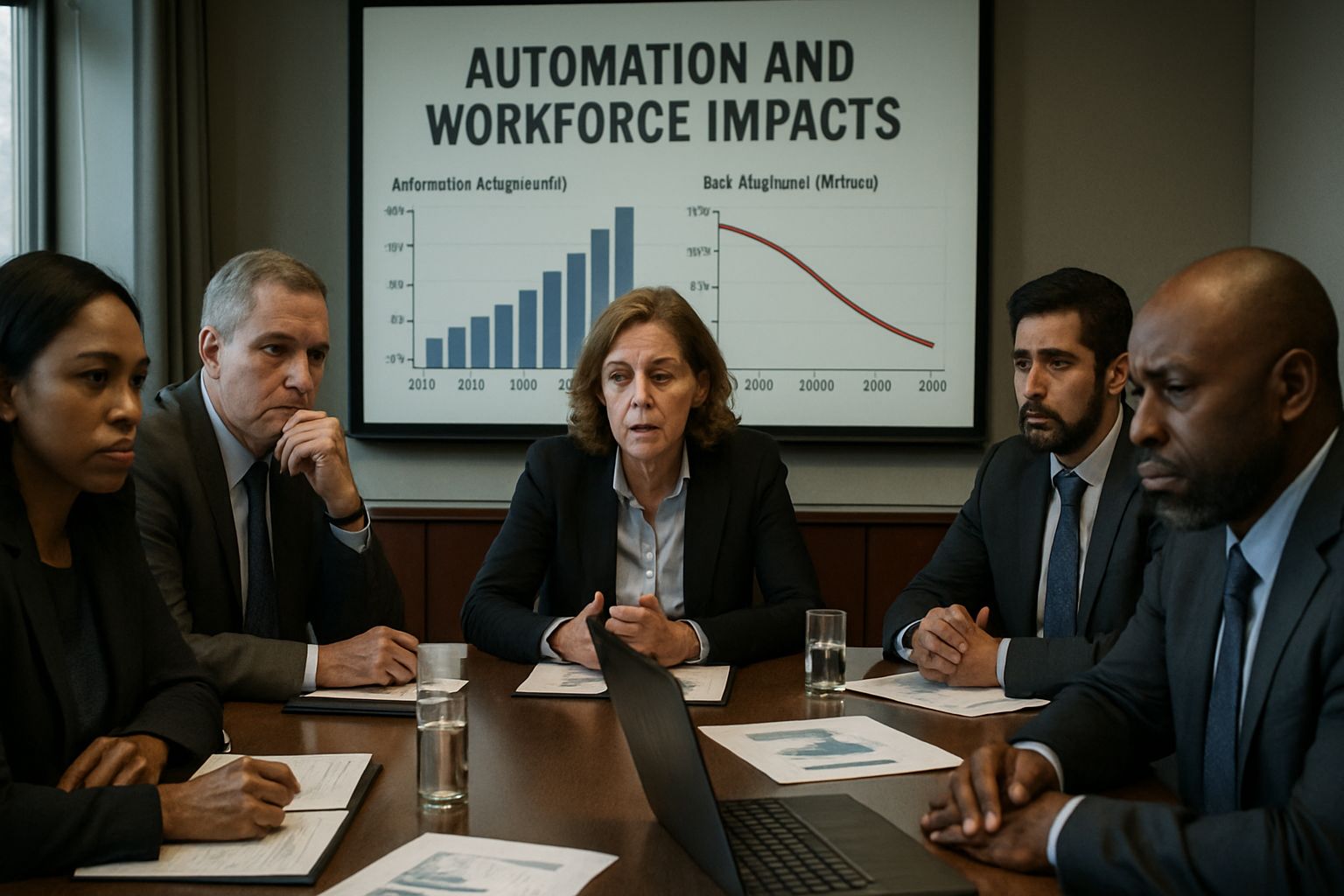
Limited disruption today offers breathing space. However, leaders must act before larger waves arrive.
These immediate insights clarify baseline conditions. Consequently, the discussion now turns toward contested forecasts.
Forecasts Fuel Heated Debate
World Economic Forum projections illustrate stark churn by 2030. Their model expects 92 million roles displaced and 170 million created. Additionally, Anthropic’s Dario Amodei warns that 50 percent of entry white-collar positions could vanish within five years. In contrast, NBER authors call such warnings speculative. Mustafa Suleyman, Microsoft’s AI chief, envisages near-total task automation within eighteen months. Meanwhile, Sam Altman counters that many firms practice “AI-washing” to justify unrelated layoffs. Consequently, journalists confront diverging narratives that complicate risk assessment. The primary keyword Job Displacement Crisis surfaces repeatedly in these debates, underscoring public concern.
Competing timelines matter for planning horizons. Nevertheless, data-driven scenario analysis helps leaders cut through hyperbole.
These contrasting visions introduce winners and losers. Therefore, the next section profiles emerging divides.
Winners And Losers Emerging
PwC’s Global AI Jobs Barometer shows productivity growth in AI-intensive sectors jumping from seven to twenty-seven percent. Consequently, workers holding AI skills earn wage premiums nearing fifty-six percent. Moreover, LinkedIn postings for AI governance roles climbed sharply through 2025. However, routine billing, scheduling, and customer-support tasks appear increasingly exposed to automation. Entry pathways that once nurtured young analysts now shrink. Therefore, many graduates feel rising AI anxiety while mid-career specialists eye urgent upskilling. The Job Displacement Crisis thus produces simultaneous opportunity and threat.
Understanding sector dynamics lets professionals target resilient niches. However, corporate narratives also shape perceptions.
These divergent outcomes segue into communication strategies. Consequently, we examine how firms frame workforce change.
Corporate Messaging Under Scrutiny
Annual reports increasingly attribute restructurings to generative tools. Nevertheless, analysts flag disclosure incentives. Altman’s “AI-washing” critique resonates because many layoff notices omit specific tool replacements. Additionally, some companies dismiss junior staff while posting senior prompt engineer openings the same week. Professionals can enhance their expertise with the AI Prompt Engineer™ certification. Moreover, Amazon and Pinterest both reduced content teams then hired AI product managers. Consequently, observers question causality claims within the broader Job Displacement Crisis. Balanced reporting requires tracing job descriptions before and after cuts.
- 54,694 U.S. layoffs in 2025 cited AI, per Challenger.
- WEF predicts net 78 million global jobs gained by 2030.
- NBER study shows no earnings change two years post-adoption.
Transparent communication rebuilds trust. However, policy frameworks also influence future labour markets.
These messaging patterns highlight perception gaps. Therefore, we next explore governmental and training responses.
Policy And Training Moves
Governments worldwide launch reskilling grants and tax incentives. Moreover, the OECD urges apprenticeship models linked to digital curricula. Consequently, national labour agencies partner with Coursera for rapid certificate delivery. Some regions test wage subsidies for displaced clerks shifting into cybersecurity. Nevertheless, uptake remains uneven, and programme metrics lack consistency. The Job Displacement Crisis demands broader coordination among ministries, academia, and industry. Additionally, unions lobby for algorithmic transparency to ease AI anxiety. In contrast, tech giants fund bootcamps that funnel talent back into proprietary ecosystems.
Robust policy accelerates adaptive capacity. However, individuals must still chart personal strategies.
These institutional efforts set context for personal planning. Consequently, attention turns to tactical career guidance.
Strategic Career Shift Playbook
Professionals should audit daily tasks for automation exposure. Furthermore, adopting complementary skills—prompt design, data governance, or model evaluation—builds resilience. Moreover, hybrid roles that blend domain knowledge with AI tooling remain hard to displace. Workers experiencing AI anxiety can pursue micro-credentials while employed. Consequently, a proactive Career shift lessens shock if headcount reductions arise. Experts recommend tracking vendor roadmaps and aligning learning with upcoming releases. The Job Displacement Crisis rewards agility more than tenure.
- Map tasks using an automation risk matrix.
- Select certifications tied to growth roles.
- Network within AI practitioner communities.
- Document quantifiable upskilling outcomes.
Deliberate planning converts uncertainty into leverage. However, continued monitoring remains essential.
These tactical steps empower individuals. Therefore, we conclude by reflecting on collective accountability.
Looking Ahead With Caution
Technological forecasts often overshoot near-term realities yet undershoot long-term transformations. Moreover, agentic systems could compress adoption curves unexpectedly. Consequently, vigilance around metrics, transparency, and equitable participation will define societal success. Stakeholders that test assumptions regularly can steer the Job Displacement Crisis toward positive-sum outcomes. Additionally, fostering open dialogue tempers AI anxiety and encourages evidence-based debate.
Uncertainty does not guarantee doom. Nevertheless, complacency invites avoidable harm.
These foresight principles anchor responsible strategy. Therefore, readers should consolidate insights with practical actions.
Conclusion And Next Steps
Generative AI reshapes cognitive work at remarkable speed. However, empirical data shows limited aggregate fallout so far. Forecasts diverge sharply, yet proactive policy, transparent corporate behaviour, and individual reskilling can mitigate risks. Moreover, targeted learning paths, such as the linked AI Prompt Engineer™ programme, convert disruption into growth. Consequently, navigating the Job Displacement Crisis hinges on agile planning and collaborative stewardship. Therefore, assess your current role, pursue relevant certifications, and join informed communities to thrive in the evolving workplace.


