

AI CERTS
1 day ago
Navigating New AI Layoff Laws Across America
Business leaders fear inconsistent rules while workers fear invisibility. Moreover, investors demand clarity on automation’s real impact. Recent measures in New York, Colorado, Illinois, and Washington promise unprecedented transparency, yet challenges abound.
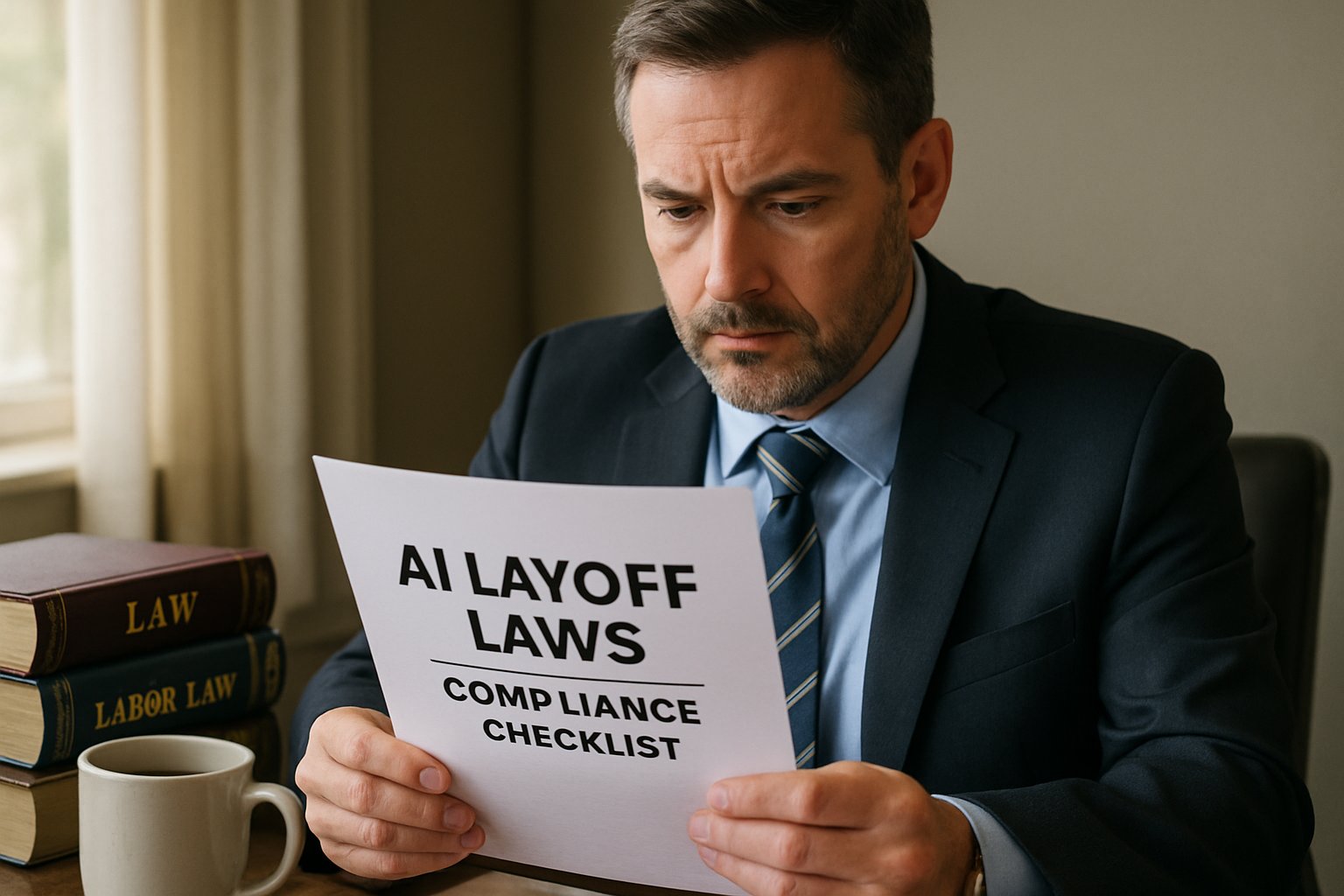
Meanwhile, Congress has entered the debate with a bipartisan reporting bill. Therefore, employers must prepare for national expectations even while adapting to shifting state portals. This article unpacks the mechanics, political drivers, and compliance strategies behind emerging AI layoff laws. Consequently, executives gain a roadmap to mitigate workforce fears and meet growing labor scrutiny.
Transparency Rules Rapidly Expand
In 2025, New York pioneered mandatory disclosure of technology-driven layoffs. Moreover, its updated WARN portal forces employers to declare whether technological innovation or automation spurred job cuts.
That single checkbox may appear minor. However, compliance lawyers say it signals a decisive shift toward granular accountability. These initial AI layoff laws have already shifted boardroom agendas.
Governors backing similar efforts highlight data gaps. Consequently, real-time insights could guide retraining funds and economic development programs. Observers await clarifying disclosure legislation from labor departments.
These transparency moves establish a new baseline. Nevertheless, regional differences complicate national strategies. The New York WARN update illustrates these complexities most clearly.
New York WARN Update
New York’s state WARN act covers employers with only 50 full-time workers. Consequently, many mid-size firms must provide 90-day notice for significant layoffs.
The 2025 portal revision layers an automation query onto that notice. In contrast, federal WARN lacks any technology disclosure requirement. Compliance with AI layoff laws now begins the moment HR drafts the notice.
If employers check the automation box, they must specify the technology, such as AI or robotics. Additionally, regulators can cross-reference this detail with training budgets and tax incentives. Ticking the automation box invites instant labor scrutiny from unions and media.
Legal counsel warn of definitional fog. Moreover, proving causation between machine learning deployment and headcount cuts remains difficult.
New York’s granular approach intensifies labor scrutiny without clear guidance. Therefore, other jurisdictions are crafting alternate playbooks. State experiments now stretch beyond the Empire State.
Emerging Statewide Compliance Trends
Colorado adopted the Colorado AI Act in 2024. Furthermore, Illinois amended its Human Rights Act to address algorithmic decisions.
Both laws stress impact assessments, bias testing, and employee notice. Consequently, they focus less on mass layoff disclosure and more on ongoing decision fairness.
Employers must document risk management programs for high-risk AI. Additionally, they must provide workers explanations whenever automated tools influence hiring, discipline, or discharge.
Experts say these notice regimes complement AI layoff laws by shining light on earlier pipeline decisions. Meanwhile, unions argue both layers are necessary to curb silent attrition. State leaders say their AI layoff laws must integrate with anti-bias frameworks.
States are weaving intertwined safeguards across the employment lifecycle. However, federal policy could soon override fragmented rules. A bipartisan Senate bill frames that possibility.
Bipartisan Federal Reporting Push
In November 2025, Senators Mark Warner and Josh Hawley introduced the AI-Related Job Impacts Clarity Act. Therefore, quarterly reports to the Department of Labor would reveal hires, layoffs, retraining, and unfilled positions tied to automation.
The bill enjoys bipartisan momentum because data appeals across ideological lines. Moreover, sponsors argue that good policy requires trustworthy metrics.
If enacted, the measure would nationalize AI layoff laws reporting. Consequently, multi-state companies could face unified disclosure legislation rather than divergent portals. The bill would convert voluntary reporting into mandatory disclosure legislation at scale.
Business associations warn about administrative load. Nevertheless, standardized definitions could ease compliance compared with varied state interpretations.
Federal advances may stabilize terminology and reduce duplicative filings. In contrast, slow passage would expand the state patchwork. Either scenario intensifies employer preparation needs. Corporate lobbyists hope clear federal policy supersedes conflicting state mandates.
Employer Challenges And Risks
Corporations face four cascading hurdles when addressing AI layoff laws requirements.
- Defining AI causation amid complex business drivers
- Collecting reliable evidence for disclosure legislation forms
- Aligning state, federal policy, and global reporting cycles
- Managing reputational fallout under growing labor scrutiny
Legal practitioners emphasize documentation. Therefore, companies should map decision workflows, capture algorithmic performance data, and store board minutes that reference automation.
Meanwhile, employee advocates flag undercount risk because WARN thresholds miss incremental attrition. Moreover, staging layoffs in smaller waves can escape notice.
Firms also worry about inconsistent audits under New York City’s AEDT law. Consequently, they call for clearer accreditation criteria and data access standards. Missing deadlines under disclosure legislation can trigger steep civil penalties.
These obstacles challenge robust implementation. Nevertheless, proactive steps can blunt regulatory shocks. Forward-looking compliance plans now gain urgency.
Preparing For Future Moves
Key Workforce Data Points
- World Economic Forum projects 92 million displaced jobs by 2030, yet 170 million created.
- Goldman Sachs estimates AI could impact 6-7% of U.S. employment.
- New York WARN applies to employers with 50 workers, requiring 90-day notice for certain layoffs.
Compliance teams should build integrated dashboards that track layoffs, retraining, and AI deployments across jurisdictions. Additionally, embedding legal checkpoints in product launch cycles reduces after-the-fact scrambles.
Professionals can deepen their knowledge through the AI Educator™ certification. Consequently, certified staff can translate technical jargon into clear reports for regulators and boards.
Scenario planning also matters. Therefore, leaders should model reputational and financial impacts under high, medium, and low automation-layoff assumptions.
A disciplined roadmap turns reactive reporting into strategic foresight. Moreover, stakeholders gain confidence despite ongoing workforce fears. Robust planning aligns with incoming AI layoff laws worldwide.
The legislative tide shows no sign of receding.
AI layoff laws are reshaping the dialogue between capital and labor. However, inconsistent definitions, evolving disclosure legislation, and fragmented enforcement create uncertainty.
Yet, transparency momentum continues at statehouses and in Congress. Consequently, executives who invest early in data governance, impact assessments, and training will navigate upcoming mandates more smoothly.
Organizations should monitor policy trackers, consult counsel, and pursue relevant credentials. Furthermore, engaging talent in reskilling programs counters workforce fears and builds goodwill.
Stay ahead by embedding compliance into strategy and securing expertise. Explore certifications such as the linked AI Educator™ program, and prepare for the next regulatory wave.


