

AI CERTs
2 months ago
Musk Drives Next-Gen Tesla AI Chip Design
When Elon Musk tweets, semiconductor markets flinch. However, his November announcement carried unusual technical weight. Meanwhile, the statement declared that he personally steers Tesla's custom silicon roadmap and meets engineers twice each week. Moreover, he revealed that AI5 is nearly at tape-out while AI6 concept work has begun. Consequently, the news ignited debate about the Tesla AI Chip strategy. Analysts discuss its impact on autonomy, robotics, and supply chains. Industry professionals now track schedules, foundry partners, and capacity claims more closely than ever. In contrast, skeptics question whether Tesla can maintain a yearly design cadence without sacrificing yield or margins. Therefore, understanding the numbers, partnerships, and engineering hurdles behind the bold projection is essential. This article dissects the latest developments, analyzes competitive context, and outlines practical implications for design leaders and procurement teams.
Musk Reveals Chip Roadmap
On 23 November 2025, Elon Musk used X to outline an aggressive silicon timeline. Moreover, he invited top chip designers to email Tesla using only three bullet points of proof.
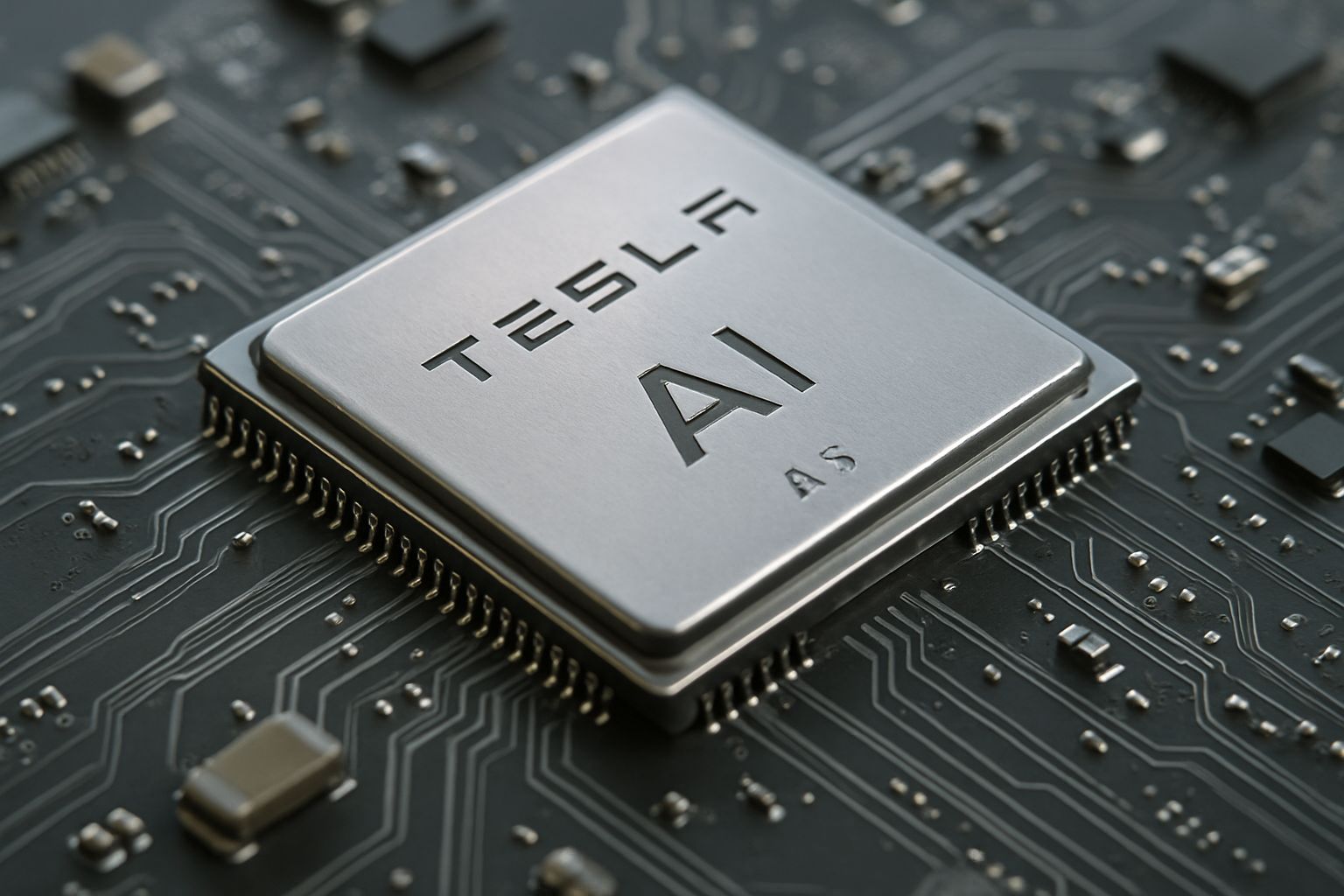
He stressed personal involvement, stating he meets the design team every Tuesday and Saturday. Consequently, Saturday sessions should end once AI5 tapes out in early 2026.
Experts note that such transparency is rare among automakers. However, the messaging aligns with Musk's long-standing playbook of open recruiting and bold target setting.
The post set the technical tone for 2026 programs. Therefore, teams now sprint toward the Tesla AI Chip AI5 milestone.
Aggressive Silicon Design Cadence
Musk claims a twelve-month cycle from concept to volume production. Moreover, he predicts volumes that exceed all other AI accelerators combined.
The roadmap lists AI4 in vehicles today, AI5 nearing tape-out, and AI6 entering architectural exploration. Consequently, each generation should deliver sharper latency and efficiency gains.
Analysts applaud the ambition. However, they caution that mask sets, advanced packaging, and validation racks rarely align to yearly calendars.
Musk counters that vertical focus shortens iteration loops. In contrast, multi-purpose GPU vendors juggle broader software requirements.
Speed remains the differentiator for Tesla. Meanwhile, the aggressive cadence underpins every future Tesla AI Chip release.
Foundry Partnerships Explained Clearly
Samsung Foundry secured a reported $16.5 billion contract to build AI6 at its Taylor, Texas plant. Moreover, Elon Musk promised to "walk the line" and personally accelerate ramp activities.
TSMC remains involved for AI5 silicon, initially in Taiwan and later Arizona. Consequently, Tesla diversifies process risk across two leading fabs.
Supply security drives these deals. However, analysts emphasize that capacity reservations do not guarantee final yield or schedule.
Professionals can enhance their expertise with the AI Executive Essentials™ certification. Furthermore, the program offers modules on negotiating foundry contracts.
These partnerships create a multi-source foundation. Therefore, they anchor the Tesla AI Chip supply strategy for the decade.
Performance Claims Under Scrutiny
Musk touts a 40× speed leap from AI4 to AI5. Moreover, he positions the new silicon as a class apart from general GPUs.
Tesla states that AI5 will handle real-time vision and planning at lower wattage per frame. Consequently, extended range and reduced cooling can follow.
However, the company offers few benchmark details. Independent reviewers await metrics like TOPS, memory bandwidth, and thermal envelopes.
In contrast, Nvidia and AMD publish full datasheets before launch. Therefore, some buyers hesitate until third-party numbers surface.
The hype cycle must soon meet measurement. Meanwhile, transparent data will decide whether each Tesla AI Chip exceeds expectations.
Fabrication Risks And Hurdles
Musk suggested building an internal "TeraFab" to meet colossal demand. However, Elon Musk faces warnings from veterans like Jensen Huang.
Manufacturing a leading-edge fab costs tens of billions and demands flawless logistics. Consequently, even Samsung and TSMC struggle with delays.
Equipment lead times stretch past two years for EUV lithography tools. Moreover, yield learning can erode margins during the first production year.
Analysts list three primary risk vectors:
- Capital intensity exceeding projected cash flow
- Process node slippage due to tooling bottlenecks
- Talent scarcity amid global semiconductor hiring wars
Nevertheless, Tesla's vertical model could unlock end-to-end optimization if executed flawlessly. Therefore, investors watch each site visit closely.
Risks remain formidable despite bold intent. Consequently, every new Tesla AI Chip will inherit manufacturing uncertainty.
Strategic Implications For Industry
If Tesla achieves its volume target, supply chains could rebalance around automotive inference devices. Moreover, datacenter GPU availability might improve.
Competitors focus on broad software stacks, while Tesla optimizes vertical workloads. Consequently, differentiation shifts from APIs to watt-per-frame efficiency.
In contrast, regulators may scrutinize domestic capacity moves, especially potential incentives for a private "TeraFab." Furthermore, policy decisions could shape cost curves.
Industry leaders therefore monitor contract disclosures, silicon benchmarks, and staffing flows. Additionally, procurement managers prepare contingency allocations.
Key Numbers To Watch
- $16.5 billion Samsung capacity deal through 2033
- 40× performance claim for AI5 over AI4
- 12-month design cadence goal
- Several million chips already deployed
- Projected 20 million Tesla AI Chip units yearly
Competitive dynamics hinge on execution speed and data transparency. Therefore, each upcoming Tesla AI Chip release could shift strategy roadmaps.
Tesla must convert roadmap slides into wafers. Moreover, consistent execution will validate the Tesla AI Chip vision across vehicles and robots. Nevertheless, investors and engineers will reserve judgment until the first AI5 Tesla AI Chip exits the foundry. Consequently, 2026 will deliver critical answers. Therefore, industry professionals should monitor benchmarks, yield disclosures, and capacity ramp signals.


