

AI CERTS
3 months ago
Municipal AI Drives UK Road Repair Revolution
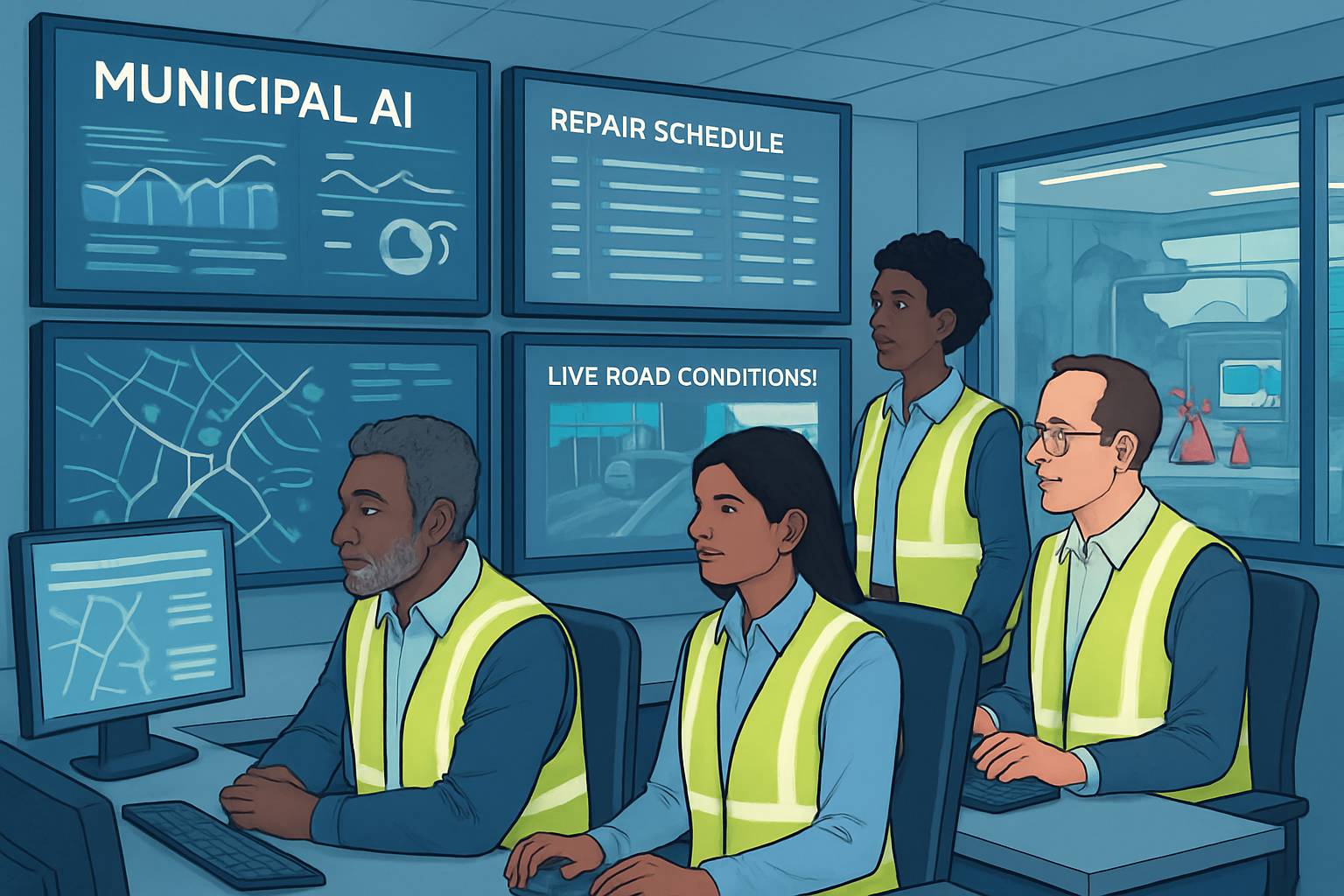
However, questions about procurement, governance, and trust accompany the technology’s rapid rise.
Local Government Pilots Surge
Local Government bodies moved from proofs of concept to public road trials during the last year.
Moreover, Hertfordshire partnered with Robotiz3d to test an autonomous repair robot called ARRES Prevent.
The Municipal AI system guided the robot to micro-cracks invisible to human patrols.
Consequently, Project Amber now markets itself as a Municipal AI benchmark for highway asset teams.
Meanwhile, Blackpool extended Project Amber, combining high-definition imagery and computer vision to flag Potholes citywide.
Milton Keynes secured £781,817 from the Regulators’ Pioneer Fund to frame safer robot deployments in public streets.
Additionally, Nottinghamshire, Peterborough, and others launched conversational assistants for social care and customer contact.
Peterborough also trials computer vision to target Fly-Tipping hotspots in rural lanes.
Guidance from GDS Local helps smaller councils replicate proven blueprints.
Digital leaders argue that successful pilots require strong vendor partnerships and rapid iterative testing.
Therefore, councils share datasets through the LGA AI hub to accelerate collective learning.
These pilots prove councils can innovate quickly with limited teams.
However, cost evidence must justify scaling, which the next section reviews.
Early Potholes Cost Evidence
Project Amber reported 5,145 Potholes filled in North Shore for roughly £450,000, saving over £1 million.
Consequently, detection speed increased, and compensation claims declined during the same window, according to council statements.
Hertfordshire’s robot improved crack detection accuracy from 66% to almost 100% in controlled scans.
However, the robot repaired only a handful of defects, so return on investment remains unproven.
- England and Wales road backlog: £17 billion (AIA 2025)
- 1.9 million Potholes fixed 2024-25 costing £137.4 million
- Milton Keynes RoboPASS grant: £781,817
- Robot accuracy jump: 66% → 100%
The 2025 ALARM report states 94% of highway teams saw no network improvement last year.
Simon Williams from RAC warns that under-investment remains a false economy that damages vehicles daily.
The numbers illustrate promising savings yet limited sample sizes.
Therefore, attention shifts to data sources and public participation.
Citizen Data Debate Intensifies
Crowdsourced apps such as Stan let volunteers photograph Potholes and upload geolocated reports.
Furthermore, machine learning grades defect severity before forwarding alerts to council dashboards.
Local Government reactions vary.
In contrast, some authorities embrace third-party data, while others fear liability from misclassified surfaces.
Regulators urge clear evidential standards to govern integration into maintenance workflows.
Similar pipelines classify Fly-Tipping images for environmental teams.
Volunteers note that recording Fly-Tipping images builds community pride alongside cleaner streets.
Agreement on standards could unleash richer datasets.
Nevertheless, governance gaps persist, as the next section details.
Governance And Key Risks
Ada Lovelace Institute warns procurement skills inside Local Government remain patchy.
Moreover, councils must complete Data Protection Impact Assessments before deploying models with personal data.
Public Sector Equality Duty analyses ensure vulnerable residents are not sidelined by algorithmic triage.
Consequently, many tend to keep humans in the loop for final decisions.
Contract clauses should guarantee model accuracy, audit rights, and limits on data reuse.
However, template contracts remain scarce, forcing each buyer to reinvent terms.
Transparent dashboards should publish Municipal AI performance, error rates, and complaint volumes.
Insurance claims for damaged wheels have increased, raising legal exposure if councils ignore flagged defects.
Consequently, lawyers suggest publishing model audit trails to demonstrate reasonable maintenance efforts.
Unaddressed, these gaps could erode public trust.
Subsequently, workforce development becomes critical.
Workforce Upskilling Imperative Now
Skilled analysts, engineers, and contract managers are in short supply across Local Government.
Furthermore, senior leaders need baseline literacy to challenge vendor claims and approve safe rollouts.
GDS Local training modules address data stewardship and agile procurement, yet demand continues rising.
Professionals can deepen their skills via the AI Foundation™ certification.
Councils increasingly need analysts who can tune models across domains, from graffiti to Fly-Tipping.
A competent workforce underpins every rollout.
Consequently, strategy now shifts toward sustainable scaling.
Apprenticeships in data analysis now include modules on computer vision for road and waste monitoring.
Future AI Roadmap Ahead
Industry experts recommend phased expansion starting with high-yield road segments and transparent metrics.
Therefore, councils should capture precision, recall, and repair costs before widening sensor coverage.
Interoperability with legacy asset systems must be proven to avoid data silos.
In contrast, unchecked deployments risk spiralling cloud bills and unverified model drift.
- Define baseline metrics and publish dashboards quarterly.
- Create shared procurement frameworks via GDS Local and LGA.
- Engage residents through Fly-Tipping reporting apps.
- Retest models annually under independent audit.
Experts advocate incremental sensor coverage, starting with 20% of network and growing after proven savings.
Therefore, councils should pool anonymised telemetry into regional data trusts to improve model generalisability.
These steps position councils for scaled benefits without sacrificing accountability.
Nevertheless, staying vigilant remains essential as technology evolves.
UK pilots show that Municipal AI can detect faults earlier, cut repair bills, and free staff for higher-value tasks. However, solid governance, skilled teams, and clear metrics decide long-term success. Moreover, shared procurement standards and GDS Local training will close capability gaps. Consequently, residents may soon enjoy smoother roads and faster digital services.
Professionals leading this journey should continuously upskill. Therefore, explore the AI Foundation™ pathway and join LGA forums to exchange lessons. Meanwhile, monitor pilot dashboards and share evidence, ensuring Municipal AI remains accountable and effective. Consequently, taxpayers gain transparency while councils demonstrate responsible innovation to national funders.


