

AI CERTs
2 hours ago
Multilingual compliance translation systems cut regulatory errors
Regulated companies now ship data, devices, and documents across dozens of jurisdictions at blistering speed. However, every jurisdiction interprets language nuances differently, and small phrasing shifts can trigger compliance nightmares. Consequently, firms are racing to deploy multilingual compliance translation systems that promise safer, faster filings. The approach blends neural machine translation, trained linguists, and audit trails into a single governed workflow. Moreover, early adopters report shorter submission cycles and multi-million dollar savings. Yet accuracy gaps, privacy fears, and shifting regulations still challenge program leaders. This article analyzes the market, risks, and best practices behind these fast-evolving solutions. Readers will gain practical guidance for cross-border governance, cost projections, and emerging legal NLP strategies. Finally, we outline vendor trends and certification options for building resilient language operations.
Global Market Forces Accelerate
The global machine translation market hit roughly USD nine billion in 2024, according to SNS analysts. Furthermore, forecasts suggest it could exceed 23 billion by 2032 with a 12-15 percent CAGR. Demand is strongest in life sciences, finance, and public administration, where translation errors carry regulatory penalties. Consequently, investment in multilingual compliance translation systems now outpaces spending on general localization tools. Forrester’s 2025 Wave ranked dedicated translation management systems as strategic purchases for risk-sensitive enterprises. Meanwhile, the EU AI Act classifies certain language technologies as potential high-risk, pressuring buyers to demand robust audit features. These regulatory pushes intersect with intense cross-border governance requirements in global supply chains. Therefore, executives view language infrastructure as critical as cybersecurity or data residency. The stakes justify enterprise-grade procurement and ongoing validation budgets. Rising volumes and stricter oversight are unmistakable drivers. Next, we examine why translation accuracy still lags these commercial ambitions.
Accuracy Gaps Persist Today
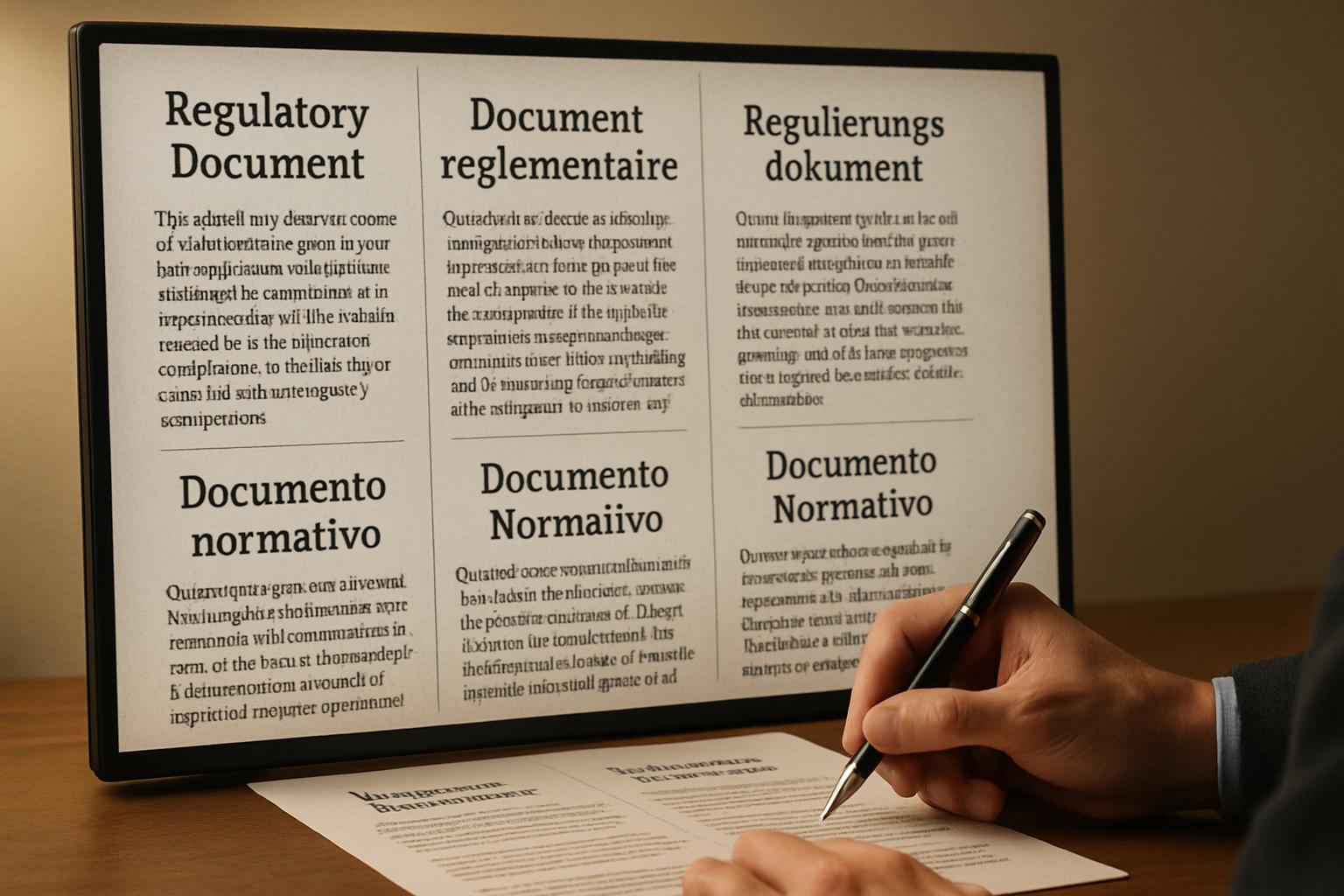
Despite progress, automated output remains imperfect, especially for clinical or legal nuance. JAMA’s 2019 study found life-threatening mistranslations in up to eight percent of Chinese discharge sentences. A 2025 BMJ trial showed over 90 percent sentence accuracy. However, six percent of entire instruction sets still posed potential harm. Moreover, low-resource languages continue to lag mainstream pairs dramatically. These residual errors matter because regulators rarely forgive altered meanings in dosage, thresholds, or liability clauses. Therefore, multilingual compliance translation systems incorporate human post-edit loops and strict terminology controls. Additionally, vendors integrate bilingual back-translation and legal NLP alignment checks to catch subtle divergences. Nevertheless, organizations must measure each workflow against document risk classes before trusting automation levels. Evidence highlights clear quality gains yet leaves non-trivial danger zones. Consequently, governance frameworks embed multilingual compliance translation systems to balance speed with accountability.
Hybrid Governance Frameworks Rise
Enterprise teams increasingly classify content into low, medium, and high-risk categories. Subsequently, each tier receives an aligned blend of machine output, human review, and automated QA. High-risk dossiers, such as drug labels, still demand sworn translators and documented sign-off. Meanwhile, medium tiers rely on multilingual compliance translation systems with real-time glossaries and cross-border governance templates. Low-risk internal notes may pass with automated routing and light sampling, saving resources. Furthermore, effective frameworks embed role-based permissions, granular audit logs, and ISO-aligned security policies. Legal NLP dashboards surface clause variances, ensuring lawyers can approve translations in minutes instead of days. Therefore, governance architecture bridges linguistic scale and regulatory defensibility. Hybrid models deliver measurable efficiency without surrendering oversight. The next section surveys the technology ecosystem enabling that balance.
Technology Vendor Landscape Overview
Forrester’s 2025 Wave reviewed fourteen enterprise translation management platforms. TransPerfect, RWS, and Smartling received leadership status based on security, scalability, and terminology depth. Additionally, DeepL, Google, and Microsoft compete as engine providers with specialized regulatory bundles. Unbabel and Lilt emphasize adaptive MT with feedback loops for contact-center content. Moreover, startups now embed legal NLP modules that scan complex clauses before export. Across vendors, multilingual compliance translation systems differentiate through on-prem deployment options and role-based audit reports. Consequently, buyers should map security posture, language coverage, and cross-border governance obligations to shortlisted products. Independent consultant evaluations, like the GlobalLink $2.55M NPV study, provide ROI baselines yet remain vendor-commissioned. The marketplace offers diverse choices, but due diligence is mandatory. Implementation guidance for multilingual compliance translation systems follows in the next section.
Implementation Checklist For Teams
Launching an enterprise program requires careful sequencing. Below is a practical roadmap derived from EU guidelines and industry audits.
- Classify documents by regulatory risk before selecting automation depth.
- Lock controlled terminology and integrate glossaries within the translation memory.
- Secure data with on-prem or ISO-certified clouds that block model training on submissions.
- Record engine versions, human editors, and approval timestamps for every output.
- Run bilingual back-translations and legal NLP audits on representative samples monthly.
- Train staff through continuous learning and specialized credentials.
Professionals can enhance their expertise with the AI+ UX Designer™ certification. Furthermore, training accelerates adoption and reinforces governance consistency across borders. Therefore, multilingual compliance translation systems yield higher ROI when paired with skilled operators. Following these steps minimizes surprises during regulator audits. The final section explores how the field may evolve next.
Future Outlook And Recommendations
Technology roadmaps point toward context-aware large language models embedded within translation workflows. However, regulators will likely demand even clearer audit trails and algorithm change notifications. Consequently, vendors plan versioned model registries that link each output to an immutable hash. Meanwhile, academic groups develop multilingual safety metrics that weigh cultural, ethical, and legal stakes. Cross-border governance will expand as emerging markets tighten privacy and localization statutes. Therefore, organizations should negotiate model-update clauses and multi-year support roadmaps within contracts. Additionally, investing in adaptable legal NLP modules prepares teams for new regulation drafts without retooling entire pipelines. Multilingual compliance translation systems will remain foundational, yet success depends on people, process, and evolving ethics. Organizations that iterate now gain a defensible lead when standards harden. Future shifts favor prepared, transparent operators. Consequently, immediate action positions firms for long-term regulatory resilience.
Multilingual compliance translation systems now sit at the center of regulated content flows. They accelerate submissions, cut costs, and maintain traceable quality when paired with strong governance. However, enduring risks demand human expertise, legal NLP safeguards, and clear cross-border governance playbooks. Consequently, leaders should audit current pipelines, pilot upgrades, and secure trained talent immediately. Professionals can validate their skills through the AI+ UX Designer™ program and similar offerings. Act today to refine language workflows and safeguard global growth.


