

AI CERTS
2 months ago
Moore Threads Debuts Huashan, Lushan GPUs to Rival Nvidia
This article unpacks technical claims, market context, and strategic implications for data center planners. Meanwhile, we spotlight critical challenges that could temper early enthusiasm. Moreover, emerging certifications help teams prepare for novel AI workflows centered on custom accelerators. Professionals can enhance their expertise with the AI Prompt Engineer™ certification. Read on for a concise yet comprehensive briefing.
MDC 2025 Key Highlights
During the Beijing event, Moore Threads executives staged live demos of training and gaming workloads. Huashan targets data center GPU roles, while Lushan focuses on mainstream gaming rigs. Additionally, CEO Zhang Jianzhong claimed 50 percent higher density and tenfold energy efficiency over prior silicon. Moreover, new MTLink interconnect appeared in cluster demos scaling to tens of thousands of accelerators. Consequently, partners showcased a KUAE rack running DeepSeek R1 models at over 4,000 tokens per second. In contrast, Nvidia’s Hopper launch highlighted similar numbers only after extensive software tuning.
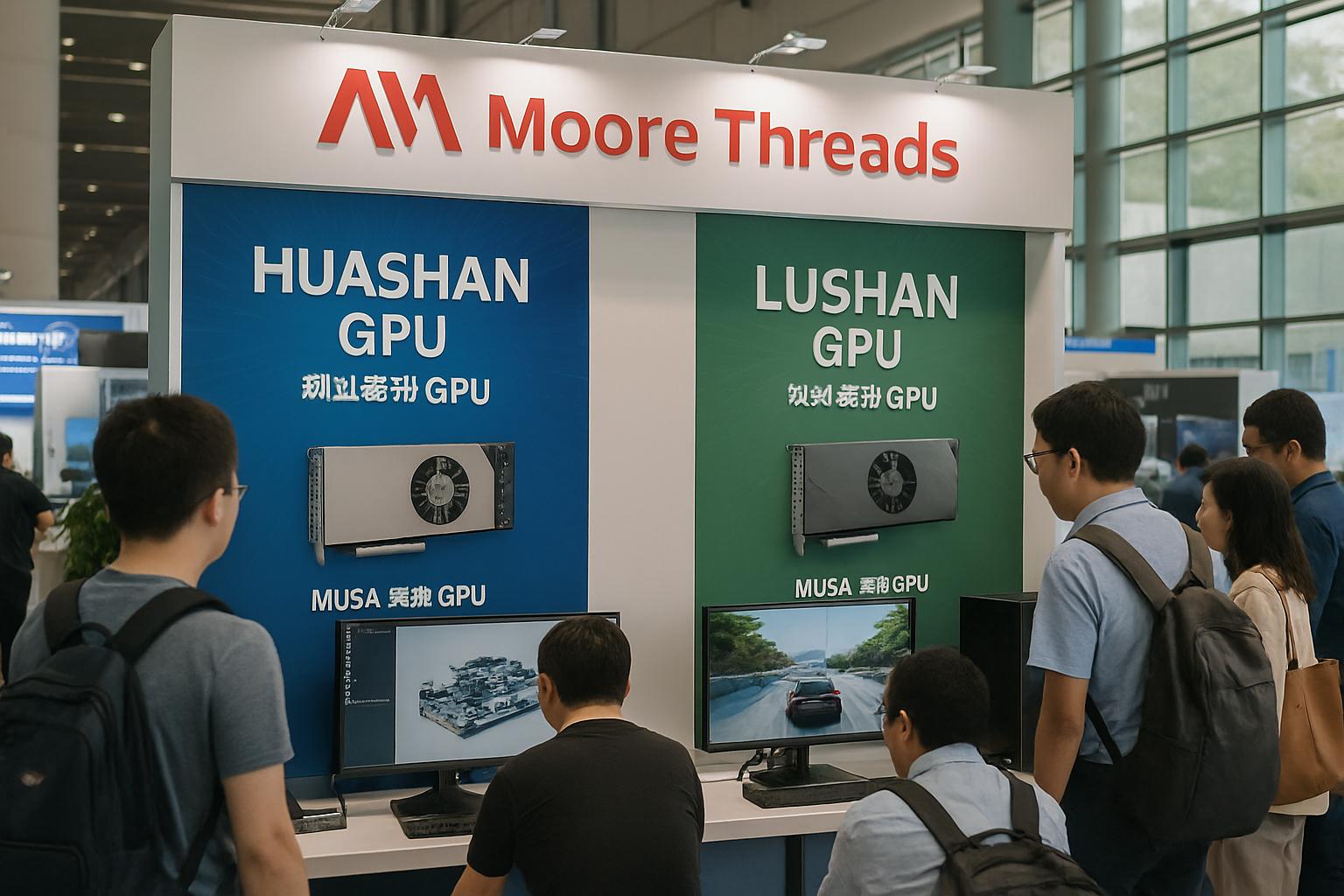
These highlights amplified the company’s hype. However, independent benchmarks remain absent, setting up the technical analysis that follows.
Core Technical Claims Overview
Huagang Performance Metrics Explained
Company slides from Moore Threads list 50 percent more cores and clocks pushed beyond 3 GHz. Furthermore, support spans FP4 through FP64, including proprietary MTFP4 and MTFP6 formats. Such granularity allows dynamic precision scaling that improves throughput and reduces watt consumption.
Huashan adopts a dual-chiplet package flanked by multiple HBM stacks delivering over one terabyte per second. Moreover, internal MTLink bridges bond two dies, forming a logical monolithic device for software. Consequently, management claims parity with Nvidia’s Hopper in FP16 tensor throughput.
- Compute density up 50 percent over last generation.
- Energy efficiency claimed at tenfold improvement.
- Precision support ranges from FP4 to FP64.
Lushan follows a traditional monolith yet touts 15× raster uplifts and 50× ray tracing improvements. Nevertheless, those gaming numbers derive solely from internal tests lacking public methodology. Engineers therefore expect the chip to outperform every domestic GPU currently shipping. In contrast, analysts note China still lags advanced process nodes that underpin these projections.
These technical assertions appear impressive at first glance. However, validation will depend on independent labs and standardized benchmarks. The financial backdrop offers additional insights into how quickly that validation might arrive.
Market And IPO Context
Earlier in December, the firm raised eight billion yuan on Shanghai’s STAR Market. Consequently, shares surged several hundred percent on debut, reflecting bullish sentiment toward domestic accelerators. Financial Times framed the listing as one of 2025’s largest tech IPOs.
Moreover, policymakers highlighted the deal as a strategic counterweight to U.S. sanctions limiting advanced parts. Moore Threads promised to invest the proceeds heavily in research, capacity expansion, and ecosystem incentives. Nevertheless, analysts warned profitability remains distant because fabrication partners trail global leaders on yield and power efficiency.
Reuters projected China’s AI chip market could approach 189 billion dollars by 2029. Therefore, even modest domestic share capture could justify ambitious valuations.
The IPO supplied vital capital for productization and ecosystem grants. However, the funding alone cannot guarantee market traction without credible benchmarks, addressed next.
Competitive Landscape Analysis
Domestic challengers like MetaX, Biren, and Enflame are racing to fill the same gap. In contrast, global giants Nvidia, AMD, and Intel still dominate international cloud contracts. Consequently, buyers compare price, performance, and software maturity rather than nationality alone.
Moore Threads positions Huashan as a direct Nvidia Rival, claiming performance between Hopper and Blackwell generations. Furthermore, the firm markets a full stack, including the MUSA programming model and KUAE servers. Meanwhile, Nvidia bundles CUDA, cuDNN, and optimized libraries, forming a formidable moat.
Analysts therefore argue the ecosystem contest may decide winners more than raw silicon specs. Nevertheless, supply chain constraints could tilt corporate purchases toward whichever vendor delivers physical boards first.
Competition remains intense across technical, logistical, and software fronts. The following section examines risks that might reshape this contest.
Challenges And Next Steps
Manufacturing tops the risk list because Moore Threads sits on the U.S. Entity List. Therefore, the company relies on SMIC nodes that trail TSMC by several generations. Lower density raises voltage, complicating thermal design and potentially lowering GPU efficiency.
Additionally, software parity remains elusive despite rapid progress on the MUSA compiler and Torch-MUSA plugins. Consequently, developers must refactor kernels, a time cost that deters early migrations. Nevertheless, government backed cloud credits could accelerate pilot deployments within China’s state owned enterprises.
Another concern involves absent third party benchmarks like MLPerf or SPECviewperf. Meanwhile, Moore Threads has promised data once silicon reaches production in 2026.
These hurdles could delay widespread adoption if not resolved swiftly. However, proactive engineering roadmaps may still convert risks into learning opportunities, explored in the next assessment.
Strategic Impact Summary Ahead
For data center architects, performance per watt often dictates rack economics more than raw tops. Huashan’s promised efficiency therefore deserves close scrutiny once reference boards ship. Moreover, organizations pursuing sovereign AI strategies may prioritize domestic silicon even before benchmarks finalize.
Moore Threads could supply those needs, positioning itself as both accelerator seller and platform steward. Consequently, the firm becomes a potential Nvidia Rival for government and telecom workloads where procurement favors local vendors. Additionally, early adopters can offset migration costs by certifying engineers through programs like the earlier referenced credential.
Professionals seeking structured knowledge may again consider the AI Prompt Engineer™ pathway. Therefore, skill readiness aligns with hardware availability, creating a virtuous loop for ecosystem growth.
This strategic outlook underscores both promise and uncertainty. However, the upcoming production year will provide the decisive verdict.
Conclusion
Moore Threads has unveiled bold silicon that, on paper, narrows the gap with incumbent leaders. However, success will hinge on meeting schedules, shipping competitive GPU boards, and publishing audited benchmarks. Furthermore, ecosystem traction requires developer confidence, stable toolchains, and robust customer support. Regulatory pressures and supply limitations persist, yet China’s policy momentum could offset certain disadvantages. Nevertheless, a credible Nvidia Rival strengthens buyer leverage, accelerating innovation across the entire sector.
Consequently, monitoring Moore Threads’ upcoming GPU trials will be essential for planners assessing budget allocations. Professionals should prepare by pursuing relevant training and certifications before procurement windows open. Explore the linked credential to stay ahead in this rapidly shifting landscape.


