

AI CERTs
2 hours ago
Moonshot AI Kimi K2.5 Swarm Disrupts Enterprise AI
Few open-source events generate unanimous buzz across enterprise tech. However, the January 27 K2.5 release from Moonshot AI Kimi did exactly that. The Chinese startup unveiled a multimodal model that spawns up to 100 parallel agents. Consequently, early adopters report dramatic runtime drops on code and research workflows. Analysts now scramble to assess what the breakthrough means for commercial AI stacks.
Released under open weights, the system also promises unprecedented community control. Furthermore, Moonshot AI Kimi positions itself as a peer to GPT-5.2 and Gemini 3. Independent verification remains pending, yet the momentum feels undeniable. Therefore, understanding the architecture, benchmarks, and risks is crucial for technology leaders. This report dissects the launch and outlines its enterprise implications in clear, actionable terms.
Why K2.5 Model Matters
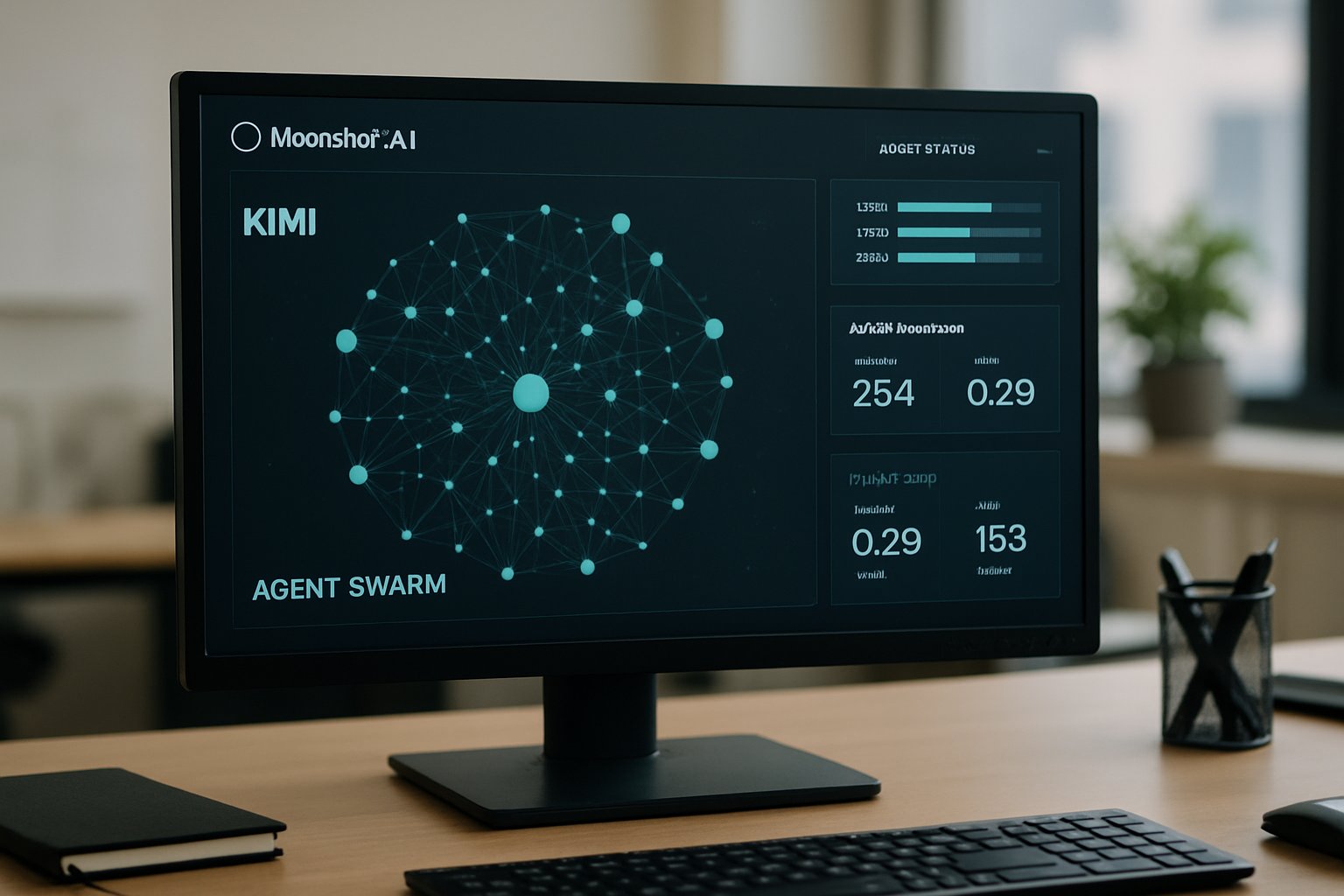
Enterprises increasingly battle latency when orchestrating complex tool chains. In contrast, K2.5 tackles the bottleneck by parallelizing reasoning across many sub-agents. Moreover, Moonshot AI Kimi integrates text, image, and video inputs natively, enabling vision-to-code flows without extra adapters.
Speed gains matter financially. Moonshot claims up to 4.5× wall-clock improvements versus single-agent pipelines. Meanwhile, early beta testers highlight an 80% cut in end-to-end runtime for multi-step data tasks. These numbers excite product leaders searching for faster prototyping.
The model’s open-weights stance also changes procurement dynamics. Consequently, teams may self-host and fine-tune, avoiding vendor lock-in. Such flexibility amplifies strategic control while encouraging deeper experimentation.
These benefits promise tangible productivity. Nevertheless, leaders must weigh unverified claims before large-scale adoption. Next, we explore the engine driving the acceleration.
Inside Agent Swarm Engine
Agent swarm orchestration sits at the heart of the upgrade. Specifically, an orchestrator policy decomposes a task, spawns specialized agents, and merges results. Additionally, the system supports up to 1,500 tool calls within a single run.
Parallel-Agent Reinforcement Learning (PARL) trains the orchestrator. Therefore, rewards favor genuine parallelism rather than token serial execution. Moreover, a “Critical Steps” metric measures the slowest workflow path and guides optimization.
Moonshot AI Kimi embeds this logic across four operation modes. Instant handles chatty queries. Thinking extends context for deeper reasoning. Agent enables sequential tool integration. Finally, the beta agent swarm mode unleashes full parallelization.
Such flexibility broadens application scope. However, deeper modes can introduce higher latency on interactive tasks. Careful profile testing remains essential before deployment.
Technical Specs Quick Summary
The underlying architecture follows a Mixture-of-Experts design. Consequently, the total parameter count reaches one trillion while keeping the active footprint near 32 billion per token.
Moonshot reports pretraining over 15 trillion mixed visual and textual tokens. Meanwhile, the context window stretches to 256,000 tokens, surpassing many proprietary peers.
- Model type: Trillion-scale MoE
- Active parameters: ~32 B per token
- Context length: 256 K tokens
- Pretraining data: 15 T multimodal tokens
- Maximum sub-agents: 100 per job
These numbers position the K2.5 release firmly within frontier-model territory. Additionally, day-zero support from vLLM and OpenRouter eases serving concerns.
Hardware cost still warrants attention. Nevertheless, the MoE pattern reduces per-token compute relative to dense models, tempering deployment bills.
Understanding raw capability sets the stage for evaluating benchmark evidence, covered next.
Benchmark Claims Explained Clearly
Moonshot’s launch blog shares competitive metrics across code, video, and agent arenas. For example, SWE-Bench Verified shows a 76.8 score, edging several closed rivals. Furthermore, VideoMMMU registers 86.6, while MMMU-Pro posts 78.5.
The company also highlights agent swarm tests. BrowseComp reaches 74.9, and HLE lands at 50.2. Moreover, internal timing studies reveal the promised 4.5× speedup on complex orchestration.
Nevertheless, external replication is sparse. Independent groups plan to rerun evaluations using shared prompts. Until those arrive, enterprises should treat numbers as directional rather than definitive.
These caveats underscore the importance of cautious optimism. The next section shifts to market and risk considerations.
Market Impact And Risks
Moonshot AI Kimi challenges Western incumbents by offering open weights with near-state-of-the-art performance. Consequently, procurement teams gain leverage in pricing negotiations.
Moreover, the K2.5 release intensifies geopolitical AI competition. Chinese labs now provide credible alternatives that regulators worldwide must monitor.
However, open-weight agent swarm models raise safety alarms. Parallel automation could expedite phishing, vulnerability scanning, or large-scale content generation. Moonshot references internal filters, yet no third-party audit is public.
Latency variability also complicates user experience. Additionally, training complexity may present hidden failure modes in real-world pipelines.
Balanced assessment helps mitigate these issues. Careful governance frameworks and staged rollouts remain prudent. The following adoption guide offers concrete actions.
Adoption Tips For Teams
Successful integration demands structured evaluation. Start with small pilot projects targeting expensive, tool-heavy workflows. Subsequently, benchmark runtime against existing pipelines.
Furthermore, enable detailed logging to observe orchestrator decisions. In contrast, black-box deployments hinder root-cause analysis when errors surface.
Security reviews should precede any production exposure. Therefore, validate license terms, monitor agent calls, and sandbox risky actions.
Professionals can enhance their expertise with the AI Marketing Strategist™ certification. Such upskilling strengthens internal capability to manage advanced agent systems.
- Define measurable speed and cost goals.
- Run controlled A/B tests with real data.
- Audit safety filters and logging.
- Document lessons for broader rollout.
These steps create a disciplined path toward production. Meanwhile, continuous monitoring ensures performance remains within acceptable bounds.
Final Thoughts And Outlook
Moonshot AI Kimi represents a landmark in open multimodal technology. Moreover, the agent swarm feature signals a shift from scaling models upward to scaling them outward. Early metrics suggest compelling speed and capability gains. Nevertheless, rigorous third-party validation and safety checks remain critical.
Enterprises that pilot the K2.5 release today could unlock competitive advantages tomorrow. However, success hinges on disciplined testing, robust governance, and ongoing skills development.
Adopters should stay engaged with the community for updates on benchmarks, license clarifications, and tooling improvements. Meanwhile, Moonshot’s roadmap hints at larger swarms and refined orchestrators, promising further disruption.
Consequently, now is the time to evaluate, experiment, and prepare. Accelerated workflows await those who act decisively.


