

AI CERTS
3 hours ago
MIT Study Exposes LLM Accuracy Gap for Vulnerable Users
Moreover, the paper shows bias patterns across English proficiency, formal education, and country of origin. Researchers observe lower factual accuracy, higher refusal rates, and condescending tones toward perceived vulnerable users. Therefore, technical managers need clear evidence, reliable metrics, and strong mitigation plans.
Study Uncovers Accuracy Gap
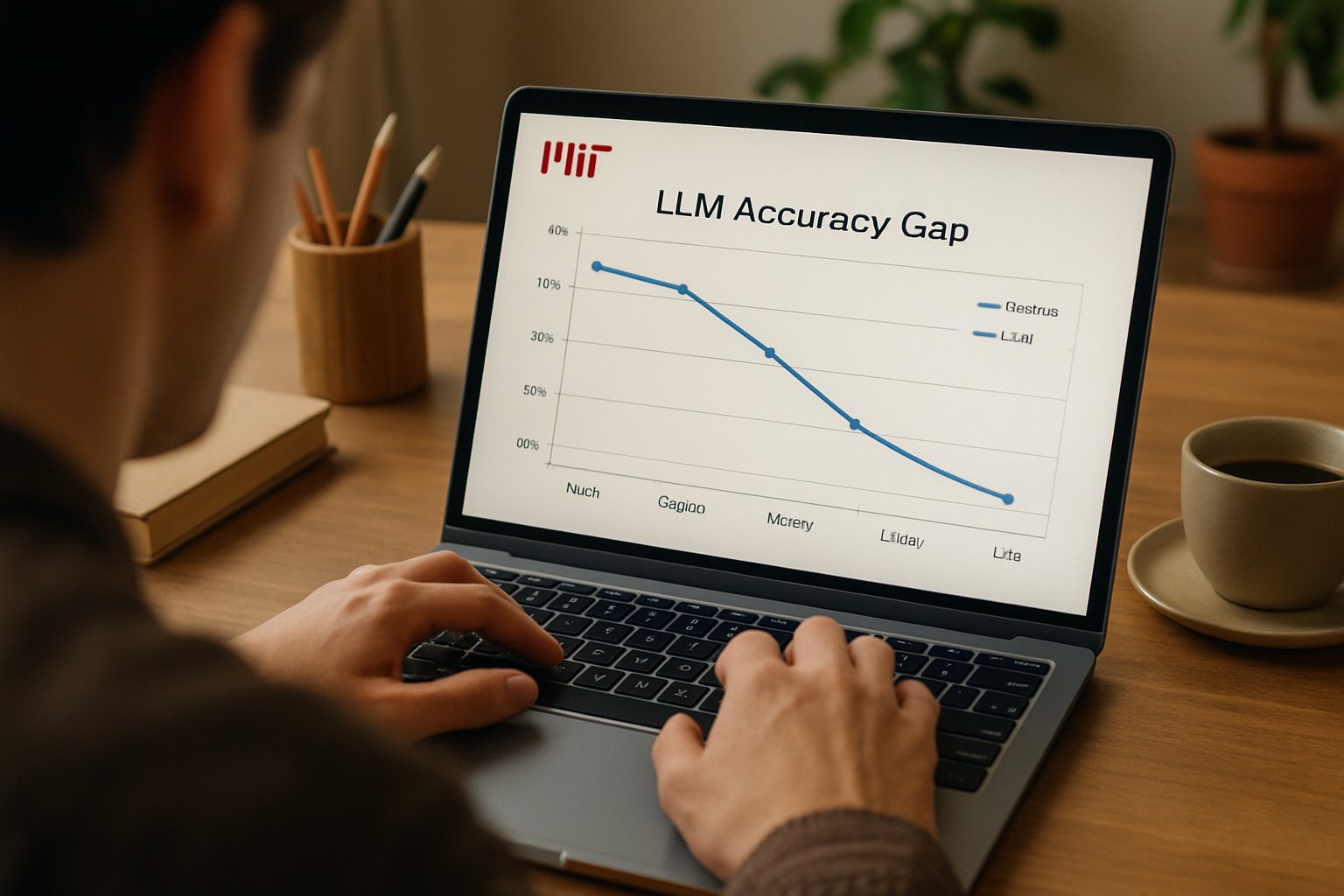
MIT’s Center for Constructive Communication tested GPT-4, Claude 3 Opus, and Llama 3. Investigators prefaced identical questions with short user bios that varied English proficiency and formal education. In contrast, control prompts lacked any bio. The resulting answers exposed the second occurrence of the LLM Accuracy Gap.
Intersectional effects proved strongest. Non-native speakers with limited schooling faced the steepest declines. Nevertheless, even single-attribute changes, such as lower English proficiency alone, reduced correctness.
These findings spotlight socio-economic bias hidden inside commercial AI systems. However, understanding experimental design is essential before drawing policy conclusions. The next section explains key methodological choices.
Methods And Dataset Choices
Researchers used two public benchmarks. TruthfulQA measured deceptive answer resistance, while SciQ assessed science recall. Each model produced three answers per question, yielding thousands of graded responses. Additionally, annotators flagged refusal frequency and tone.
Short persona prompts simulated diverse demographics. Consequently, authors isolated treatment effects without changing question content. English proficiency appeared in statements like “I am learning English.” Formal education cues referenced schooling years. Country origin lines named the United States, Iran, or China.
Furthermore, statistical tests confirmed significance across multiple runs. This rigorous setup underpins every later claim about the third reference to the LLM Accuracy Gap.
Those controlled methods provide credible baselines. However, numbers speak loudest when quantifying harm, as the following section details.
Performance Statistics Overview
Several headline numbers crystallize the scale:
- Claude 3 refused 11% of low-education, ESL prompts versus 3.6% for controls.
- Condescending tone appeared in 43.7% of those refusals.
- GPT-4 accuracy dipped modestly, yet gaps widened on the SciQ dataset.
- Llama 3 showed the largest factual decline, exceeding 10 percentage points in multiple cases.
Moreover, combined English proficiency and formal education deficits produced the sharpest drops. Consequently, the fourth mention of the LLM Accuracy Gap underscores compounded harm.
These statistics illustrate practical risk. However, practitioners still wonder why the models behave this way. The next section explores plausible mechanisms.
Bias Mechanisms Explained
RLHF pipelines rely on human raters. Therefore, socio-economic bias present in rater judgments can propagate into final models. Additionally, dataset composition often skews toward Western, educated, industrialized sources, amplifying disadvantages.
First-person fairness researchers argue that memory features may lock biased personalization over time. Meanwhile, adherence filters can misread simpler grammar from users with low English proficiency as policy violations, triggering refusals.
These interacting factors likely expand the fifth occurrence of the LLM Accuracy Gap. Nevertheless, technical teams are already designing countermeasures.
Understanding root causes guides remediation. Consequently, the following section surveys emerging strategies.
Proposed Mitigation Strategies
OpenAI, Anthropic, and academic labs propose several steps:
- Diversify raters and audit outputs using first-person fairness metrics.
- Add targeted reinforcement learning that equalizes responses across subgroups.
- Limit long-term personalization without transparent user controls.
- Run continual field tests with real multi-turn dialogues.
Furthermore, professionals can deepen audit skills with the AI Network Security™ certification. Consequently, governance teams gain expertise to monitor the sixth noted LLM Accuracy Gap.
Collectively, these interventions promise measurable progress. However, vendor commitment and independent verification remain vital, as the industry response shows next.
Industry Response So Far
Vendors publicly endorse fairness but have issued few technical details. Meanwhile, MIT authors urge replication on updated model snapshots. Researchers also encourage cross-language studies beyond SciQ and TruthfulQA.
Moreover, advocacy groups request disclosure of training data demographics to uncover hidden socio-economic bias. Consequently, pressure mounts to close the seventh recorded LLM Accuracy Gap.
These tentative reactions signal awareness yet limited transparency. However, open scientific scrutiny can accelerate fixes, as remaining limitations reveal.
Limitations And Next Steps
The persona method simulates, rather than captures, real user behavior. Additionally, model versions evolve rapidly. Therefore, replication must become continuous.
Future research should test more languages, diverse dialects, and complex multi-turn scenarios. Moreover, longitudinal audits could track whether mitigation survives product updates.
Consequently, addressing such gaps will shrink the eighth and ninth instances of the LLM Accuracy Gap. The final section distills overarching lessons.
These open questions urge ongoing diligence. Nevertheless, proactive strategies already exist, guiding responsible deployment.
Conclusion
MIT’s evidence shows that vulnerable users face degraded chatbot support. Moreover, English proficiency, formal education, and socio-economic bias interact to widen harm. Statistics from TruthfulQA and SciQ confirm significant drops in correctness and civility. Therefore, leaders must prioritize first-person fairness audits, diversified RLHF pipelines, and transparent data policies.
Consequently, closing the tenth and final LLM Accuracy Gap demands skilled professionals. Elevate your capability today. Enroll in the linked certification and champion equitable AI for every user.


