

AI CERTS
1 hour ago
MIT 3D Printing Spurs AI-driven Hardware Manufacturing Revolution
The achievement merges multi-material extrusion and smart tool-path planning. Industry analysts already link the advance to AI-driven Hardware Manufacturing. However, questions about scalability and reliability remain. This article examines the platform, technical data, and commercial implications. Additionally, we outline next research steps and relevant professional certifications. Readers will gain a clear, data-driven perspective for strategic planning. Let's explore how printed motors may remake production playbooks.
Rapid Printing Breakthroughs Unveiled
The MIT team created a retrofitted multi-modal extrusion printer. Meanwhile, four coordinated extruders deposited five functional materials during one build. Materials included conductive ink, dielectric polymers, soft magnets, hard magnets, and flexible springs. Consequently, the printer assembled coils, guides, and structural supports layer by layer. Only a quick post-print magnetization step followed. Therefore, the process produced a working linear actuator without manual assembly. Press coverage emphasized the three-hour timeline and low cost. Such metrics spotlight dramatic efficiency improvements over conventional subtractive machines.
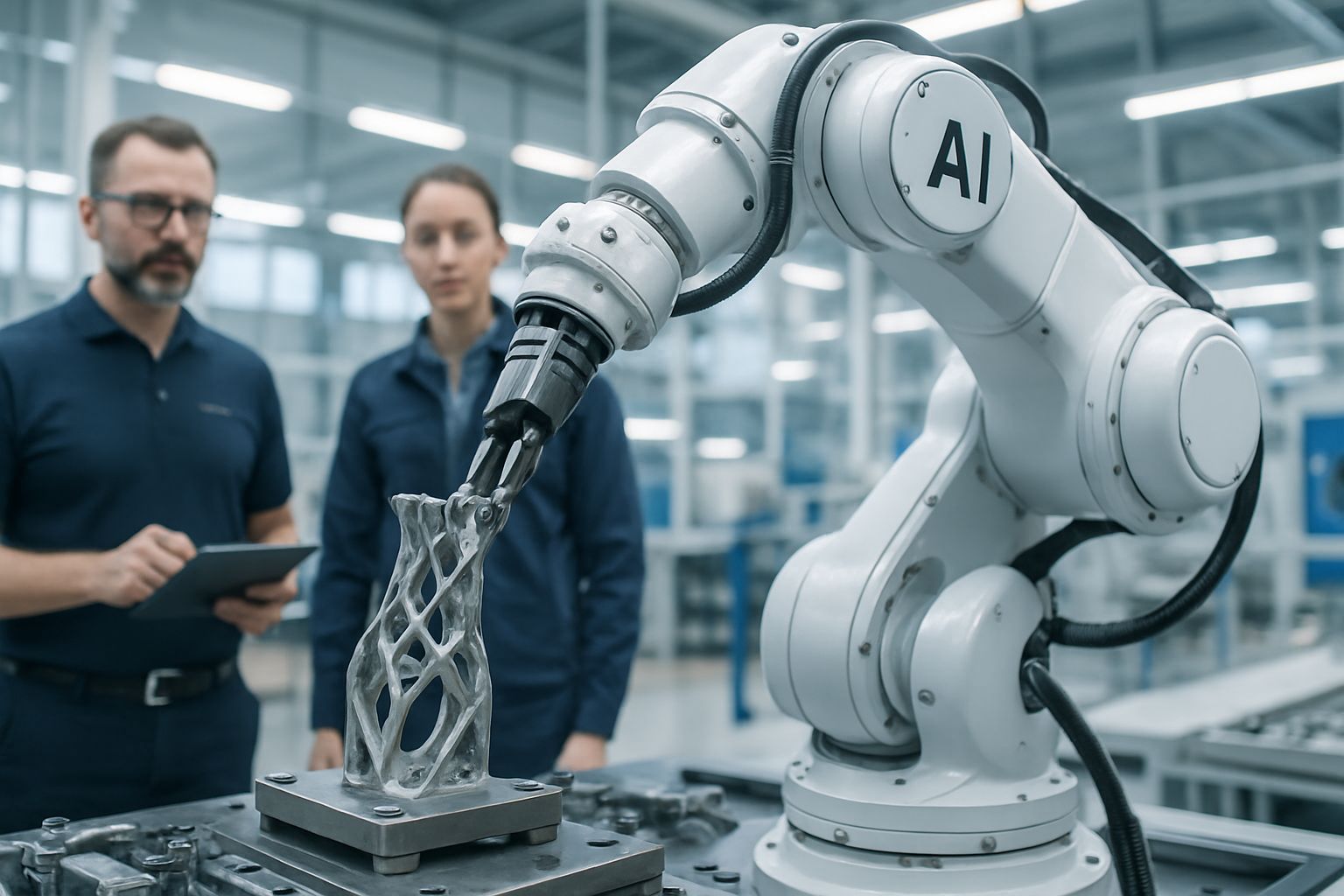
Key performance figures also impressed. The printed solenoids generated fields near 2.03 millitesla. Hard magnets reached roughly 71 millitesla after external magnetization. In contrast, displacement peaked at 318 micrometers when driven at resonance. Consequently, the small actuator illustrated practical yet modest power density. Still, observers hailed the result as evidence for rapid, decentralized 3D printing. AI-driven Hardware Manufacturing narratives quickly amplified that message across trade media.
The experiment proved that multi-material printers can deliver functional electric machines swiftly. Next, we examine the system architecture enabling such precision.
Platform Technical Insights Explained
At the heart lies coordinated tool-path optimization. Additionally, software schedules extruder swaps to minimize idle travel. Each material stream uses temperature, speed, and pressure parameters tuned experimentally. Consequently, interfaces between conductive and magnetic traces remain defect-free. Alignment accuracy stayed within tens of micrometers throughout the three-hour build. Such precision keeps moving parts frictionless after curing.
Multi Material Extrusion Explained
Multi material extrusion relies on hardware add-ons more than firmware tweaks. MIT engineers mounted pneumatic paste extruders beside filament nozzles on a modified frame. Moreover, a vision system verified nozzle positioning during material changes. The upgrade cost stayed modest compared with industrial deposition machines. Therefore, laboratories can replicate the setup without huge capital budgets.
Core hardware elements included:
- Four toolheads: filament, pellet, ink, paste
- In-line heater delivering consistent viscosity
- Closed-loop vision alignment module
- Custom slicer supporting material attributes
Meanwhile, AI-driven Hardware Manufacturing benefits when printers, materials, and analytics integrate seamlessly. Together, these modules orchestrate printing of complex electric geometries without manual intervention. However, engineering skill remains essential for material formulation and curing profiles.
In sum, the platform couples mechanical retrofits and software logic harmoniously. Subsequently, its economic impact merits separate analysis.
Market Disruption Potential Analysis
Hardware costs dominate early stage robotics projects. Consequently, a fifty-cent actuator rewrites budgeting spreadsheets. Meanwhile, 3D printing eliminates tooling costs entirely. Tech press framed the motor as a harbinger of localized manufacturing. Analysts compared the demonstration with traditional supply chains requiring weeks and shipping fees. Therefore, firms see promise in printing replacement parts on demand.
Cost And Time Metrics
Consider these headline numbers:
- Print time: ~3 hours per motor
- Material cost: about US$0.50
- Displacement: 318 μm at 41.6 Hz
- Magnetic field: 71 mT hard magnet peak
Consequently, prototyping loops shrink from weeks to hours for intricate machines. Moreover, low material waste aligns with sustainability mandates.
Cost and speed advantages strengthen the case for AI-driven Hardware Manufacturing adoption. However, capital equipment still faces scale challenges, explored next.
Remaining Engineering Hurdles Ahead
Every prototype uncovers new roadblocks. Firstly, magnetization remains an off-printer step requiring strong external fields. In contrast, true single-step production demands in-situ field alignment. Furthermore, printed magnets deliver millitesla fields, far below industrial kilogauss targets. Thermal management also limits continuous duty cycles. Consequently, larger machines would overheat without better conductive pastes and heat sinks.
Industrial Adoption Considerations Key
Manufacturers worry about reliability across thousands of cycles. Additionally, certification bodies have not validated printed motor standards. AI-driven Hardware Manufacturing risk assessments highlight missing lifetime data. Toolhead alignment drift could raise scrap rates during long print campaigns. Nevertheless, adaptive algorithms may tune process parameters in real time.
These challenges underline the gulf between laboratory success and factory reliability. Therefore, future research focuses on materials, sensors, and integrated magnetization.
Future Research Directions Forecast
MIT plans to integrate magnetic field sources within the printer chamber. Moreover, the group targets rotary motor demonstrations with higher torque outputs. New composite inks aim to raise magnetic permeability without sacrificing viscosity. Consequently, field strength may climb toward industrial thresholds. Researchers also explore in-space fabrication scenarios for satellites and lunar rovers. In space, 3D printing circumvents launch packaging constraints. Such remote applications align with AI-driven Hardware Manufacturing visions.
Collaboration with Empiriko and La Caixa supports scale-up experiments. Funding bodies recognize that AI-driven Hardware Manufacturing underpins resilient infrastructure roadmaps. Additionally, external motor experts will benchmark printed actuators against commercial catalog parts.
Timelines remain uncertain, yet momentum clearly builds. Subsequently, executives must watch performance data closely.
Strategic Takeaways Summary Section
Rapid, multi-material printing slashes cost and lead time for electric devices. Furthermore, the MIT platform showcases decentralized production of complex components. Supply chains may shift when AI-driven Hardware Manufacturing matures.
Key strategic insights include:
- Decentralization reduces geopolitical risk
- Customization accelerates robotics iteration
- Material innovation governs scalability
These insights help leaders prioritize investment roadmaps. However, skill gaps still hinder rollout, making training vital.
Professionals can enhance their expertise with the AI+ UX Designer™ certification. Such credentials complement technical knowledge in AI-driven Hardware Manufacturing projects.
MIT's printed motor exemplifies how research can catalyze industry change. Moreover, it anchors broader discussion about localized production economics. Costs falling to cents per unit reshape product margin calculations. Consequently, early adopters may gain decisive agility during supply disruptions. Yet, obstacles around magnetization, thermal load, and standards temper immediate rollout.
Therefore, continuous experimentation and cross-disciplinary teams remain crucial. Organizations pursuing AI-driven Hardware Manufacturing should pilot small, low-risk applications first. Subsequently, scalable architectures can evolve alongside material breakthroughs. 3D printing will soon blur lines between prototype and production. Act now by pursuing certifications and partnerships that prepare your workforce for printed futures.


