

AI CERTS
2 days ago
Microsoft’s Majorana 1 Signals New Era for Quantum AI Hardware
At its center sits a claimed hardware advantage: intrinsic protection against local noise. This article analyses the release, the data, and the commercial outlook for Quantum AI Hardware. Moreover, we weigh community skepticism against the vendor’s aggressive roadmap. Readers will gain clear metrics, contextual physics, and actionable next steps. Furthermore, every sentence remains concise for rapid executive digestion.
Quantum AI Hardware Context
Majorana 1 represents an early test bed rather than a finished product. However, the firm framed the eight qubits as proof that topological encoding now exits the lab. In contrast, rival superconducting arrays already showcase hundreds of noisy qubits. Nevertheless, the company argues its architecture could slash error correction overhead by nearly tenfold.
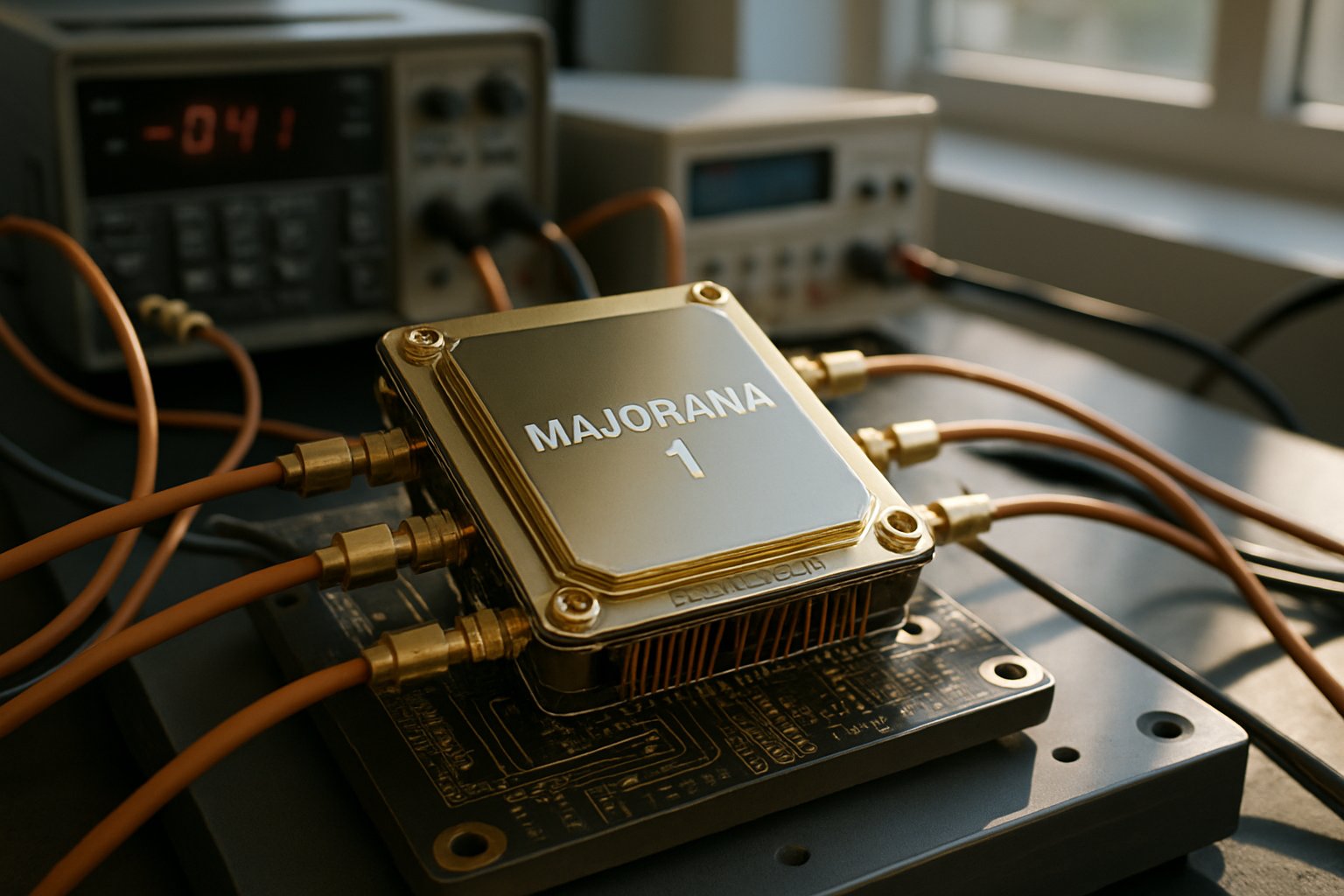
These contrasts situate the prototype within a crowded field. Consequently, serious investors must examine the physics claims. Therefore, the next section breaks down the underlying science in plain terms.
Core Physics Explained Simply
Topological qubits encode information in separated Majorana zero modes. Because the modes sit apart, local perturbations cannot easily flip the stored parity. Additionally, the team couples each wire to a quantum dot for microwave reflectometry parity readout. Yet many wonder when Quantum AI Hardware will demonstrate full braiding. The Nature paper reports single-shot measurements with about one percent assignment error. Moreover, dwell times exceeded one millisecond, indicating low quasiparticle poisoning.
These numbers suggest stable, fast measurement primitives. However, verifying topological protection still requires braiding demonstrations. Consequently, we now examine the hard performance statistics.
Performance Metrics And Claims
Signal-to-noise ratio reached unity after only 3.6 microseconds at optimal flux. Moreover, a 90-microsecond window delivered an SNR of 5.01, according to Nature. Assignment error stayed near one percent, a figure attractive for future error correction codes. Meanwhile, parity flips occurred roughly once per millisecond, reinforcing stability estimates.
- SNR: 1 in 3.6 µs; 5.01 in 90 µs
- Assignment error: ~1%
- Dwell / poisoning time: >1 ms
- Physical qubit count: eight qubits
- Investors note credible numbers are vital for Quantum AI Hardware fundraising.
In contrast, competitors must run complex pulse sequences to reach similar fidelities. Therefore, the vendor posits its system can dedicate more silicon to logical operations instead of redundancy.
These metrics appear encouraging yet preliminary. Consequently, scalability becomes the decisive question. The roadmap section addresses that scale challenge.
Scaling Roadmap And Challenges
The roadmap claims the topoconductor platform can integrate a million tetrons on one chip. Furthermore, the company targets a fault-tolerant prototype under the DARPA US2QC program. However, fabrication yield, cross-talk, and cryogenic integration remain open engineering hurdles. Error correction will still demand many physical qubits per logical unit, although fewer than in conventional devices. Researchers still lack quantum-aware design tools for million-device chips. Broad adoption of Quantum AI Hardware hinges on such reproducible evidence.
The roadmap promises scale but requires proof. Nevertheless, market watchers are already reacting. The next section captures those reactions.
Industry Reactions And Skepticism
Reuters highlighted Microsoft’s bold forecast of usable machines within years, not decades. However, Oxford physicist Steven Simon voiced cautious optimism, refusing life-or-death bets on the data. In contrast, Sergey Frolov declared the underlying physics remains unproven. Additionally, Vincent Mourik argued the approach cannot work fundamentally. The company counters that peer review and DARPA validation bolster confidence in its qubits. Nevertheless, the controversy itself raises public awareness of Quantum AI Hardware benefits and risks.
Community dispute keeps scrutiny high. Therefore, enterprises must weigh strategic timing carefully. The following section explores those strategic issues.
Strategic Implications For Enterprises
Executives considering long-term compute investments must parse between hype and validated milestones. Moreover, built-in protection could lower total cost of ownership once platforms mature. Error correction budgets dominate current designs; a tenfold reduction changes financial models dramatically. Consequently, organizations that monitor Quantum AI Hardware progress can secure early competitive advantage. Meanwhile, cloud services may offer hybrid simulators that bridge classical accelerators and limited topological cores.
- Create internal watch teams tracking Microsoft milestones
- Engage with DARPA US2QC publications
- Prototype algorithms for Quantum AI Hardware deployment
- Invest in staff training on topological concepts
Additionally, professionals can validate skills through the Certified AI Expert™ credential.
Prepared enterprises will pivot faster when hardware stabilizes. In contrast, passive observers may face sudden disruption. The following section outlines individual career moves.
Next Steps For Professionals
Engineers should review the Nature paper to understand parity readout protocols. Subsequently, researchers can replicate simpler interferometer circuits using open hardware recipes. Furthermore, thought leadership articles on Quantum AI Hardware can showcase expertise to employers. Developers must also track error correction benchmarks because they dictate algorithm feasibility.
Moreover, collaborating with the Azure Quantum academic program provides early tooling exposure. These activities build relevant experience quickly. Consequently, practitioners stay ready for sudden hardware breakthroughs.
Majorana 1 illustrates both promise and uncertainty. Nevertheless, the prototype injects fresh momentum into Quantum AI Hardware research. Balanced metrics, cautious optimism, and transparent replication remain essential. Therefore, readers should follow peer-reviewed updates, refine skill sets, and position projects for topological progress. Act now to explore certifications, pilot workloads, and strategic partnerships that prepare teams for the coming era.


