

AI CERTs
2 hours ago
Meta’s MTIA Plan Spurs Nvidia Dependency Reduction Strategy
Meta has fired another salvo in the hyperscale chip wars. On 11 March 2026, Meta revealed a rapid roadmap for four custom AI accelerators, MTIA 300 through 500. The program promises shorter iteration cycles and lower inference costs. Importantly, it targets Nvidia Dependency Reduction for Meta's vast recommendation and generative workloads. Furthermore, executives framed the effort as "inference-first," signaling that training remains largely on commercial GPUs. Consequently, analysts see the announcement as a tactical move rather than an outright divorce from GPU suppliers. Meta is simultaneously buying record volumes of NVIDIA and AMD silicon, pursuing a diversified compute stack. Nevertheless, the internal chips could shift bargaining power and long-term economics. This article dissects the technical claims, supply partnerships, financial upside, and potential roadblocks. Each section blends verified data with expert commentary to give Infrastructure architects and business leaders a clear, actionable picture. Moreover, readers will discover how certifications can sharpen their strategic vantage point in this evolving field. The roadmap also signals to investors that Nvidia Dependency Reduction has shifted from aspiration to funded program.
Meta Silicon Strategy Shift
Meta's pursuit of Nvidia Dependency Reduction began years before the MTIA 300 brand surfaced. However, the formal roadmap clarifies intent. Under the plan, MTIA 300 already handles ranking inference across flagship apps. Additionally, generation 400 enters data-center racks later in 2026, while versions 450 and 500 follow in 2027. Therefore, Meta commits to a six-month silicon cadence, mirroring consumer hardware refresh rates rather than enterprise norms. Analysts call that velocity unprecedented for large-scale Infrastructure deployments. In contrast, earlier hyperscaler chips, such as Google's TPU series, moved on 18-month cycles. Meta says the chiplet architecture enables modular upgrades without wholesale platform replacement. Consequently, the company expects faster adaptation to changing model architectures. Yee Jiun Song said, "Inference demand is exploding, and that is our current focus." That focus aligns with Meta's vast daily traffic, which requires billions of low-latency predictions across multiple Data Centers worldwide. Collectively, these iterations drive Nvidia Dependency Reduction by targeting inference bottlenecks directly.
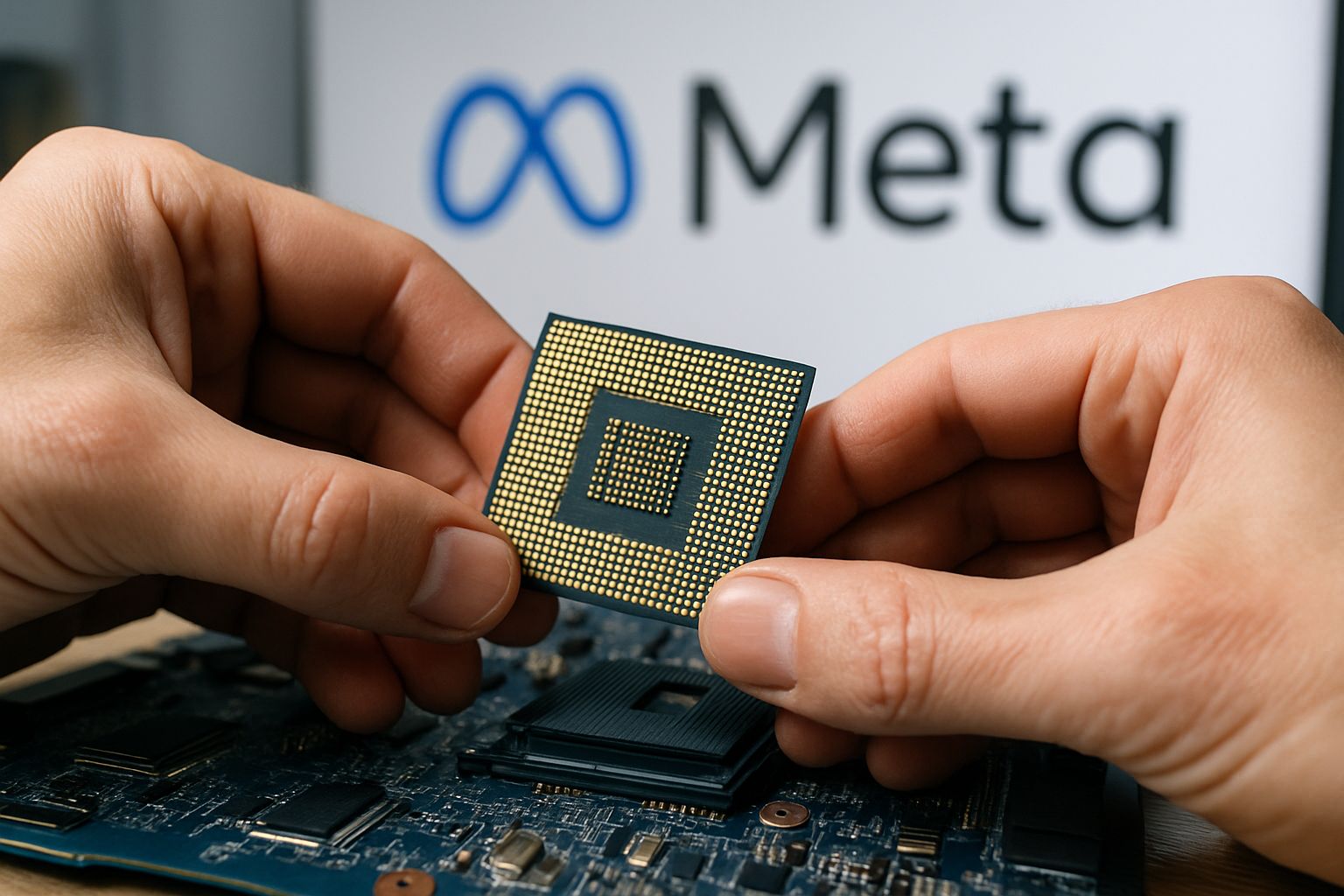
In sum, Meta bets on speed and specialization to reshape compute economics. Next, we examine the chips themselves.
Inside The MTIA Roadmap
The MTIA family advances in power, bandwidth, and compute with each generation. Moreover, every version targets specific workload classes.
Chiplet Design Explained Clearly
Each accelerator fuses compute, network, and HBM chiplets on a single interposer. Consequently, Meta can swap individual slices while keeping shared IO stable. The design uses TSMC 5-nanometer nodes and advanced CoWoS packaging, according to TrendForce. Furthermore, Broadcom reportedly supplies high-speed fabric IP, underscoring the collaborative Hardware approach. Engineers emphasize PyTorch-native software stacks, ensuring models flow between in-house boards and external GPUs without code rewrites. That compatibility eases fleet orchestration across sprawling facilities.
HBM Supply Constraints Ahead
High-Bandwidth Memory fuels the throughput promise. However, global HBM supply remains tight. Generation 450 allegedly carries 288 GB of HBM delivering 18.4 TB/s bandwidth, while generation 500 could top 512 GB. Therefore, Meta must lock early wafer and packaging capacity. TrendForce warns that shortages could derail the six-month release cadence. Nevertheless, Meta insists existing contracts cover near-term production needs.
Collectively, the architectural choices enable dramatic performance scaling. Yet components like HBM introduce external risk. The following section explores how partners mitigate those pressures.
These design highlights underscore both power and fragility within the roadmap. However, partnerships shape execution success.
Supply And Partnership Landscape
Meta cannot achieve Nvidia Dependency Reduction alone. Consequently, the company stitched a broad supplier web. TSMC fabricates the compute dies, while Broadcom co-designs networking blocks. Meanwhile, Meta announced multiyear GPU procurements with NVIDIA on 17 February 2026 and AMD one week later. Moreover, those contracts safeguard training capacity as the accelerator generations mature. Analysts note the dual sourcing grants Meta leverage during price talks. In contrast, smaller cloud players lack such bargaining chips.
Key supply facts appear below:
- TSMC manufactures MTIA wafers on 5-nanometer nodes.
- Broadcom contributes chiplet fabric and packaging expertise.
- NVIDIA and AMD deliver tens of thousands of GPUs under recent deals.
- HBM modules come from Samsung, SK Hynix, and Micron based on press reports.
Furthermore, Meta states that in-house boards will coexist with GPU clusters inside unified Infrastructure racks. Therefore, orchestration software must schedule workloads dynamically. Independent observers say this hybrid fleet embodies pragmatic risk management. Nevertheless, complexity increases operational overhead across global facilities.
Each partnership unlocks critical materials required for Nvidia Dependency Reduction at global scale. This partnership mosaic distributes technical and sourcing risk. Yet financial implications ultimately decide success, as we discuss next.
Economic Stakes And Risks
The headline promise remains lower cost per inference. Meta claims in-house boards deliver superior energy efficiency relative to flagship GPUs. However, the company has not published exact savings percentages. Consequently, investors await hard numbers. Analysts estimate that shaving even 5 cents per thousand predictions could save hundreds of millions annually.
Nevertheless, capital expenditure balloons during transition phases. Meta funds internal silicon development, GPU purchases, cooling upgrades, and bespoke Hardware testing gear simultaneously. Moreover, executing a six-month cadence demands overlapping validation teams, increasing payroll outlays. Opportunity cost thus looms large.
Execution risk also persists. TrendForce highlights tight HBM supply and limited advanced packaging capacity. Therefore, any delay cascades through deployment timetables. Additionally, cooling a 1,700-watt module inside existing server halls challenges facility teams. Meta says liquid cooling retrofits are underway, yet that Infrastructure lift remains nontrivial.
Such optimizations underpin Nvidia Dependency Reduction forecasts issued by several equity analysts. Summarily, potential savings entice, but execution pitfalls threaten. The next section gauges broader operational ramifications.
Implications For Data Centers
Rolling out four accelerator generations within 24 months tests operational agility. Furthermore, each board variation introduces distinct power envelopes and airflow demands. Facility managers must recalibrate power distribution units, rack densities, and cooling loops. Consequently, Meta is piloting rear-door heat exchangers and cold-plate systems.
Software orchestration also shifts. PyTorch modules now decide between GPU or in-house targets based on latency and cost metrics. Moreover, unified observability tools must surface performance counters across heterogeneous Hardware. These requirements drive new Infrastructure abstractions.
Industry peers watch closely. Many plan similar strategies yet operate smaller Data Centers with narrower margins. Therefore, Meta's outcome could influence investment blueprints across the sector.
Facility retrofits therefore play a hidden role in Nvidia Dependency Reduction outcomes. Operational adjustments reshape physical layouts and software layers alike. Subsequently, market perception turns toward competitive positioning.
Broader Market Comparisons Ahead
Meta joins Google, Amazon, and Microsoft in designing proprietary accelerators. However, MTIA's six-month cadence stands out. Analysts argue that pace accelerates Nvidia Dependency Reduction beyond historical norms. Additionally, it pressures GPU vendors to tighten release schedules and pricing.
In contrast, NVIDIA retains unmatched training leadership. Therefore, Meta continues buying H100 and forthcoming B100 GPUs. The hybrid stance balances innovation with capacity assurance. Moreover, AMD's MI300X deal gives Meta further pricing leverage.
Competitive dynamics may shift if generation 500 meets the reported 30 PFLOPS mark. Consequently, hyperscalers lacking internal chips could face rising costs. Investors will monitor gross margin trends for confirmation.
Professionals can enhance their expertise with the AI Government™ specialization certification. This credential equips leaders to navigate emerging policy and security issues surrounding custom AI Hardware.
Market comparisons illuminate strategic stakes. Nevertheless, decision-makers need clear next steps, addressed in the conclusion.
Meta's internal roadmap signals accelerated Nvidia Dependency Reduction, yet the journey remains fraught with supply, engineering, and economic hurdles. Furthermore, rapid chiplet iterations promise agile responses to shifting model demands. Server campuses will undergo simultaneous Hardware and Infrastructure upgrades to harness those gains. Meanwhile, diversified partnerships hedge supply and pricing exposure. Consequently, success may redefine hyperscale cost baselines and influence competitor roadmaps. Industry professionals should track production milestones and published efficiency metrics closely. Additionally, they can sharpen strategic insight through specialized learning paths. Consider pursuing the linked certification to stay ahead in this dynamic landscape.


