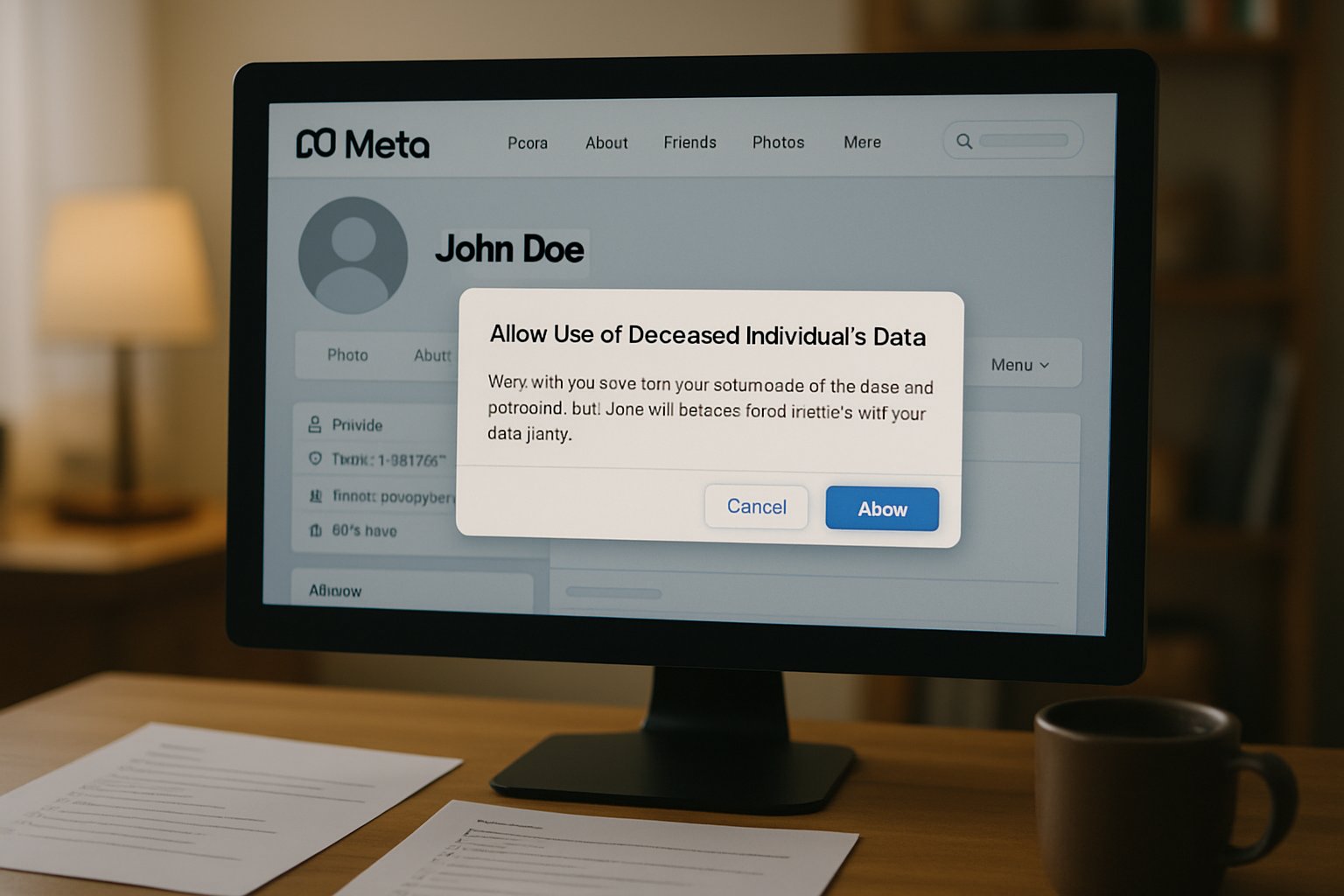
Meta has secured a controversial U.S. Patent that outlines social media personas surviving their owners. The document imagines an AI-driven avatar posting, liking, and even speaking while the real person is absent or deceased. Consequently, policymakers, technologists, and bereavement experts have rekindled fierce debate over AI Ethics and digital remembrance.
Business Insider broke the story soon after the December 2025 grant, quoting Meta’s assurance that no deployment is planned. However, prior patents from Microsoft show that intellectual property often precedes real prototypes. Meanwhile, regulators still lack coherent rules for post-mortem data rights or consent. Therefore, organizations must study the Patent closely to anticipate ethical, legal, and psychological fallout. This article examines the technical proposal, potential benefits, serious risks, and emerging governance options. Along the way, we anchor each finding in AI Ethics principles that guide responsible innovation.
Meta’s technology prompts new conversations about data consent in AI Ethics.
Patent Raises Ethical Questions
USPTO issued Patent No. 12,513,102 on 30 December 2025. It names Meta Platforms Technologies as assignee and Andrew Bosworth as inventor. Moreover, the specification explicitly states the model may operate when a user is deceased. That wording crystallizes why AI Ethics scholars worry about consent after death. In contrast, Meta claims the filing does not indicate product intent. Nevertheless, critics argue that each Patent creates strategic options that firms rarely ignore forever. Edina Harbinja remarks that the document raises profound dignity and privacy dilemmas. These dilemmas, she adds, demand early board-level governance aligned with AI Ethics.
The Patent signals Meta's legal preparedness. Yet public trust hinges on transparent value alignment. Next, we unpack the model architecture that underpins the proposal.
Technical Concept Behind Simulation
The filing describes a pipeline that first ingests historical posts, comments, and messages. Subsequently, the system fine-tunes a large language model on that personal corpus. Consequently, the tailored model predicts how the person would react to new stimuli. Audio or video data can be layered to add multimodal finesse. Furthermore, a monitoring bot scans incoming content and decides when to trigger a response. Simulation fidelity improves as the network feeds each new interaction back into training loops. In contrast, traditional rule-based chatbots lack such personalised nuance. Moreover, the claims include ranking candidate outputs using engagement probability scores. However, responsible teams must validate outputs against AI Ethics checklists to curb hallucinations or impersonation abuse.
These mechanics show technical feasibility without confirming commercial readiness. Moreover, architecture choices shape downstream societal impact. The broader industry landscape and digital afterlife concerns now demand attention.
Industry Context And Legacy
Digital afterlife services are not new. Replika, StoryFile, and HereAfter AI already market memorial chatbots. Nevertheless, market sizing remains fuzzy, ranging from hundreds of millions to several billions. Analysts link demand to ageing populations and creator economies seeking perpetual engagement. In contrast, Legacy management laws lag behind platform innovation. Moreover, fragmented jurisdictional rules complicate cross-border data transfer once a user dies. Recent reports from GiiResearch project the broader end-of-life planning market to exceed forty billion dollars by 2030. Still, only a fraction concerns conversational memorials, leaving room for growth yet fostering volatile forecasts. Therefore, companies face patchwork compliance even before considering nuanced AI Ethics obligations.
The market appears young yet growing. Still, unresolved Legacy governance threatens adoption speed. Next, we examine claimed benefits that proponents emphasize.
Benefits And Potential Uses
Proponents list several advantages for simulated personas.
Creator accounts maintain audience momentum during vacations or illness.
Bereaved families gain conversational comfort immediately after loss.
Brands tied to charismatic founders preserve voice continuity following unexpected events.
Estate executors can schedule commemorative announcements without accessing private credentials.
Moreover, advocates argue these gains outweigh implementation costs when balanced against retention metrics. Consequently, some therapists suggest structured interaction could aid early Grief processing. Furthermore, interactive avatars could serve as narrative sources for documentaries or educational archives. Consequently, cultural institutions are exploring archives that balance memory with authenticity. However, such claims remain preliminary and require peer-reviewed trials. AI Ethics frameworks insist on measuring psychological outcomes before wide rollout.
Clear benefits exist for engagement and remembrance. Nevertheless, every upside introduces parallel hazards. We now confront the risks that dominate expert discourse.
Risks, Rights, And Grief
Ethicists highlight several dangers. Foremost, users rarely grant explicit consent for post-mortem data exploitation. Moreover, ongoing chats may prolong Grief by delaying acceptance of finality. Researchers like Joseph Davis warn that digital echoes can hinder emotional closure. Additionally, massive data pools invite identity theft or malicious impersonation. Consequently, regulators fear that Simulation services could commercialize memory without safeguards. Privacy advocates also question which relative, if any, should control a deceased person’s memorial profile. Therefore, robust policies anchored in AI Ethics must precede any launch.
The psychological and legal stakes are substantial. Absent guardrails, trust in Simulation technology will erode quickly. The following section reviews emergent compliance pathways.
Regulatory And Compliance Outlook
Policymakers worldwide study existing privacy statutes for gaps. In Europe, GDPR ends at death, leaving estates with limited leverage. Meanwhile, several U.S. states debate digital asset succession bills that could mandate explicit opt-in for Simulation. Furthermore, standards bodies examine consent capture, data minimization, and explainability clauses. Consequently, legal scholars propose a dedicated Digital Legacy Act covering storage, transfer, and deletion of post-mortem data. Nevertheless, harmonization will take years, so self-regulation grounded in AI Ethics remains essential.
Policy momentum shows encouraging signs. Yet uncertainty persists across jurisdictions. Practical guidance can still help firms act responsibly today.
Guidance For Responsible Adoption
Organizations exploring post-mortem Simulation should start with clear value statements signed by senior leadership. Moreover, multidisciplinary review boards must include ethicists, lawyers, engineers, and bereavement specialists. Additionally, developers should implement rigorous consent workflows and periodic audits. Professionals can enhance their expertise with the AI Human Resources™ certification. Consequently, trained staff better translate AI Ethics principles into daily practice. Transparency dashboards, opt-out toggles, and sunset dates further protect family interests. Meanwhile, continuous user research tracks Grief impact and reports findings publicly.
Following these steps builds social licence. Consequently, responsible actors can innovate while preserving dignity. We close with overarching reflections.
Meta’s filing illustrates how fast frontier technologies confront society with ancient questions about death and identity. Nonetheless, informed design can balance remembrance with autonomy. Consequently, leaders should watch regulatory developments, invest in transparent governance, and empower teams through continuous education. AI Ethics offers the compass for that journey. Therefore, consider deepening expertise via the AI Human Resources™ program or similar credentials.