

AI CERTS
7 months ago
Meta Smart Glasses Add Conversation Focus and Spotify Integration
Consequently, a single frame now covers audio entertainment and situational Hearing Assistance. Industry analysts view the move as a bold push toward sensory convergence. Meanwhile, clinicians caution that consumer hearables still differ from regulated medical devices. This article unpacks the update, market implications, competitive context, and next steps. Readers will discover benefits, limitations, and opportunities to upskill through specialized certifications.
Meta Smart Glasses Update Arrives
Meta revealed Conversation Focus during its Connect keynote and began shipping v21 on 16 December 2025. Initially, enrollment runs through an Early Access Program limited to the United States and Canada. Consequently, broader regions must wait for a staged rollout later in 2026. Supported hardware includes Ray-Ban Meta Gen 2 families and the Oakley Meta HSTN line.
Users can invoke the feature by saying, “Hey Meta, start conversation focus,” or by tapping the right temple. Furthermore, a swipe gesture cycles through three amplification levels for noisy, moderate, or quiet environments. These controls reinforce a hands-free ethos that distinguishes the Meta Smart Glasses experience.
Early Access limits reach but offers valuable performance feedback. Subsequently, the next section dissects Conversation Focus at a technical level.
Technical Features In Depth
Conversation Focus tackles the classic cocktail-party dilemma by isolating the voice positioned directly ahead. It combines a multi-microphone beamformer with on-device AI noise suppression. Moreover, head orientation and subtle eye-tracking cues guide the algorithm toward the intended speaker. Processing occurs locally, therefore latency stays minimal and network privacy risks diminish.
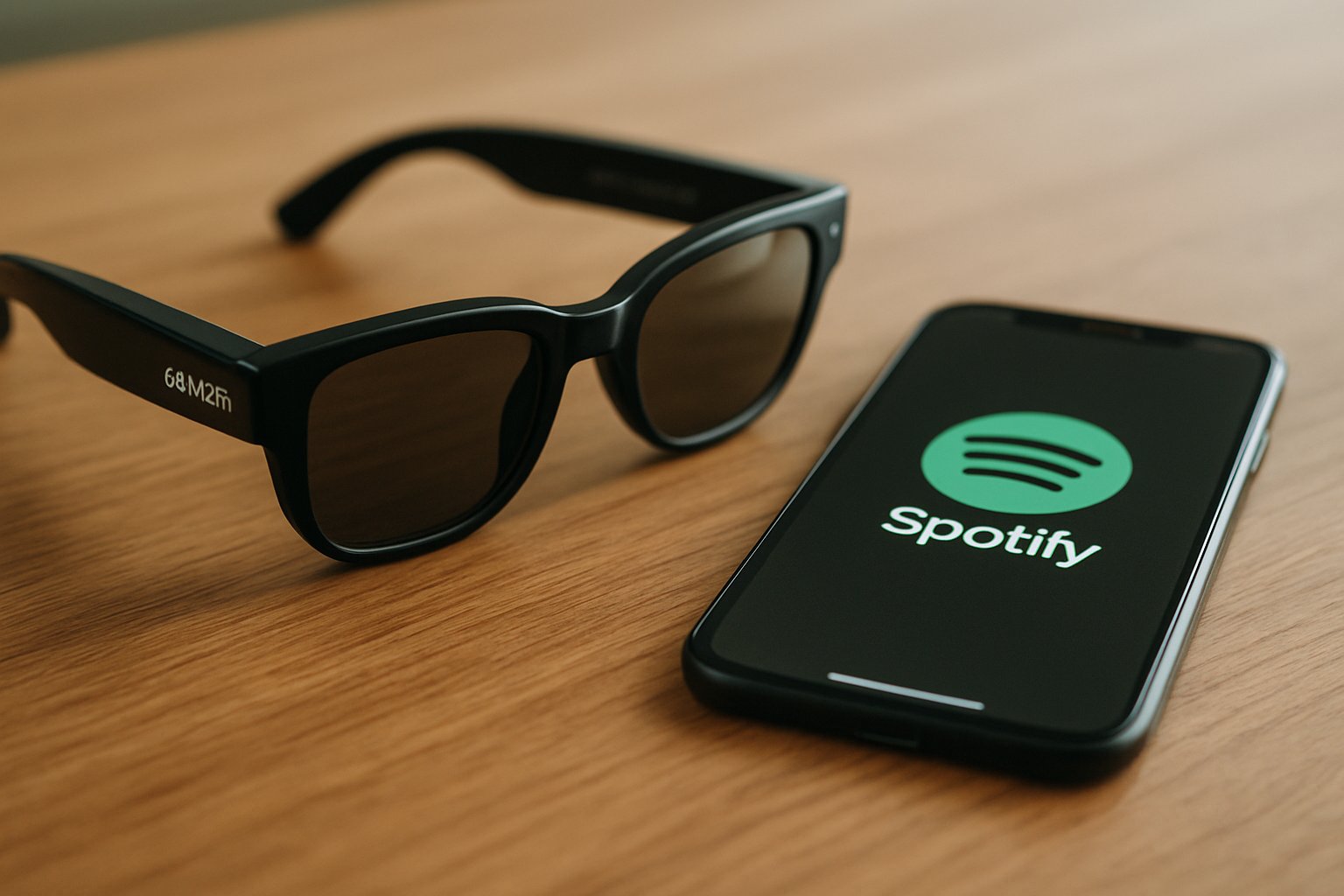
Meanwhile, the Spotify integration pairs Meta AI visual context with streaming controls. Look at a mural, ask the assistant, and matching music starts playing instantly. Consequently, Meta Smart Glasses blend situational Hearing Assistance with mood-aware entertainment.
The technical approach promises clarity without sacrificing awareness. In contrast, performance gains only matter when a market exists, which the next section explores.
Market Context And Demand
Statista valued the AR glasses market at roughly $6.3 billion in 2024, projecting growth through 2026. Therefore, Meta seeks to capture rising consumer interest before rivals mature offerings. Demand also stems from hearing-health realities. The Global Burden of Disease estimated 1.55 billion people living with some hearing loss in 2021. Consequently, consumer devices promising mild Hearing Assistance address a huge latent audience.
Key numbers underscore the commercial logic:
- December 16 2025: v21 announcement date.
- 19 regions receive the Spotify feature at launch.
- Hearing-aid market could reach $37.7 billion by 2030.
These figures reveal both revenue potential and social impact. Subsequently, we examine competitive pressure shaping Meta's roadmap.
Competitive Landscape Snapshot Today
Apple offers Conversation Boost on AirPods Pro and an FDA-registered Hearing Aid mode. In contrast, Nuance Audio and EssilorLuxottica plan OTC audio glasses approved by regulators earlier this year. Furthermore, Amazon and Google reportedly prototype similar multimodal eyewear.
Reviewers note that Meta Smart Glasses enjoy an advantage in seamless social media sharing. However, Apple remains stronger in personalized audio fitting and health branding. Competitive dynamics will intensify once Meta scales Conversation Focus globally.
Each rival brings distinct hardware strengths and regulatory positions. Nevertheless, practical value still hinges on user benefits, discussed next.
Benefits And Key Limitations
Conversation Focus offers discreet Hearing Assistance without the stigma linked to dedicated hearing aids. Moreover, users gain photography, calls, and Spotify playback in the same device. Pricing around $299-$379 undercuts many premium prescription aids.
However, the open-ear speaker design limits maximum gain and allows sound leakage. It also lacks audiogram-based tuning, so moderate or severe losses stay underserved. Furthermore, privacy advocates warn about constant microphones inside public spaces.
The trade-offs illustrate why education and professional guidance remain essential. Consequently, programs like the AI+ UX Designer™ teach designers to build inclusive products. Next, we address compliance and privacy.
Privacy And Regulatory Questions
Meta claims Conversation Focus processes audio locally, thereby avoiding cloud round-trips. Nevertheless, critics recall previous policy shifts that expanded data retention without granular consent. Regulators will scrutinize always-listening glasses more intensely than earbuds, because the camera adds complexity.
Meanwhile, the FDA's OTC pathway defines clear labeling rules for assistive audio claims. Meta has not announced plans to seek such authorization yet. Therefore, marketing language stays cautious, highlighting “situational clarity” rather than medical treatment.
Policy outcomes could reshape feature scope or data practices. Subsequently, testing and rollout milestones will determine real-world viability, covered in our final section.
Future Outlook And Testing
Independent labs have yet to publish speech-in-noise benchmarks for Meta Smart Glasses. Consequently, objective gains remain speculative until peer-reviewed data emerges. Meta promises broader distribution once Early Access feedback meets quality thresholds.
Analysts predict global rollout during the second half of 2026 alongside incremental AI model updates. Moreover, future firmware could integrate audiogram import or personalized gain maps. Such improvements would push Meta Smart Glasses deeper into health territory.
Roadmap visibility remains fluid yet promising. Therefore, professionals monitoring wearables should revisit metrics and regulations every quarter.
Meta Smart Glasses now amplify conversations, stream context-aware Spotify tracks, and snap photos within one familiar form factor. However, Meta Smart Glasses still require independent testing and clearer privacy assurances before health professionals can wholeheartedly recommend them. Nevertheless, early adopters confirm that situational Hearing Assistance delivers noticeable relief in noisy venues. Organizations innovating in UX, AI, or acoustics should monitor updates and experiment with Meta Smart Glasses prototypes. Further mastery is within reach; professionals can pursue the linked AI+ UX Designer™ certification to build inclusive products. Consequently, adopting Meta Smart Glasses early can position teams ahead in the multimodal wearables race.
Disclaimer: Some content may be AI-generated or assisted and is provided ‘as is’ for informational purposes only, without warranties of accuracy or completeness, and does not imply endorsement or affiliation.


