

AI CERTS
3 months ago
Medical Data AI Drives Konica Minolta’s Exa Platform Evolution
However, stakeholders still seek clarity on performance, validation, and total ownership cost.
This feature analysis explores how Medical Data AI underpins Exa’s latest architecture and market strategy.
Moreover, readers will learn where the platform excels, where risks remain, and which steps can maximize adoption.
Industry reports estimate the global PACS market at roughly USD 5.4 billion today, rising steadily toward 7.6 billion by 2033.
Therefore, vendors that harness disruptive cloud services and granular automation stand to capture outsized share.
Meanwhile, hospital executives demand interoperable solutions that streamline imaging archives, reduce clicks, and accelerate revenue cycles.
Exa’s refreshed modules target those pain points through native 3D tools, open APIs, and strategic partner tie-ins.
In contrast, earlier generation systems often forced radiologists to juggle separate viewers and manual data transfers.
Market Momentum Signals Rise
Global demand for flexible picture archiving remains vibrant. Additionally, analysts project mid-single-digit compound growth for cloud PACS through the next decade.
Reports cite 30-65 percent of new procurements shifting toward managed services rather than on-premises appliances.
Consequently, procurement teams now rank interoperability, predictable costs, and workload elasticity above legacy vendor familiarity.
Konica Minolta answered this trend by launching Exa Enterprise, hosted on AWS HealthImaging, in late 2024.
The release combined universal viewing, VNA consolidation, and partner connectivity into one subscription.
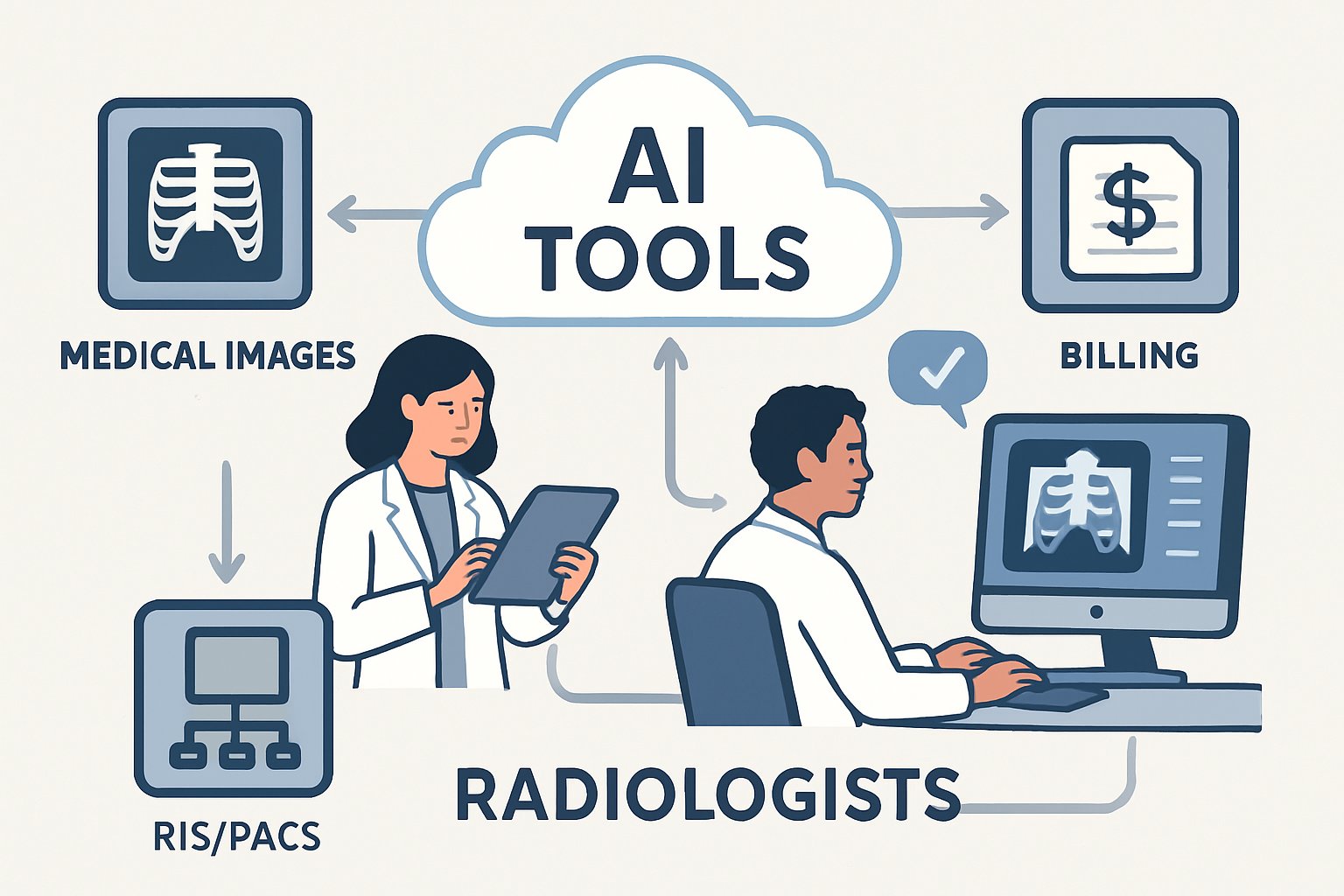
Crucially, the architecture places Medical Data AI tools alongside archives, letting algorithms scale with study volume.
Meanwhile, competitive benchmarks show many risk management suites lag on seamless cloud integrations and developer APIs.
Stronger cloud economics and open platforms are reshaping buyer priorities. However, execution complexity remains a deciding factor ahead.
These signals validate Exa’s cloud pivot. Subsequently, feature deeper dives reveal how Konica Minolta delivers on promises.
Platform Evolution Key Highlights
April 2025 delivered a marquee upgrade. Furthermore, Exa Advanced Imaging introduced native multi-planar reconstruction, 3D models, and segmentation inside the zero-footprint viewer.
Moreover, server-side rendering ensures mobile devices display heavy studies without choppy performance.
Integration depth matters for radiologists who previously bounced between proprietary 3D software and base ris pacs viewers.
Medical Data AI underlies the segmentation workflow, labeling structures, and forwarding results to reporting templates automatically.
Therefore, Medical Data AI shortens measurement steps and supports longitudinal comparison across follow-up exams.
The same release unveiled a redesigned API layer, exposing REST endpoints for study retrieval, task orchestration, and third-party analytics.
- Zero-footprint viewer with server rendering
- Advanced 3D, MPR, and segmentation
- REST and DICOMweb developer APIs
- Risk-aware audit logging defaults
Collectively, these features reshape the healthcare workflow by collapsing previously siloed steps into a single browser window.
The upgrade replaces multiple niche tools with one cohesive interface. Consequently, attention turns toward financial and operational outcomes.
Those outcomes become clearer when studying revenue cycle and workflow integrations, discussed next.
Cloud Architecture Core Benefits
Hosting Exa Enterprise on AWS HealthImaging brings elastic storage, regional redundancy, and simplified updates.
Additionally, object lifecycle policies automatically tier cold studies, controlling spend without manual archive management.
Universal viewer support lets cardiology, pathology, and radiology teams access consistent interfaces, reducing training overhead.
Consequently, cross-department collaboration improves, streamlining the healthcare workflow and minimizing duplicate image transfers.
Because compute bursts can scale instantly, Medical Data AI models no longer stall during peak reading hours.
Legacy ris pacs deployments often throttle throughput when high-resolution series arrive; serverless retrieval alleviates that choke point.
Nevertheless, buyers must validate encryption, access logging, and disaster protocols before migrating protected health data.
Cloud services offer speed and financial agility. Meanwhile, deeper integration depends on revenue cycle alignment, covered in the following section.
Workflow And Billing Synergy
February 2025 introduced ImagineOne integration, marrying Exa ris pacs data with automated billing algorithms.
Furthermore, charge capture, claim validation, and denial prevention now trigger inside the same reading pane.
Therefore, organizations experience fewer hand-offs, reducing revenue leakage and shortening days sales outstanding.
Medical Data AI surfaces context, such as exam indications and CPT suggestions, enabling real-time billing code validation.
By embedding finance checkpoints inside clinical screens, the healthcare workflow gains transparency for both radiologists and accountants.
- Projected 3-7 percent uplift in net collections
- Up to 20 percent faster claim submission
- Reduced manual rebilling touchpoints
Kevin Chlopecki summarized the move, noting increased revenues while decreasing costs for Exa customers.
Nevertheless, final billing outcomes depend on payer mix, coding accuracy, and training, factors still under study.
Financial automation strengthens the broader value proposition. Subsequently, attention shifts toward workforce challenges addressed by Exa Teleradiology.
Teleradiology Burnout Relief Focus
Distributed reading groups face high study volumes, staffing shortages, and irregular shift patterns.
Moreover, the May 2025 Exa Teleradiology launch, powered by NewVue, tackles those pain points.
The AI-curated worklist prioritizes critical exams and balances load across radiologists, promoting sustainable work hours.
Medical Data AI analyzes metadata, modality, and workload metrics before routing each case to the best available reader.
Consequently, urgent imaging findings surface sooner, potentially improving patient outcomes and hospital satisfaction scores.
This dynamic assignment further smooths the healthcare workflow, avoiding manual call trees during peak activity.
Early adopters report calmer shifts and faster turnaround.
However, governance considerations require equal attention, explored in the next section.
Governance And Risk Factors
Regulatory bodies urge hospitals to validate radiology algorithms continuously, tracking bias, drift, and technical faults.
In contrast, vendors seldom publish longitudinal performance data, leaving diligence tasks to procurement teams.
Therefore, buyers deploying Medical Data AI within Exa should request algorithm lineage, FDA clearance status, and monitoring dashboards.
Legacy ris pacs migrations also demand careful identity reconciliation and audit mapping to maintain legal record continuity.
Additionally, cloud feeds into billing and analytics increase the vendor roster, amplifying SLA management complexity.
Nevertheless, structured governance committees can align security, healthcare workflow, and change management for smoother rollouts.
Professionals can enhance their expertise with the AI Learning & Development™ certification, which covers AI safety and deployment governance.
Risk mitigation must accompany innovation to sustain trust. Subsequently, strategic recommendations finalize the analysis.
Actionable Insights
Konica Minolta’s Exa platform exemplifies how Medical Data AI, open APIs, and cloud engines can modernize diagnostic operations.
Because Medical Data AI powers segmentation, prioritization, and revenue integrity, stakeholders gain clinical and commercial benefits.
Furthermore, new visualization capabilities reduce system switching, while automated billing routines protect margins.
Nevertheless, careful governance, security audits, and continuous algorithm validation remain essential for sustained trust.
Organizations ready to modernize should pilot Exa modules with clear metrics, then cultivate staff expertise through targeted credentials.
Start evaluating your roadmap today and empower teams with advanced certifications to capture the full value of AI-driven radiology.


