

AI CERTs
3 months ago
Medical coding automation systems speed revenue cycles
Hospitals face shrinking margins and mounting claims denials. Consequently, leaders are targeting speed inside the revenue cycle. Many now pilot medical coding automation systems that promise near-instant code assignment. These platforms embed natural language processing and machine learning within electronic health records. Moreover, vendors claim faster claim submission, higher cash collections, and fewer payer rejections. Independent analysts note adoption accelerated during 2024 and 2025. However, regulatory auditors are also upgrading their own technology. Therefore, hospitals must weigh productivity gains against oversight demands. This article unpacks market signals, measurable outcomes, and prudent implementation tactics. Readers will gain actionable insights for investing safely in next-generation coding automation. Additionally, we spotlight certification paths that strengthen workforce readiness. Consequently, organizations can align innovation with rigorous compliance accuracy goals.
Healthcare Billing AI Shift
Market analysts forecast robust growth for healthcare billing AI and autonomous coding through 2030. ResearchAndMarkets attributes the trend to hospitals migrating from legacy CAC to real-time engines. Moreover, its 2025 report links autonomous coding to a projected $272.8 billion RCM market. In contrast, traditional manual workflows struggle with staffing gaps and volatile payer rules. Vendors such as 3M, CodaMetrix, and Nym introduced upgrades that embed algorithms inside EHR interfaces. Consequently, clinicians receive code suggestions during documentation, accelerating downstream billing. Many early adopters report 40-70% shorter chart turnaround times and improved first-pass acceptance rates. These claims, while impressive, remain mostly vendor supplied. Nevertheless, momentum appears genuine when viewed across multiple announcements and purchase disclosures. Continued press coverage shows chief financial officers allocating new budget toward medical coding automation systems. Overall, billing AI momentum is reshaping revenue operations. However, outcome validation requires deeper data, which we examine next.
Operational Gains Observed Widely
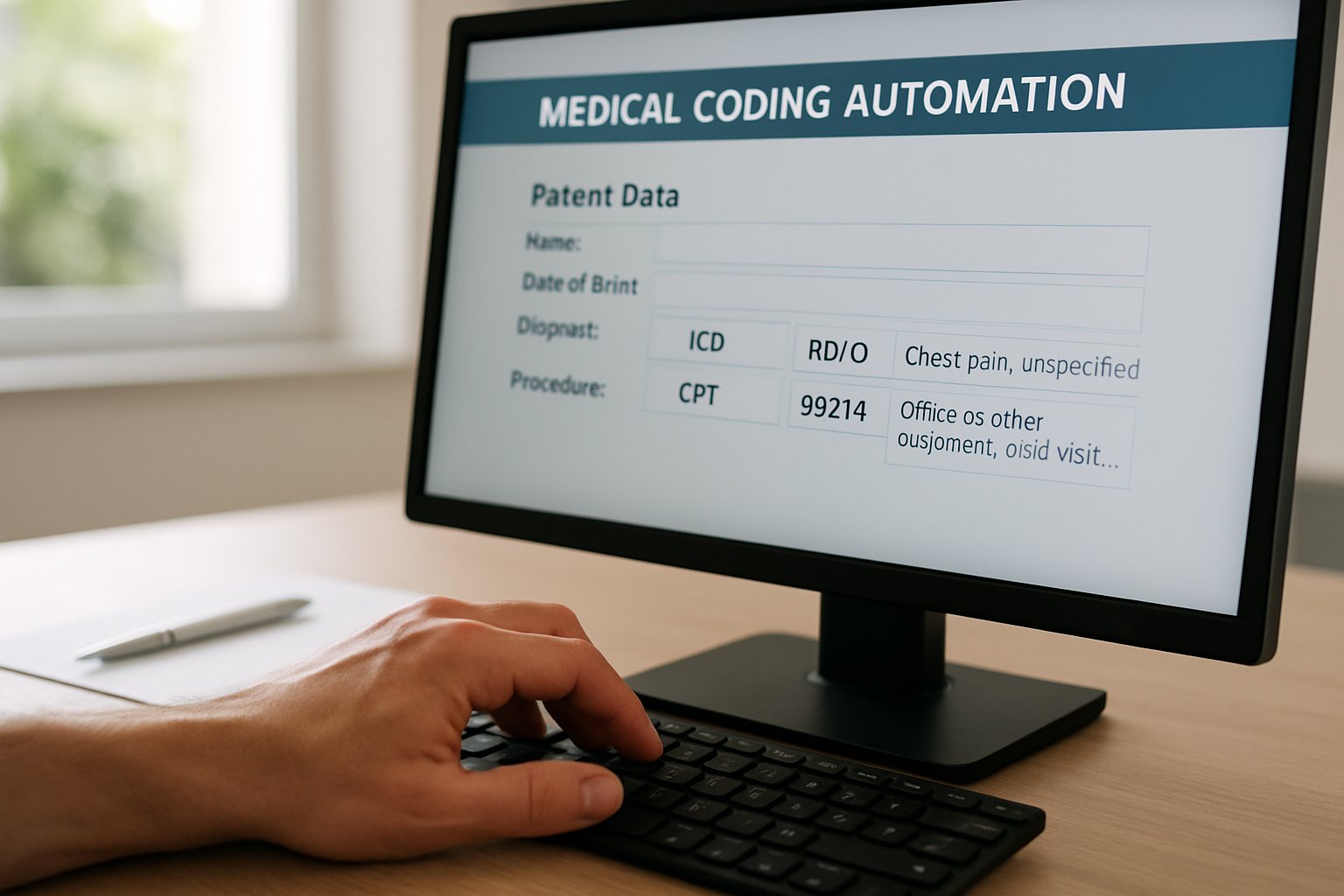
Provider case studies highlight tangible speed and revenue benefits. Arintra clients experienced 12% fewer A/R days and 43% reduced denials. Meanwhile, Omega Healthcare processed 100 million transactions using RPA plus AI, halving document turnaround. Zotec cites 70% touchless coding at 96% accuracy, producing three percent extra charge capture. Furthermore, 3M’s investor filings mention coder productivity gains of up to sevenfold. These numbers emerge when medical coding automation systems handle routine encounters without manual delay. Productivity frees coders for complex charts, audit preparation, and compliance accuracy reviews. Hospitals also report labor savings that offset subscription fees within months. Nevertheless, experts warn averages mask specialty variation, documentation quality, and payer mix effects. Consequently, leaders should benchmark critical metrics before and after deployment. The evidence suggests real operational lift, yet requires disciplined measurement. Therefore, we now dissect the metrics executives must monitor continuously.
Critical Metrics Checklist Guide
- Days in A/R
- First-pass acceptance rate
- Denial rate by category
- Coder productivity hours
- Net revenue capture
Tracking these indicators provides an objective foundation for ROI discussions. Consequently, organizations can adjust workflows before negative patterns emerge.
Risk Governance Imperatives Emerge
Greater automation invites heightened scrutiny from regulators and payers. CMS expanded RADV audits in 2025 and signaled technology-driven record reviews. Moreover, legal advisers warn that overreliance on algorithms can jeopardize compliance accuracy during audits. Becker’s analysts emphasize humans must remain in the oversight loop. In contrast, fully autonomous deployments without thresholds risk overcoding or missed documentation. Therefore, hospitals often configure confidence levels requiring coder validation below 95% certainty. Governance committees monitor model drift, payer edit changes, and documentation gaps weekly. Additionally, detailed audit logs help defend medical coding automation systems under external review. Organizations should align algorithm updates with change-management protocols and HIPAA safeguards. Subsequently, robust governance reinforces trust while preserving automation speed. Strong governance balances velocity with defensibility. Next, we outline vendor and implementation steps to operationalize that balance.
Implementation Best Practice Steps
Selecting partners requires evaluating performance, integration, and support breadth. Major platforms like 3M 360 Encompass, Optum, and Change offer embedded engines. Meanwhile, AI-native players such as CodaMetrix, Aidéo, and Nym compete on specialty automation depth. Healthcare billing AI market comparisons from KLAS provide independent perspective on vendor reliability. Nevertheless, purchase decisions should prioritize measurable outcomes over marketing narratives.
Key Vendors Landscape Highlights
- 3M: Integrated NLP coding within large EHR footprints
- CodaMetrix: High touchless rates in radiology
- Nym: Emergency medicine specialization
- Aidéo: Cloud-native platform for mid-size groups
- UiPath: RPA layer supporting document workflows
Each vendor claims distinctive strengths yet still depends on sound client governance. Furthermore, reference checks with peer institutions reveal practical deployment lessons. Medical coding automation systems also require skilled analysts to tune payer rules continuously. Professionals can sharpen skills through the AI+ Cloud™ certification. Certified staff bolster compliance accuracy and support continuous model retraining. Effective vendor alignment plus skilled staff accelerate time to value. Consequently, measuring progress demands the structured checklist discussed below.
Future Outlook And Research
Independent studies lag behind vendor publicity. However, KLAS and HFMA researchers plan wider surveys of medical coding automation systems across specialties. Academic consortia are designing multi-center trials comparing human coders, CAC tools, and autonomous engines. Meanwhile, healthcare billing AI vendors are opening limited sandboxes for third-party validation. Researchers expect findings on denial reductions, revenue lift, and workflow satisfaction by late 2026. Moreover, policymakers may release guidance harmonizing automation practices with evolving RADV protocols. Until then, executives should publish before-and-after datasets to encourage market transparency. Medical coding automation systems will likely integrate generative summarization and predictive denial prevention next year. Consequently, continuous monitoring frameworks must evolve alongside algorithm complexity. Healthcare billing AI momentum will persist as reimbursement pressures intensify. Nevertheless, evidence-based procurement remains the safest path forward. Emerging research will clarify ROI ranges and risk factors. Therefore, decision makers should watch forthcoming peer-reviewed results.
Real-time medical coding automation systems are transitioning from hype to measurable impact. Providers adopting these medical coding automation systems report faster cash flow and stronger audit readiness. However, leaders succeed only when governance, metrics, and skilled teams accompany technology. Continuous benchmarking safeguards compliance accuracy while preserving speed. Consequently, organizations should pilot with tight feedback loops, then scale confidently. Additionally, workforce upskilling through the AI+ Cloud™ certification accelerates maturity. Future regulation will likely favor transparent medical coding automation systems with auditable decision paths. Therefore, now is the moment to explore, validate, and deploy responsibly. Visit our resources page and begin your automation readiness journey today.


