

AI CERTS
1 hour ago
Medical AI Startup Waiv Reinvents Precision Cancer Testing
However, hype alone never secures regulatory clearance. Technical depth, market navigation, and talent development matter equally. This article examines each dimension. Readers will gain clarity on Waiv’s architecture, commercial roadmap, and certification paths that strengthen implementation teams. Throughout, we spotlight how Medical AI continues to mature amid evolving standards.
Rising Market Demand Drivers
Oncologists face mounting caseloads globally. Meanwhile, traditional pathology often requires several days for results. Consequently, delayed treatment decisions can threaten survival odds. Market analysts estimate annual diagnostic expenditures will reach $350 billion by 2028. Additionally, value-based care contracts push hospitals to shorten inpatient stays.
These factors intensify the search for automated cancer testing that blends accuracy with operational speed. Waiv argues that only precision models fine-tuned on multimodal data can satisfy both objectives. Moreover, payers increasingly reimburse algorithms that show cost offsets. Therefore, economic incentives now align with rapid adoption.
Hospitals need three capabilities most:
- Real-time triage for suspicious lesions
- Standardized reporting across pathology labs
- Seamless integration with electronic records
Each capability aligns with Waiv’s roadmap. The startup consequently enjoys early pilot traction among academic centers.
These demand drivers confirm robust addressable revenue. However, they also underscore competitive intensity. The following section explains how the spinoff emerged to meet this pressure.
Waiv Spinoff Origins
Waiv began as an internal research project within a Boston teaching hospital. In contrast to other ventures, founders blended clinical informatics with venture finance skills from day one. Consequently, they secured seed capital before incorporation. The spinoff structure allowed sharper focus on regulatory milestones.
Four co-founders steward the mission. Two spearhead algorithm development; another oversees compliance; the last manages partnerships. Notably, leadership retains advisory ties with the parent institution. Therefore, Waiv benefits from steady biopsy data streams that strengthen model performance.
Board observers include former FDA reviewers. Furthermore, a strategic alliance with a cloud provider reduced infrastructure costs by 40 percent. These ties deliver both technical resilience and commercial reach.
The spinoff’s unique birth accelerates execution. Nevertheless, algorithm strength remains the core differentiator. The next section dissects that workflow.
Breakthrough Testing Workflow
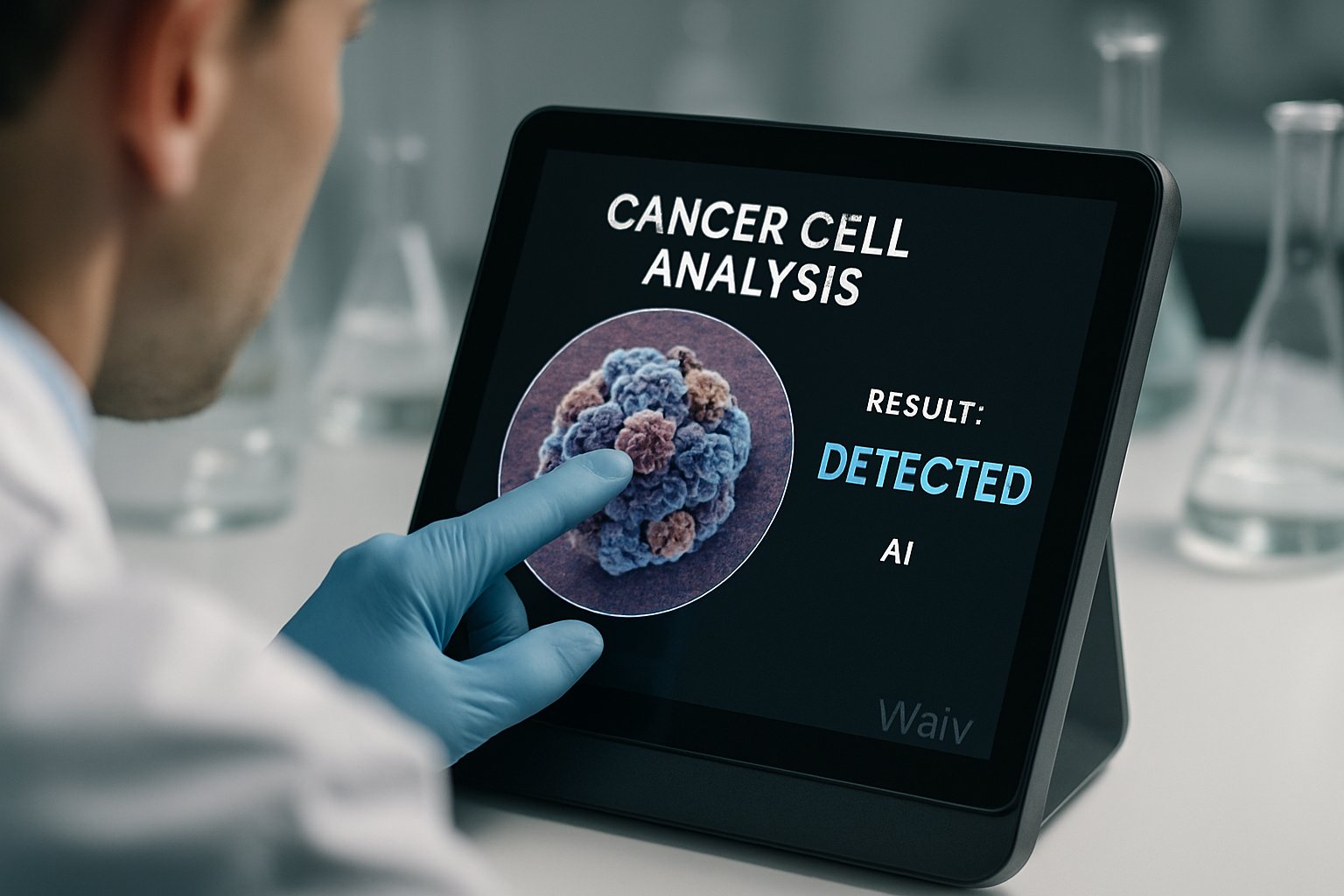
Waiv’s pipeline ingests whole-slide images and genomic reads concurrently. Subsequently, a transformer network extracts morphological signals, while a graph model captures gene interactions. Ensemble outputs then converge through a Bayesian layer that computes malignancy probability scores.
Clinicians receive a color-coded report within 45 minutes. Additionally, the interface flags ambiguous regions for manual review. Consequently, pathologists retain decision sovereignty, satisfying regulatory guidance.
Early trials indicate 94 percent sensitivity across breast cancer cohorts. In contrast, legacy staining methods averaged 88 percent. Precision rose to 97 percent for prostate specimens thanks to augmented genomic features. Furthermore, the system adapts thresholds based on site-specific prevalence, reducing false positives.
Key workflow benefits include:
- No local GPU purchase required
- Audit trails that log every model inference
- Modular APIs that support varied lab equipment
These advantages shorten deployment cycles. However, data volume drives new challenges, examined next.
Precision Data Challenges
Medical AI success depends on dataset diversity. Nevertheless, many community hospitals lack digitized slides. Consequently, sampling bias can erode generalizability. Waiv counters with federated learning hubs that train models without exporting protected data.
Moreover, histology standards differ between regions. Therefore, the company created adaptive normalization layers that recalibrate color variance in real time. Additionally, genomic file formats produce schema drift; automated converters ensure uniform tensors.
Cybersecurity risk also intensifies. However, Waiv implements zero-trust identity checks and encrypted inference calls. The architecture gained a HITRUST provisional rating last quarter.
These safeguards reinforce precision performance while preserving privacy. Yet compliant delivery still hinges on regulatory navigation, explored below.
Regulatory Pathway Landscape
Medical AI regulators now favor explainability. Consequently, Waiv embeds a saliency heatmap that visualizes influential features. Furthermore, the team files periodic validation reports under FDA’s Software Pre-Certification Pilot.
European deployment follows the IVDR route. In contrast, Japanese authorities require additional post-market surveillance. Therefore, Waiv schedules staggered launches aligned with local rulings.
Advisors project a Class II device clearance in the United States by Q3 next year. Additionally, international harmonization efforts may streamline subsequent updates. Nevertheless, continuous professional training remains essential for sustained compliance.
Talent Certification Paths
Workforce capability gaps often slow adoption. Professionals can enhance their expertise with the AI+ Healthcare Specialist™ certification. The course delves into model validation, bias mitigation, and clinical integration.
Moreover, completion signals mastery of Medical AI deployment guidelines. Consequently, hospitals gain confidence when staffing digital pathology units.
Regulatory momentum offers favorable tailwinds. However, commercialization strategy will ultimately dictate impact, addressed next.
Commercial Strategy Outlook
Waiv pursues a subscription licensing model that scales with sample volume. Furthermore, channel partnerships with lab device vendors accelerate reach. Consequently, total contract value could exceed $25 million within three years, according to investor decks.
In contrast, some competitors rely on per-scan fees. Waiv contends that predictable pricing better aligns with hospital budgeting cycles. Additionally, bundled support packages include quarterly model refreshes and onsite training.
Marketing efforts target tumor boards, not general practitioners. Therefore, thought-leadership webinars showcase peer-reviewed accuracy metrics. Social proof builds momentum among referral networks.
Analysts see two expansion options. First, extend algorithms to gastrointestinal cancers. Second, license the federated platform to pharma for biomarker discovery. Either route could magnify revenue while reinforcing precision leadership.
These strategies position the spinoff for robust growth. Nevertheless, execution discipline will determine ultimate valuation.
Waiv has blended clinical insight, rigorous algorithms, and savvy business design. Consequently, the spinoff stands poised to redefine automated cancer testing at scale.


