

AI CERTS
4 months ago
Market Assessment: Gartner’s Top AI Vendor Frontrunners Ranked
The report also clarifies which challengers dominate across cloud, chip, and platform segments. In contrast, several niche providers accelerated innovation yet remained outside the leadership column. This article unpacks the data, framing critical trends, risks, and buying guidance. Additionally, we connect findings to practical upskilling paths, including a respected AI marketing certification. Readers will exit with an actionable perspective on the unfolding AI Vendor Race. Therefore, align your strategic roadmap with the insights detailed below. Meanwhile, stay alert to rapid regulatory and technical shifts shaping tomorrow's competitive field. Nevertheless, disciplined governance remains essential regardless of vendor promises.
Gartner Report Highlights
Gartner aggregated data from Magic Quadrants, Hype Cycles, and Digital Markets leaderboards. Consequently, the research covers performance indicators across model quality, revenue, and customer traction. The resulting Market Assessment synthesizes 1,200 client inquiries logged during the past year. Moreover, analyst surveys captured executive sentiment on deployment pain points and desired Solutions. Data triangulation produced a short list of 15 frontrunners spanning infrastructure, platforms, and business applications.
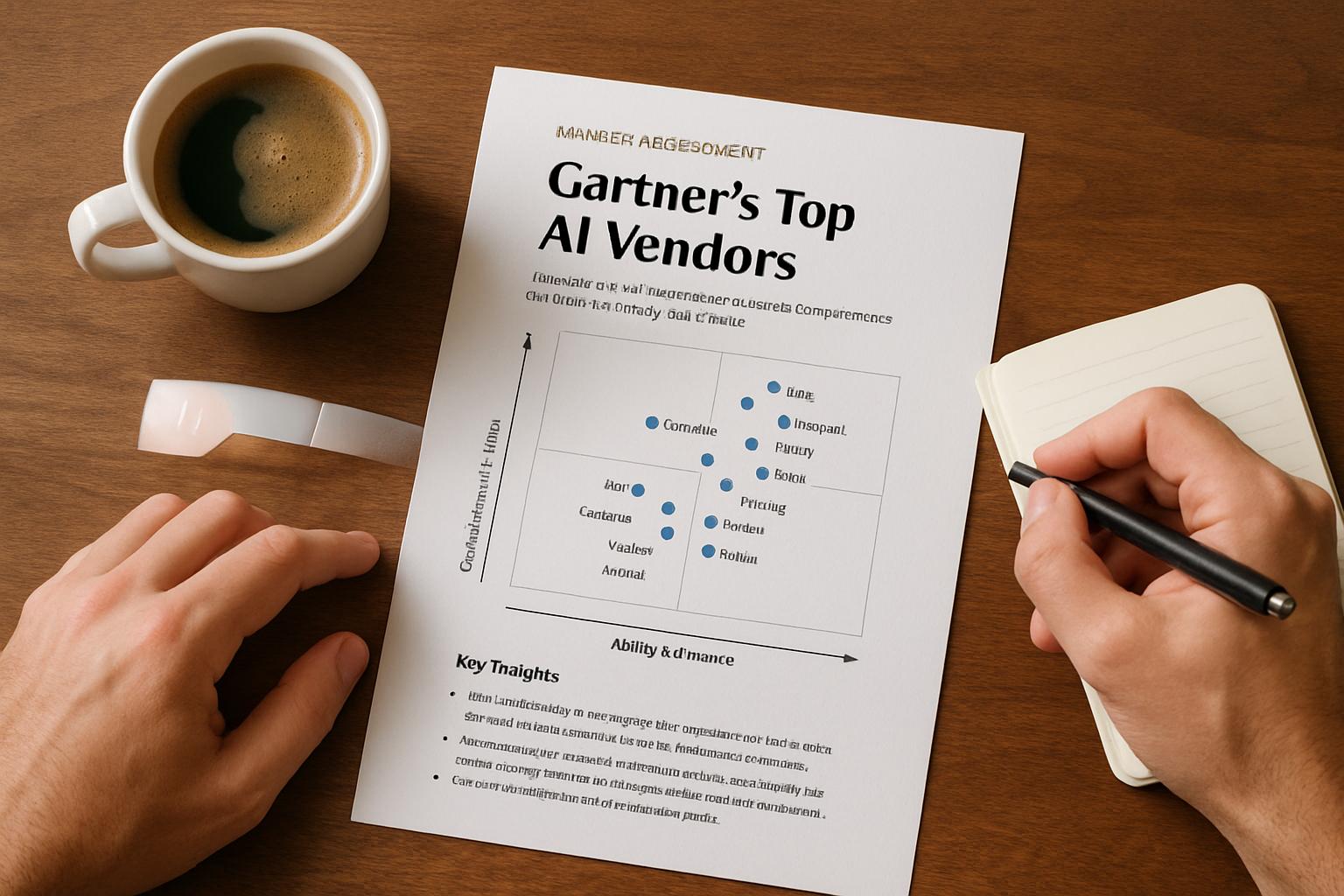
Among cloud hyperscalers, Microsoft, AWS, and Google secured leadership thanks to integrated Ecosystem breadth. Meanwhile, Nvidia emerged dominant in silicon acceleration, reflecting unrivaled Technical Capability in GPU design. OpenAI, Anthropic, and Cohere topped foundation model charts despite revenue immaturity. Additionally, ServiceNow and Salesforce led packaged AI Solutions targeting specific enterprise workflows. These findings underscore Gartner's assessment rigor and reveal clear Companies to Beat this fiscal cycle.
The Market Assessment fuses multiple lenses to surface consistent performance signals. However, deeper criteria explain why certain vendors outrank peers. Subsequently, we examine those criteria in detail.
Frontrunner Selection Criteria
Gartner weighted four pillars to finalize the leaderboard. Firstly, Technical Capability accounted for algorithm performance, data governance, and model interpretability. Secondly, Ecosystem strength measured partner integrations, marketplace reach, and API openness. Thirdly, operational resilience evaluated uptime, compliance audits, and incident response maturity. Finally, business momentum focused on revenue growth and renewal rates.
Moreover, the Market Assessment applied penalty weights for opaque model usage policies. Consequently, vendors without published responsible AI frameworks slipped below the leadership line. In contrast, Microsoft gained points for proactive red teaming and customer co-innovation programs. Meanwhile, smaller startups excelled in niche offerings yet lacked scale metrics. Therefore, buyers must align risk tolerance with each vendor's documented guardrails.
Criteria clarity empowers procurement teams to justify shortlist decisions. Nevertheless, the Vendor Race remains fluid as capabilities evolve. The next section groups vendors into strategic clusters.
Key Vendor Clusters
Gartner categorized frontrunners into three functional clusters for clearer benchmarking. Infrastructure Enablers include AWS, Google Cloud, and Microsoft Azure. Additionally, Nvidia anchors this cluster by providing dominant training accelerators. Consequently, these firms influence cost curves and architecture patterns across the wider Ecosystem. Procurement teams often negotiate multiproduct bundles to maximize discount leverage.
Model Innovators comprise OpenAI, Anthropic, Cohere, and Stability AI. Moreover, several enterprises treat them as CoE partners for advanced language Solutions. However, volatile licensing terms add ownership uncertainty during proof-of-concept stages. Therefore, governance teams insist on indemnity clauses before proceeding. Subscription flexibility remains the Companies to Beat benchmark within this cluster.
Application Accelerators include ServiceNow, Salesforce, Adobe, and HubSpot. These vendors embed AI into domain workflows, hiding most Technical Capability details from end users. Meanwhile, packaged dashboards deliver quick productivity wins with minimal configuration. In contrast, customization depth remains shallower than platform offerings from hyperscalers. Nevertheless, time-to-value keeps them prominent during any Market Assessment.
Cluster mapping sharpens negotiation leverage and deployment planning. Subsequently, competitive dynamics reveal how leadership could change. We explore those dynamics next.
Competitive Landscape Shifts
Pricing pressure intensified as additional chip vendors entered the Vendor Race. For example, AMD's MI300 accelerators challenge Nvidia on both throughput and cost. Consequently, hyperscalers now pursue multi-vendor silicon strategies to hedge supply constraints. Moreover, open-source model releases from Meta and Mistral accelerate commoditization trends. These forces could reorder Companies to Beat rankings within six quarters.
Regulatory scrutiny also shapes momentum. The EU AI Act demands transparent model documentation and risk classification. Therefore, vendors with mature compliance tooling enjoy a defensible advantage. Meanwhile, smaller start-ups stretch legal budgets to maintain pace. Gartner's Market Assessment models these costs when updating forecasts.
- Revenue growth rate over trailing four quarters.
- Number of certified implementation partners worldwide.
- Average inference cost per thousand tokens.
- Percentage of roadmap delivered on schedule.
Competitive shifts reward adaptable operating models and diversified partnerships. However, buyers still need structured evaluation guidance. The following section delivers that guidance.
Strategic Buyer Guidance
CIOs should begin with a fresh Market Assessment aligned to internal value streams. Subsequently, score vendors using Gartner criteria plus domain-specific benchmarks. Additionally, validate Technical Capability claims through pilot projects and third-party audits. Demand detailed throughput metrics instead of generic performance adjectives. Involve finance early to model subscription escalators and potential overage penalties.
Cross-functional teams must evaluate Ecosystem compatibility, especially data integration overhead. Moreover, review roadmap alignment to avoid redundant Solutions already licensed elsewhere. Nevertheless, avoid vendor lock-in by prioritizing portable model formats and open APIs. Consequently, negotiation leverage improves as providers compete for reference logos. Professionals can deepen credibility with the AI Marketing Strategist™ certification.
- Define success metrics tied to revenue or cost reduction.
- Run sandbox experiments using anonymized datasets.
- Document risk mitigations within governance charters.
- Negotiate exit clauses before production deployment.
Disciplined process shortens deployment cycles and limits downstream regrets. Consequently, leadership can redirect savings into further innovation. We conclude with forward-looking trends.
Future Outlook Trends
Gartner anticipates quarterly refreshes of the Market Assessment as velocity increases. Moreover, multi-agent orchestration tools will create new Solutions categories by mid-2025. Open telemetry standards should mature, easing Ecosystem integration headaches. Meanwhile, capital markets expect consolidation among mid-tier Model Innovators. Therefore, acquisition watchlists become critical for tracking Companies to Beat evolution.
Technical Capability gaps will shrink as open-source libraries propagate advanced optimizations. Nevertheless, data privacy regulation could reset competitive baselines overnight. In contrast, vendors with federated learning roadmaps appear insulated from such shocks. Consequently, buyers should embed scenario planning within annual strategy offsites. Periodic Market Assessment cycles keep assumptions current and defensible.
The future favors agile organizations that institutionalize continuous learning. Subsequently, certified talent will differentiate those organizations.
Conclusion And Next Steps
Gartner's evidence-based Market Assessment equips leaders to navigate an accelerating AI Vendor Race. Key criteria span Technical Capability, Ecosystem alignment, and business momentum. Moreover, Companies to Beat may shift as pricing, regulation, and consolidation unfold. Therefore, update internal scorecards quarterly and test Solutions before scale commitments. Meanwhile, cross-skill your workforce to maintain negotiation leverage and governance rigor. Professionals can prove readiness through the AI Marketing Strategist™ certification. Consequently, organizations amplify execution velocity while mitigating strategic risk. Explore the full Gartner report and deepen skills today.


