

AI CERTS
3 months ago
LLM Temporal Limitations Expose AI Time-Telling Flaws
This article unpacks why the gap exists, how researchers measure progress, and which fixes look most promising.
Why Time Queries Fail
ChatGPT often refuses or guesses when asked for the exact time. In contrast, Gemini or Copilot usually answers correctly. Consequently, users wonder why capabilities differ. OpenAI explains that models lack a built-in system clock. Therefore, they must call external tools to fetch live data. Whether that call triggers depends on the configuration, leading to inconsistency. Pasquale Minervini notes that giving clock access solves the problem instantly. Nevertheless, many ChatGPT sessions run without such tools, exposing one facet of LLM Temporal Limitations.
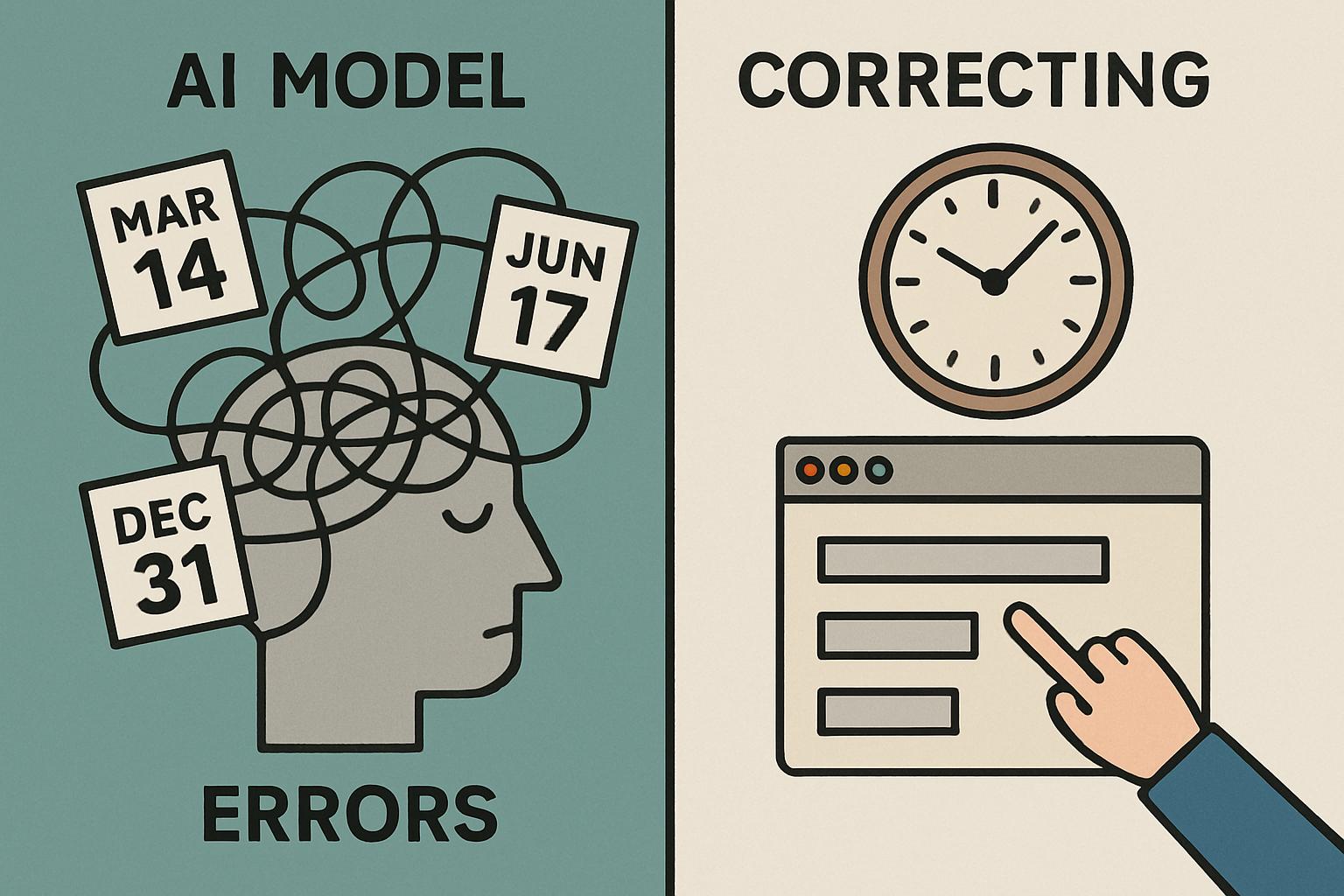
Two issues emerge. First, no intrinsic temporal signal flows into model tokens. Second, tool calling is nondeterministic, producing unpredictable behaviour. These issues reduce perceived accuracy and erode confidence. Understanding the underlying mechanics sets the stage for deeper analysis. However, we must also study how token limits influence design choices.
Context Window Token Tradeoffs
Large language models process conversation inside a finite context window. Each extra token consumes scarce space and compute. Consequently, repeatedly inserting “12:01 PM” wastes capacity that could support reasoning. Researchers warn that token clutter can trigger hallucinations because the network overfits recent noise. In contrast, framing time as a callable function keeps the window clean.
Furthermore, engineers debate the optimal frequency for time updates. Some propose injecting time every minute. Others prefer on-demand calls only when queries arise. Each strategy balances accuracy against cost. These design tensions illustrate another layer of LLM Temporal Limitations that product teams must navigate.
These challenges highlight critical gaps. Nevertheless, practical tool integrations can mitigate many tradeoffs.
System Clock Access Integration
Assistants that expose a system clock sidestep the timing puzzle. Google’s ADK tutorial shows a simple function returning current_time. Consequently, Gemini responds with precise local time without bloating its context window. Meanwhile, Grok and Copilot follow similar patterns.
- Gemini: deterministic clock API call
- Grok: host-time injection at session start
- ChatGPT: optional web search tool, nondeterministic
- Claude: similar behaviour to ChatGPT, often refusing
Pasquale Minervini summarises the contrast: “It’s able to tell the time if you give it access to a clock.” Therefore, integration choices determine visible capability. However, granting external access expands the attack surface and heightens privacy concerns. Security teams must harden endpoints and monitor for prompt injection. Consequently, organisations tread carefully while enhancing accuracy.
System clock tools solve immediate needs. Yet, deeper research aims to improve genuine temporal understanding beyond simple timestamp retrieval.
Research Benchmarks Show Advance
Academic groups push temporal reasoning forward. TimeMaster reports a 14.6 percent gain over classical models on its TimerBed benchmark. Moreover, its approach surpasses few-shot GPT-4o by 7.3 percent. Similarly, Time-R1 shows a 3B model beating one 200 times larger on temporal prediction tasks. These studies tackle ordering, duration, and forecasting, not live time reporting. Nevertheless, they chip away at core LLM Temporal Limitations.
Researchers use reinforcement learning curricula, timeline self-reflection, and synthetic datasets. Consequently, models learn to anchor events along explicit axes, reducing hallucinations. However, deployment remains experimental. Compute costs, latency, and safety reviews still block production rollout. Therefore, industry observers anticipate gradual adoption over 2026.
The data underscores real momentum. Yet, bridging lab gains to consumer chatbots requires careful engineering, which brings us to risk management.
Mitigating Hallucinations Risk Factors
When models guess time without a system clock, errors appear as confident statements. Such hallucinations damage trust more than refusals. Consequently, many platforms default to “I’m sorry, I don’t know.” Additionally, combining live data with stronger temporal reasoning cuts misstatements further. However, developers must still balance transparency with usability.
Moreover, injecting external data increases context complexity, which can cascade into other errors. Engineering teams therefore isolate time APIs and label tool responses explicitly. These controls preserve accuracy while lowering security risk. The process exemplifies how addressing one dimension of LLM Temporal Limitations can influence overall system quality.
Risk mitigation improves reliability. Consequently, product roadmaps now include structured tool calls and clearer user messaging.
Practical Implementation Paths Ahead
Several practical steps can enhance assistant time responses today. Firstly, integrate a deterministic clock function inside the agent framework. Secondly, trigger that function only on explicit user queries to reduce context window load. Thirdly, display provenance so users know the answer came from live data. Finally, log failures and monitor tool latency to maintain high accuracy.
OpenAI has acknowledged gaps but shared no public timeline for fixes. Meanwhile, enterprises building private copilots can implement their own tools immediately. Consequently, they avoid user frustration caused by unresolved LLM Temporal Limitations.
These measures close urgent gaps. However, professionals also seek skills to design and audit such integrations effectively.
Upskilling Paths For Professionals
AI product managers, data scientists, and solution architects need fluency in temporal reasoning tradeoffs. Furthermore, marketing leaders must understand limitations to set realistic expectations. Professionals can enhance their expertise with the AI Marketing Strategist™ certification. The program covers agent design patterns, safety controls, and measurement frameworks that reduce hallucinations while improving accuracy.
Moreover, it teaches practical mitigation strategies for system clock integrations and context window management. Consequently, graduates drive more trustworthy AI deployments. By mastering these techniques, they help organisations overcome persistent LLM Temporal Limitations.
Upskilling aligns talent with evolving benchmarks. Therefore, it ensures future products deliver dependable experiences despite shifting constraints.
These insights illustrate the path forward. Subsequently, a strategic skill investment prepares teams for next-generation assistants.
Conclusion: ChatGPT’s time-telling hiccups reveal systemic LLM Temporal Limitations affecting many assistants. However, deterministic clock tools, smarter context window policies, and advancing research all point toward solutions. Moreover, structured risk controls curb hallucinations and improve accuracy. Consequently, organisations must combine engineering fixes with workforce upskilling. Ready to lead that change? Explore specialized training and start strengthening your AI roadmap today.


