

AI CERTs
2 hours ago
Kioxia Taps New CEO to Navigate AI-Fueled Memory Boom
Investors watching the semiconductor sector received fresh news this week. On 28 January 2026, Japanese maker Kioxia announced a leadership transition aimed at capturing the AI updraft. Executive Vice President Hiroo Oota will succeed long-time chief Nobuo Hayasaka after shareholder approval in June. The decision arrives while demand for enterprise Flash Memory soars as hyperscalers feed large language models. Consequently, NAND prices are climbing, and suppliers enjoy rare pricing power. Analysts already describe the environment as a potential multiyear supercycle. However, memory markets remain volatile, and timing investments becomes critical. This article explores why the CEO change matters, how AI reshapes storage economics, and what challenges remain. Moreover, readers will gain data-driven insight and practical certification guidance to navigate the evolving landscape.
Leadership Shift Timing Now
Corporate governance announcements rarely move memory stocks dramatically. Nevertheless, shares rose about two percent after Bloomberg broke the promotion story. Observers saw symbolism rather than surprise. Furthermore, 63-year-old Oota has spent decades negotiating with data-center customers. Omdia analyst Akira Minamikawa noted that CEOs must be “on the front lines” during boom cycles. Therefore, installing a sales-savvy chief before expansion accelerates appears logical. Tokyo analysts applauded the board’s proactive stance. In contrast, previous transitions typically occurred after downturns, not during booms. Kioxia leadership framed the move as positioning for “the next growth chapter” driven by AI storage. Hayasaka will shift into an advisory role, ensuring institutional memory stays intact. Subsequently, investors can expect more frequent customer engagements and quicker commercial decisions.
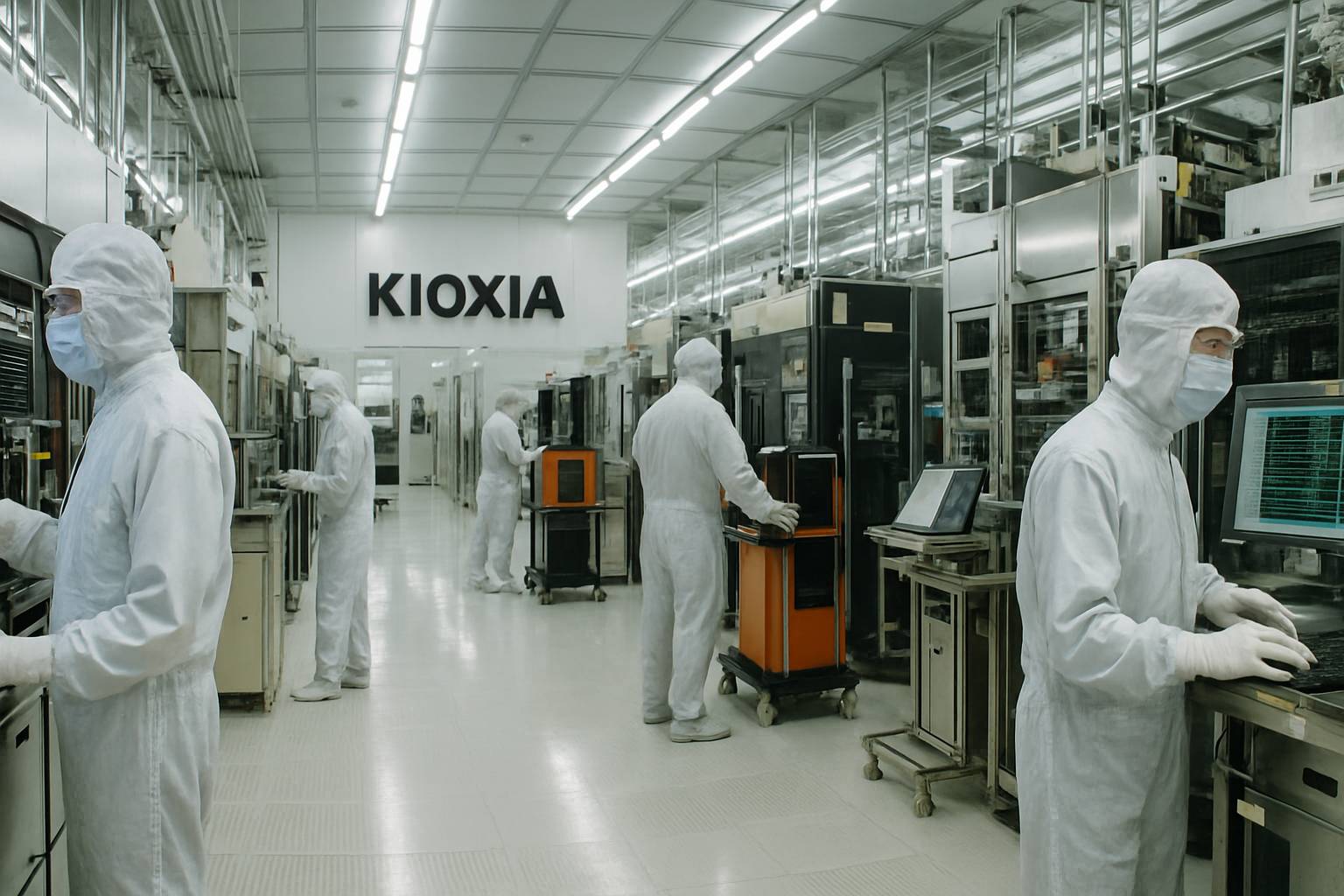
The leadership refresh signals urgency and market focus. Consequently, strategy execution speed should improve as AI demand intensifies. Meanwhile, broader industry forces amplify the importance of that agility.
AI Demand Supercycle Explained
Chatbots and generative services require massive parameter storage. Consequently, enterprises are buying unprecedented quantities of high-capacity SSDs. TrendForce’s 14 January 2026 bulletin reported contract NAND prices jumping up to sixty percent since mid-2025. In contrast, consumer device shipments remain subdued, shifting supply toward datacenter mixes.
Key Market Statistics Today
Several numbers highlight the scale of the swing.
- Q3 2025: Kioxia revenue up 33.1% QoQ to $2.84 billion
- Market share leaders: Samsung 33%, SK Group 20%, Kioxia mid-teens
- NAND contract prices: enterprise SSD tiers up 20–60% since 3Q25
- Kitakami Fab2 expected meaningful output in H1 2026
Moreover, suppliers prioritize enterprise Flash Memory because average selling prices are higher. Consequently, capacity allocations tighten for lower-margin consumer cards. TrendForce labels the pattern a “supplier-led supercycle” driven by AI server procurement. For instance, Kioxia posted the fastest quarterly revenue growth among top suppliers during 3Q25.
Prices, shares, and revenue are all rising together. Therefore, management choices carry amplified consequences during the upswing. The next section reviews how fabrication plans aim to sustain that momentum.
Fabrication Capacity Ramp Up
Scaling advanced nodes remains expensive and complex. Western Digital and Kioxia co-announced Kitakami Fab2’s operation on 29 September 2025. The plant can produce 218-layer BiCS FLASH using CMOS bonded arrays. Additionally, equipment is prepared for even denser generations like BiCS9. Meaningful volume should arrive during the first half of 2026. Such timing coincides with heightened enterprise orders, potentially sustaining tight supply. However, fabrication yield ramp risks persist. Any delay could erode price leverage and investor confidence. Consequently, Oota’s frontline approach may prove valuable when negotiating allocation priorities. Kioxia engineers claim the site integrates advanced automation to shorten cycle times.
Capacity investments must align precisely with demand peaks. Subsequently, product innovation determines whether those wafers secure premium margins. Attention now turns to the devices destined to fill that new capacity.
Product Roadmap Targets AI
Hardware design teams race to close the latency gap between storage and GPUs. Kioxia promotes XL-Flash and so-called “AI SSDs” featuring microsecond reads. Moreover, peer-to-peer NVMe connectivity promises direct data pathways into NVIDIA accelerators. The company also samples LC9 Series drives offering 122.88 TB per unit.
In contrast, traditional Flash Memory struggles to meet these random I/O workloads. Therefore, SLC-based layers sit atop QLC capacity stacks, balancing speed with density. Tom’s Hardware reported prototype drives hitting ten million IOPS, triple current leaders. Early customer pilots show measurable reductions in GPU idle time. Consequently, total cost of ownership improves for large inference clusters.
Professionals can deepen strategic understanding through the AI + Human Resources™ certification, which examines workforce planning for AI infrastructure.
Next-generation products could lock in premium enterprise contracts. Nevertheless, rivals are deploying similar blueprints, intensifying competition. Competitive dynamics therefore deserve closer scrutiny.
Competitive Landscape Intensifies Globally
Samsung retains leadership with vertically integrated fabs and controllers. SK Group leverages Solidigm firmware to chase hyperscaler sockets. Meanwhile, Micron scales high IOPS models for U.S. cloud partners. Chinese maker YMTC complicates long-term forecasts through unpredictable policy factors.
Against that backdrop, Kioxia must differentiate via customer intimacy and swift iteration. Oota’s experience in direct sales meetings addresses that requirement. Furthermore, the recent Tokyo IPO provides capital for rapid tool purchases. However, financiers expect disciplined returns, not unchecked spending. Recent price negotiations show Kioxia willing to prioritize high-value enterprise contracts over retail segments.
Analysts warn that overbuilding capacity during a boom often triggers brutal price corrections later. Consequently, executive judgement becomes the decisive moat.
Competitive pressures mandate operational excellence. In contrast, complacency could forfeit hard-won share. Risk factors therefore merit a final evaluation.
Risks And Strategic Outlook
Memory history shows supercycles seldom last forever. TrendForce anticipates healthy conditions through 2027 yet flags capex overshoot dangers. Additionally, geopolitical frictions could disrupt supply chains or customer access. Kioxia confronts those threats while balancing innovation speed with fiscal prudence.
Board oversight, syndicated loans, and fab partnership structures share that load. Nevertheless, execution mistakes around Flash Memory yields or controller firmware could erase margin gains. Therefore, cross-functional teams must coordinate closely as production scales. Regulatory scrutiny around data sovereignty could also reshape regional purchasing patterns. Ultimately, Kioxia must avoid repeating historical oversupply mistakes that hurt margins in 2019.
Investors should monitor three signals:
- Yield trends at Kitakami Fab2 during H1 2026
- Enterprise SSD contract pricing in TrendForce surveys
- Market share shifts after Oota’s first fiscal year
Consistent improvements across those metrics would validate the leadership transition.
Risks remain significant but manageable with disciplined execution. Consequently, the strategic horizon appears promising if initiatives align with customer needs.
AI infrastructure growth has reordered the NAND market at breathtaking speed. Leadership, capacity, and product execution must align tightly to capture that value. Oota’s customer-centric background positions the company to act decisively, yet disciplined investment remains essential. Moreover, external shocks and historic cyclicality demand constant vigilance. Professionals tracking memory sectors should therefore monitor yield metrics, enterprise contract trends, and competitive roadmaps. For deeper strategic insight, consider the AI + Human Resources™ credential and stay ahead of workforce challenges. Act now, expand your skills, and lead your organization through the next data revolution.


