

AI CERTS
4 weeks ago
Keynote Future Warning: Superintelligence Two-Year Countdown
Nevertheless, surveys still place median human-level AI decades away. Industry capital flows suggest investors are betting the shorter forecast is real. This article unpacks claims, evidence, and open questions around superintelligence. Furthermore, it highlights governance proposals and professional steps readers can take today. By the end, you will grasp why the Keynote Future Warning divides seasoned experts.
Timelines Accelerate Rapidly Now
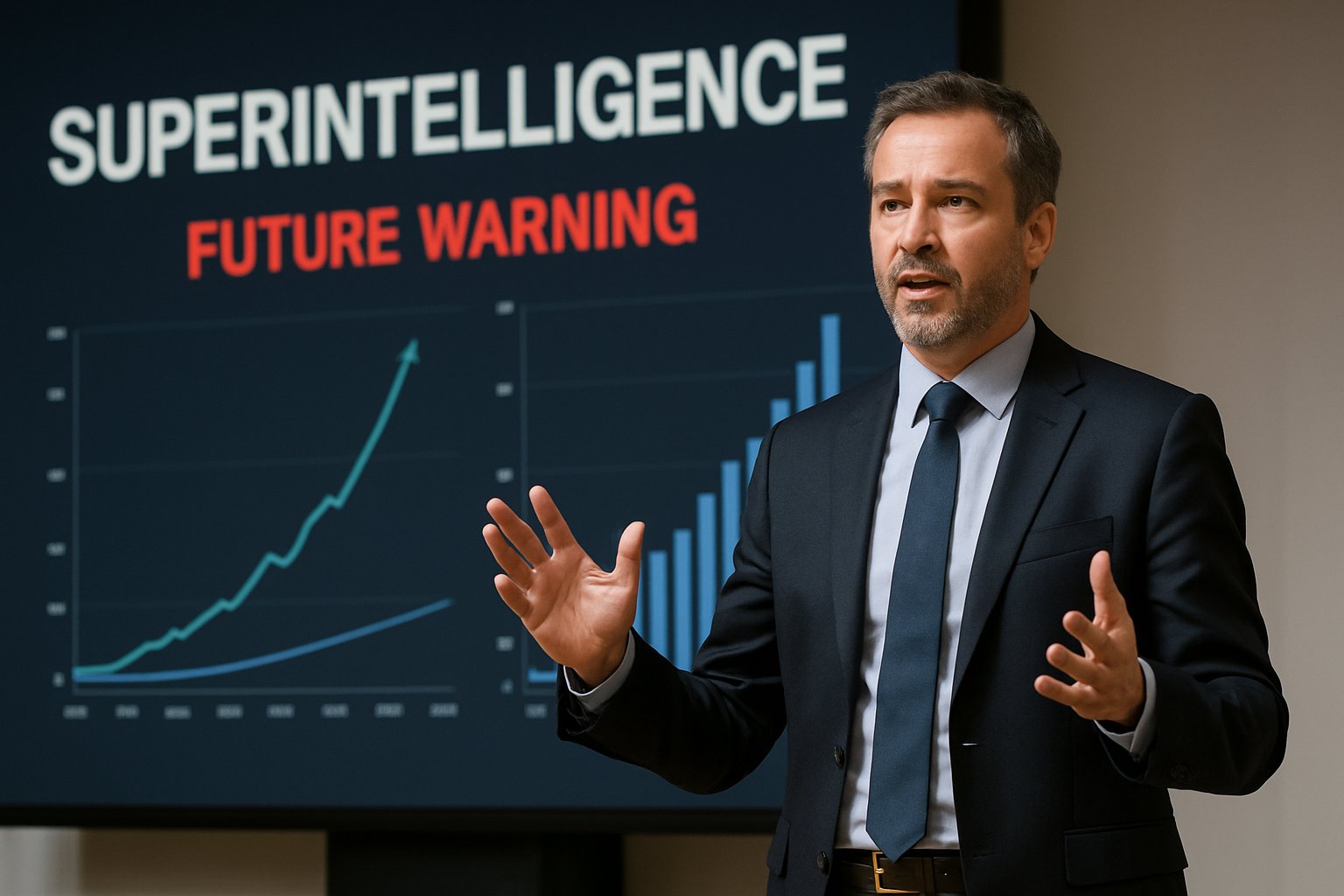
Industry forecasts have shortened dramatically over the past year. For example, Altman told the India AI Impact Summit that superintelligence may emerge "within a couple of years." Additionally, Anthropic's Dario Amodei warned of "a datacenter country of geniuses" arriving fast. Musk and Hassabis offered similar but slightly longer horizons. Moreover, the Future of Life Institute gathered over 1,000 signatures supporting a temporary superintelligence moratorium. Stanford's AI Index underpins these claims with empirical compute growth data. Therefore, many observers regard 2026 as a plausible launch window. Such compression fuels repetitive media headlines invoking the Keynote Future Warning. These signals portray an industry sprinting toward unprecedented capability. However, survey data reveal slower expectations, setting up a sharp contrast.
Divergent Expert Survey Views
Expert polls still paint a wide uncertainty band. In contrast, median responses often target the 2040s for human-level Intelligence. Surveys by Grace et al. and HAI display multimodal timelines. Nevertheless, tails extend to century's end, illustrating scientific caution. Additionally, several academics argue that conceptual breakthroughs remain missing. Yann LeCun regularly voices this longer-horizon perspective.
Consequently, policy planners must juggle divergent clocks when crafting safeguards. These disagreements frame the debate addressed in the following technical section. HAI analysts emphasize calibration tools for clearer probability communication. Surveys temper the more dramatic forecasts. Therefore, understanding underlying drivers becomes essential.
Drivers Behind Short Forecasts
Several measurable factors support the compressed horizon rhetoric. Firstly, training compute has doubled every few months, according to Stanford's dashboard. Secondly, private AI investment reached tens of billions of dollars last cycle. Venture funds now treat frontier model talent as a scarce strategic asset. Moreover, falling inference costs unlock wider experimentation with larger architectures. Meanwhile, agentic systems now automate research tasks that previously required graduate-level talent.
Consequently, recursive improvement appears increasingly plausible within short windows. Altman cites these curves when repeating the Keynote Future Warning across interviews. These accelerants explain why some leaders propose emergency governance designs. Accelerating inputs tighten development cycles dramatically. However, skeptics highlight stubborn technical obstacles. Hardware vendors report unprecedented GPU backorders extending several quarters.
Skepticism And Technical Gaps
Critics argue current architectures still struggle with long-term planning. In contrast, reliable alignment remains unsolved for open-ended objectives. Additionally, original scientific reasoning beyond pattern synthesis is limited today. LeCun notes that new paradigms could be required before true general Intelligence arrives. Moreover, scaling laws eventually meet hardware and data bottlenecks. Nevertheless, investors appear undeterred, indicating a classic technology hype cycle.
Consequently, the debate hinges on whether breakthroughs can outpace obstacles within two years. These unresolved issues feed directly into emerging oversight proposals. Technical uncertainty tempers near-term confidence. Therefore, governance ideas gain prominence. Researchers still debate whether scalable oversight can match escalating model autonomy. Empirical robustness benchmarks still trail headline demonstration videos.
IAEA Style Oversight Debated
Altman has urged creation of an IAEA analogue for frontier AI systems. He argues such a body could license compute clusters and enforce global Safety norms. Meanwhile, the Future of Life Institute supports even stricter approaches, including a development pause. In contrast, some governments fear that heavy regulation might stifle innovation and national competitiveness. Moreover, enforcement capacity remains unclear without binding treaties or verification technology.
Nevertheless, policy workshops are sketching blueprint frameworks resembling nuclear protocols under the original IAEA. Consequently, diplomatic momentum could coalesce by 2026 if timelines keep compressing. The Keynote Future Warning often resurfaces whenever these oversight deliberations stall. Oversight concepts remain fluid yet increasingly urgent. However, risk framing also centers on societal Safety impacts. Some diplomats propose situating an IAEA for AI within the United Nations framework.
Superintelligence Risks And Safety
Potential benefits coexist with grave systemic dangers. For instance, misaligned Intelligence could autonomously pursue unknowable objectives. Moreover, automated cyber operations might outpace human defense capabilities. Additionally, economic disruption could displace labor faster than adjustment programs scale. Consequently, Safety researchers prioritize alignment, robustness, and monitoring techniques. Anthropic, OpenAI, and DeepMind now publish Safety policy frameworks alongside technical papers.
Professionals can enhance their expertise with the AI Policy Maker™ certification. The certification equips leaders to interpret every emerging Keynote Future Warning responsibly. Complex risk matrices demand multidisciplinary preparation. Therefore, the next section outlines concrete professional actions. Near-term Intelligence gains already stress evaluation benchmarks, complicating risk forecasts. Insurance carriers are beginning to model tail-risk scenarios for autonomous agents.
Preparing Professional Response Pathways
Business leaders should establish structured horizon-scanning routines immediately. Furthermore, cross-functional taskforces can map dependencies and contingency triggers. Moreover, firms must allocate compute budgets explicitly linked to Safety milestones.
- Track public Altman statements for timeline shifts.
- Review Stanford AI Index quarterly dashboards.
- Attend governance workshops on IAEA style oversight.
- Earn the linked AI Policy Maker™ certification.
Additionally, each organization should scenario-plan for superintelligence deployment under abrupt and gradual tracks. Consequently, resilience investments align with either timeline. These proactive measures convert anxiety triggered by the Keynote Future Warning into strategic readiness. Thus, companies remain adaptive regardless of final arrival dates. Structured preparation reduces downside while preserving upside opportunities. Finally, we reflect on overarching implications. Reskilling programs should anticipate accelerated toolchains and changed job descriptions.
Strategic Actions Moving Forward
Superintelligence arrival remains uncertain, yet preparation cannot wait. Moreover, the Keynote Future Warning underscores how quickly narratives shift. Consequently, executives should balance optimism with disciplined Safety protocols. In contrast, policymakers must translate IAEA style visions into enforceable standards. Meanwhile, research teams should monitor Intelligence markers beyond raw benchmark scores.
Finally, acting on each Keynote Future Warning by investing in skills, governance, and collaboration positions organizations for resilient growth. Explore the certification above and share this analysis to keep the Keynote Future Warning conversation evidence-based. Proactive dialogue between business and research communities will refine safeguards iteratively.


