

AI CERTS
2 months ago
Intel Xeon 6 Boosts Cloud Compute Efficiency
Furthermore, the launch included bold claims: up to forty-percent faster workload completion and tighter integration with next-generation GPUs. Meanwhile, analysts note the company faces mounting competition from AMD and ARM upstarts, heightening expectations around every silicon release. Nevertheless, early design-win announcements, including NVIDIA’s DGX B300, suggest market traction is real. This article unpacks technical advances, business implications, and concrete steps IT teams can take to harness the new silicon.
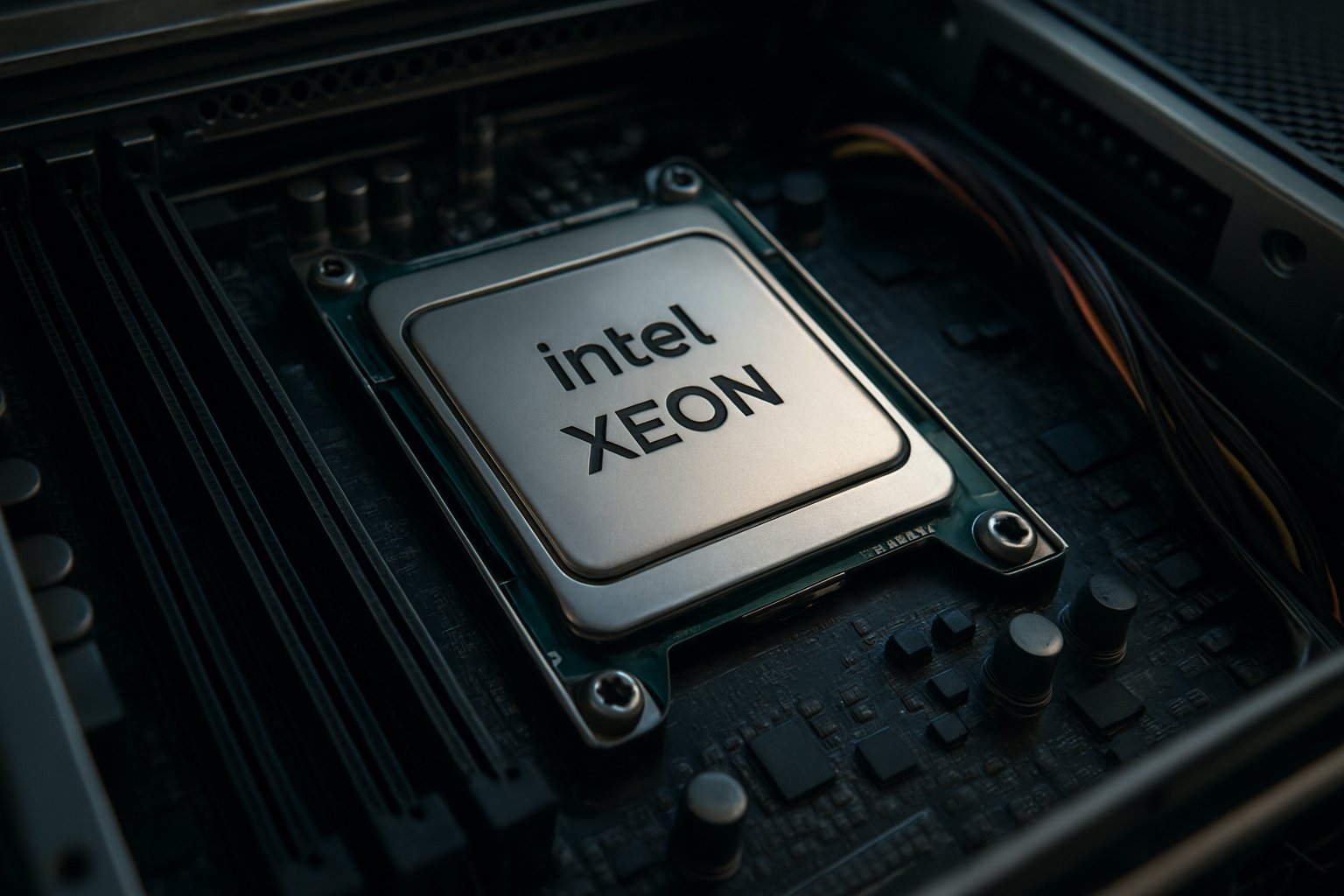
Boosting Cloud Compute Efficiency
Intel’s executives framed the new lineup around one metric: Cloud Compute Efficiency measured through workload throughput per watt.
Moreover, internal tests cite a forty-percent improvement against previous Xeon generations in mixed AI and transactional loads.
Consequently, enterprises hosting large language models can expect reduced node counts, smaller power domains, and lower licensing expenses.
These savings broaden budgeting headroom. Subsequently, organizations can reallocate capital toward strategic data initiatives or new inference services.
Improved ratios redefine cost baselines for many cloud providers. However, deeper technical analysis clarifies how Intel engineered the gain.
AI Market Momentum Overview
Industry forecasts show generative AI spending reaching $153 billion by 2027, according to IDC figures referenced by Intel.
Meanwhile, server market share reports place AMD in the mid-20 percent range, intensifying competitive urgency for the server roadmap.
Nevertheless, over 500 OEM designs already list Xeon 6 processors, spanning HPE, Dell, Lenovo, and hyperscale cloud builders.
Consequently, market momentum appears durable despite rivalry, especially where Cloud Compute Efficiency drives procurement decisions.
Adoption indicators suggest strong demand through 2026. Therefore, understanding the silicon’s core advances becomes critical for architects.
Key P-Core Technical Advances
At the heart lies Priority Core Turbo, a firmware feature that elevates cores while holding others at base clocks.
Additionally, Intel SST-TF provides per-class frequency controls, letting orchestration software tune silicon behaviour for specific GPU stages.
Moreover, each P-core integrates AMX instructions, accelerating on-CPU matrix operations that previously consumed discrete accelerator cycles.
- Higher memory bandwidth via DDR5 MRDIMMs, reaching up to 8000 MT/s.
- Eight channels of PCIe Gen5 offering abundant accelerator connectivity.
- CXL 2.0 lanes supporting coherent memory expansion for large models.
Collectively, these advances elevate host-to-GPU flows, boosting Cloud Compute Efficiency and raw Processing throughput. In contrast, real benefits depend on workload patterns and tuning.
GPU Host Synergy Points
NVIDIA selected the 64-core Xeon 6776P as host CPU for its DGX B300 systems built around Blackwell Ultra GPUs.
Consequently, latency between serialization stages and massive GPU matrices drops, improving end-to-end inference Performance across multimodal workloads, and Cloud Compute Efficiency.
Furthermore, Priority Core Turbo can assign dedicated threads to pre-processing or post-processing tasks, feeding accelerators without starving backend services.
Subsequently, testing by OEM partners shows up to 8 percent higher GPU utilization versus prior host configurations.
The host synergy story therefore resonates with AI architects. Nevertheless, competitive pressures require deeper market context analysis.
Competitive Server Landscape Shifts
AMD’s EPYC family continues eating share, leveraging aggressive core counts and strong memory bandwidth to lure Datacenter buyers.
However, Intel still dominates unit volume, and Xeon 6 aims to protect that lead using Cloud Compute Efficiency gains.
In contrast, ARM licensees promote lower power draw per thread, challenging traditional x86 assumptions in edge Processing scenarios.
Moreover, several hyperscalers run internal silicon evaluations that could shift procurement toward whichever architecture delivers predictable Performance per dollar.
Competitive dynamics remain fluid and data driven. Consequently, operational planning demands careful consideration of power, licensing, and benchmarking.
Vital Operational Planning Considerations
Systems teams must validate BIOS support for Priority Core Turbo and SST-TF before committing large rollouts.
Additionally, cooling budgets need revision because priority cores can spike thermal envelopes during burst Processing phases.
Meanwhile, memory channel layout directly affects latency. Four-rank MRDIMMs require careful population to maximize bandwidth claims.
- Monitor real power draw using rack-level telemetry, not TDP figures.
- Benchmark with production dataflows, including serialization overheads.
- Align scheduler policies with Priority Core Turbo hints.
Professionals can enhance their expertise with the AI Cloud Architect™ certification.
Disciplined evaluation mitigates deployment risk while safeguarding Cloud Compute Efficiency targets. Therefore, attention now shifts toward forthcoming independent benchmark disclosures.
Key Forward Looking Benchmarks
Third-party MLPerf submissions remain the gold standard for verifying vendor Performance claims.
Nevertheless, official results featuring Xeon 6776P paired with Blackwell GPUs have not yet appeared.
Subsequently, early lab testing from OEMs and cloud providers will offer interim insight into real Cloud Compute Efficiency improvements.
Furthermore, the community expects rigorous disclosure of power, throughput, and latency metrics under audited conditions.
Transparent benchmarking will confirm or contradict vendor rhetoric. In conclusion, procurement timing should align with published data.
Concluding Insights And Action
Intel’s latest Xeon 6 P-core chips target faster AI cycles, tighter GPU coupling, and measurable Cloud Compute Efficiency improvements.
Moreover, successful deployments will depend on BIOS readiness, workload tuning, and transparent benchmarks from trusted laboratories.
Nevertheless, early ecosystem momentum and design wins suggest the architecture will influence Datacenter strategies through 2026.
Therefore, teams should track forthcoming MLPerf data, run pilot tests, and pursue skills credentials to maximise Cloud Compute Efficiency benefits.
Call to action: Stay informed, benchmark early, and consider certifications that deepen architectural expertise to secure competitive advantage in AI infrastructure.


