

AI CERTS
3 hours ago
Insider Faces Byline Protest Over AI Author Experiment
Moreover, executives launched an AI News Desk that drafts quick stories before human edits. Many reporters fear that automation will erode their role and the outlet’s hard-won reputation. Consequently, the Insider Union organized flyers, Slack actions, and a planned rally at One Liberty Plaza. Their message is blunt: “No Slop in Our Shop.” Industry observers are watching closely because similar experiments elsewhere produced embarrassing retractions. Therefore, this article examines the stakes, competing arguments, and possible compromises as artificial intelligence reshapes reporting.
AI Push Spurs Backlash
Business Insider’s leadership embraced generative models with public enthusiasm. CEO Barbara Peng declared the newsroom was "going all-in on AI." Additionally, internal data said 70 percent of employees already used Enterprise ChatGPT daily. The company aimed for complete adoption before 2026.
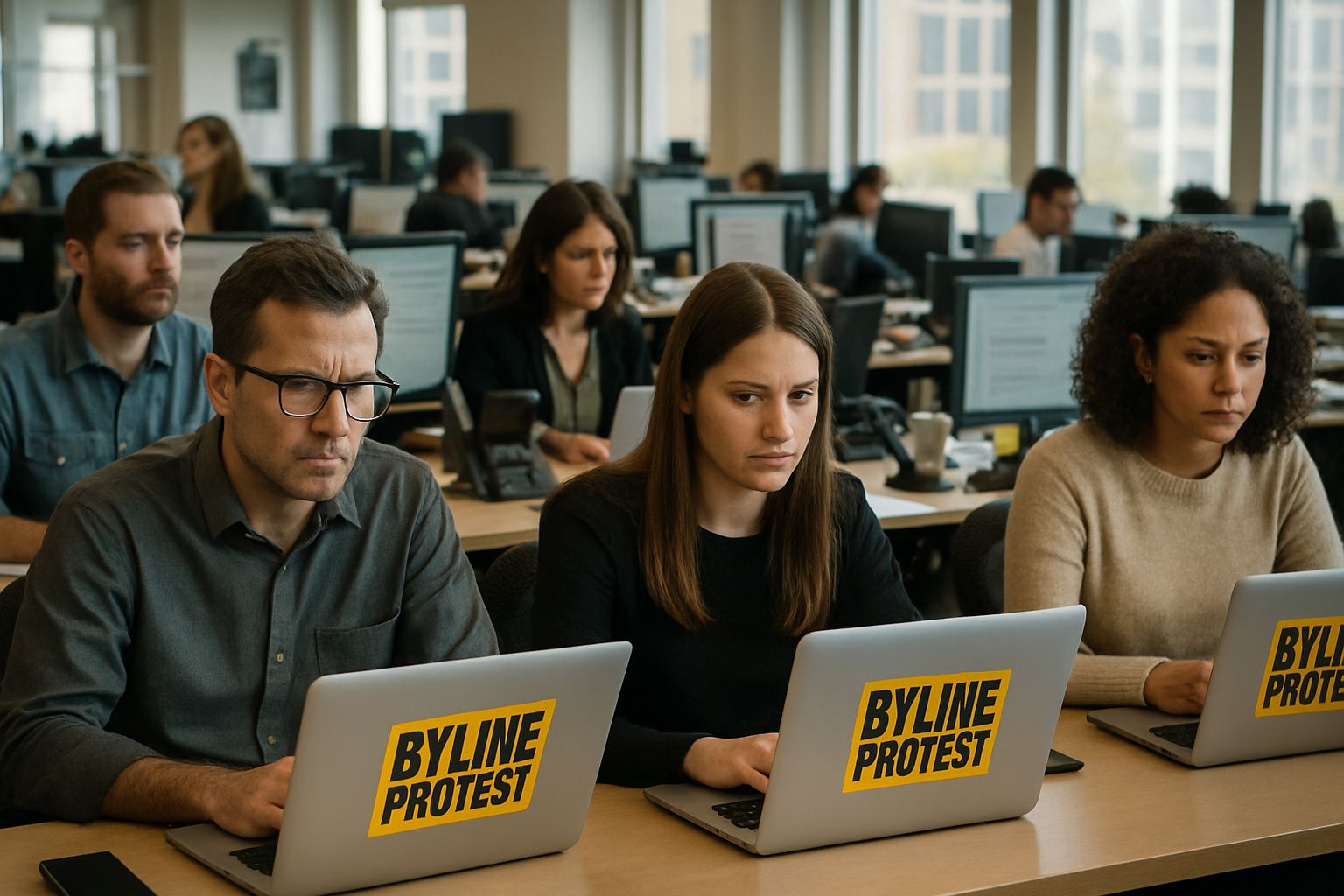
Meanwhile, the same months saw sweeping layoffs. Management removed roughly 21 percent of editorial positions in May 2025. Consequently, surviving reporters interpreted the acceleration as a cost-saving gambit rather than pure innovation. The brewing Byline Protest began to take shape.
Subsequently, workers noticed a new “Business Insider AI” byline attached to short market updates. An internal memo from Editor-in-Chief Jamie Heller explained that an AI News Desk would surface several quick stories daily. Nevertheless, details about verification procedures remained sparse.
Staff viewed velocity without vigilance as dangerous. Next, their collective response gained visible momentum.
Union Leads Byline Protest
Insider Union leaders framed the discovery as a wake-up call. Their Byline Protest campaign used flyers, Slack avatars, and the slogan “No Slop in Our Shop.” Moreover, they filed a formal request for information demanding workflow specifics and job impact assessments.
Furthermore, The NewsGuild of New York coordinated an in-person rally outside One Liberty Plaza. Organizers argued that unchecked automation jeopardizes journalism quality and employment protections secured through bargaining. In contrast, management described human editors as the ultimate gatekeepers.
Nevertheless, tensions rose when staff saw an AI "author" page listing dozens of articles. Reporters feared readers would assume machines now replaced journalists entirely, damaging trust. Consequently, the protest gained social media traction within media circles.
Collective action signaled newsroom resolve and publicized unresolved questions. However, management soon mounted a detailed defense.
Management Defends AI Strategy
Business Insider leaders insisted the Byline Protest mischaracterized the project. Barbara Peng’s memo asserted that AI augments, not replaces, human reporting. Additionally, she linked AI search and personalized paywalls to higher conversion rates.
Moreover, executives claimed resource reallocation would fund deeper enterprise investigations. They argued short automated summaries free journalists for complex narratives. Consequently, the AI News Desk became a symbolic battleground about value allocation.
Jamie Heller stated that every AI-drafted story passes through an experienced editor. Therefore, any published material meets existing editorial standards. Nevertheless, she acknowledged that hallucination risks require vigilant fact-checking protocols.
Management framed AI as indispensable for sustainability. The next section examines reputational stakes shaping that debate.
Risks To Editorial Reputation
Media scholars warn that synthetic text can appear plausible while embedding fabricated facts. Consequently, outlets have retracted AI-assisted stories, most notably the "Margaux Blanchard" scandal. Such events tarnish brand reputation quickly.
Furthermore, Business Insider faces unique scrutiny because layoffs coincide with automation claims. Critics argue that reducing human oversight magnifies potential errors. In contrast, proactive transparency could reinforce journalism credibility.
Union representatives highlighted Lily Oberstein’s quote describing vague policies and a dangerous pace. They fear one flawed AI author article could undermine years of trust. Moreover, outside experts recommend robust provenance labels on every automated paragraph. That fear fuels the Byline Protest’s messaging.
Accuracy safeguards underpin public faith and advertising revenue. Subsequent industry comparisons offer perspective on feasible controls.
Industry Context Offers Lessons
Other major publishers, including The Washington Post, experimented with AI podcasts that later required corrections. Moreover, Wired removed several freelance pieces after uncovering fictional sources. These incidents mirror concerns driving the Byline Protest.
Nevertheless, several newsrooms now publish detailed AI disclosure frameworks. Reuters, for example, mandates dual human review before release. Such policies balance speed with responsible journalism.
Additionally, the Associated Press partners with OpenAI under strict licensing terms. The deal funds newsroom initiatives while clarifying data rights. Consequently, observers suggest Business Insider could adopt similar guardrails. Critics note that an unnamed author obscures accountability.
These examples validate Byline Protest warnings. Peer experiences reveal that transparent standards mitigate backlash. Finally, potential future pathways deserve exploration.
Possible Paths Move Forward
Experts outline three reconciliation approaches:
- Form a joint labor-management committee reviewing AI tool usage weekly.
- Guarantee a human author shares credit on every hybrid story.
- Publish a live correction dashboard accessible to all readers.
Their proposals respond directly to the Byline Protest demands. Moreover, Insider Union members propose contract clauses protecting intellectual property and bonus sharing for AI-driven revenue. Meanwhile, executives may accept independent audits to certify accuracy rates.
Professionals seeking to shape ethical AI writing can validate their skills through the AI Writer™ certification. Consequently, credentialed staff could oversee model prompts and outputs.
Structured oversight and shared incentives can ease distrust. The concluding section reviews pivotal insights and next steps.
Certification Upskill Opportunities Ahead
Career resilience demands continuous learning. Therefore, many reporters explore specialized programs covering prompt engineering, fact-checking, and AI policy. Furthermore, the previously mentioned AI Writer™ credential verifies competencies that complement traditional journalism experience.
Graduates report stronger negotiating positions during technology rollouts. Additionally, employers appreciate verifiable expertise when delegating oversight of synthetic contributors. Consequently, professional development undercuts fears that machines will fully displace human creativity. Skills development also supports the Byline Protest goal of safeguarding quality.
Upskilling empowers individuals and supports quality control. We now summarize the overall debate.
Business Insider’s Byline Protest spotlighted wider industry tension between innovation and integrity. Management touts cost savings and speed, yet staff emphasize journalism standards, union protections, and brand reputation. Moreover, external case studies prove that careless AI authorship can inflict lasting damage. Nevertheless, evidence suggests that clear disclosures, rigorous human editing, and shared governance reduce risk. Consequently, outlets that align technology with transparent policy may enjoy both efficiency and trust.
Readers and professionals should monitor forthcoming negotiations and policy releases. For Business Insider, resolving the Byline Protest will signal its editorial priorities. Finally, consider enhancing personal expertise with credentials such as the AI Writer™ certification to remain indispensable in a hybrid newsroom.


