

AI CERTS
2 hours ago
Industrial Humanoid Automation Powers Guchi Robotics Factories
It is not a story driven solely by heavyweight multinationals. Moreover, mid-sized integrators such as Guchi Robotics are supplying turnkey assembly cells to domestic automakers. Consequently, provincial officials hail these deployments as proof that technology can offset factory labor shortages. Therefore, analysts now track Guchi as a bellwether for China’s automation momentum.
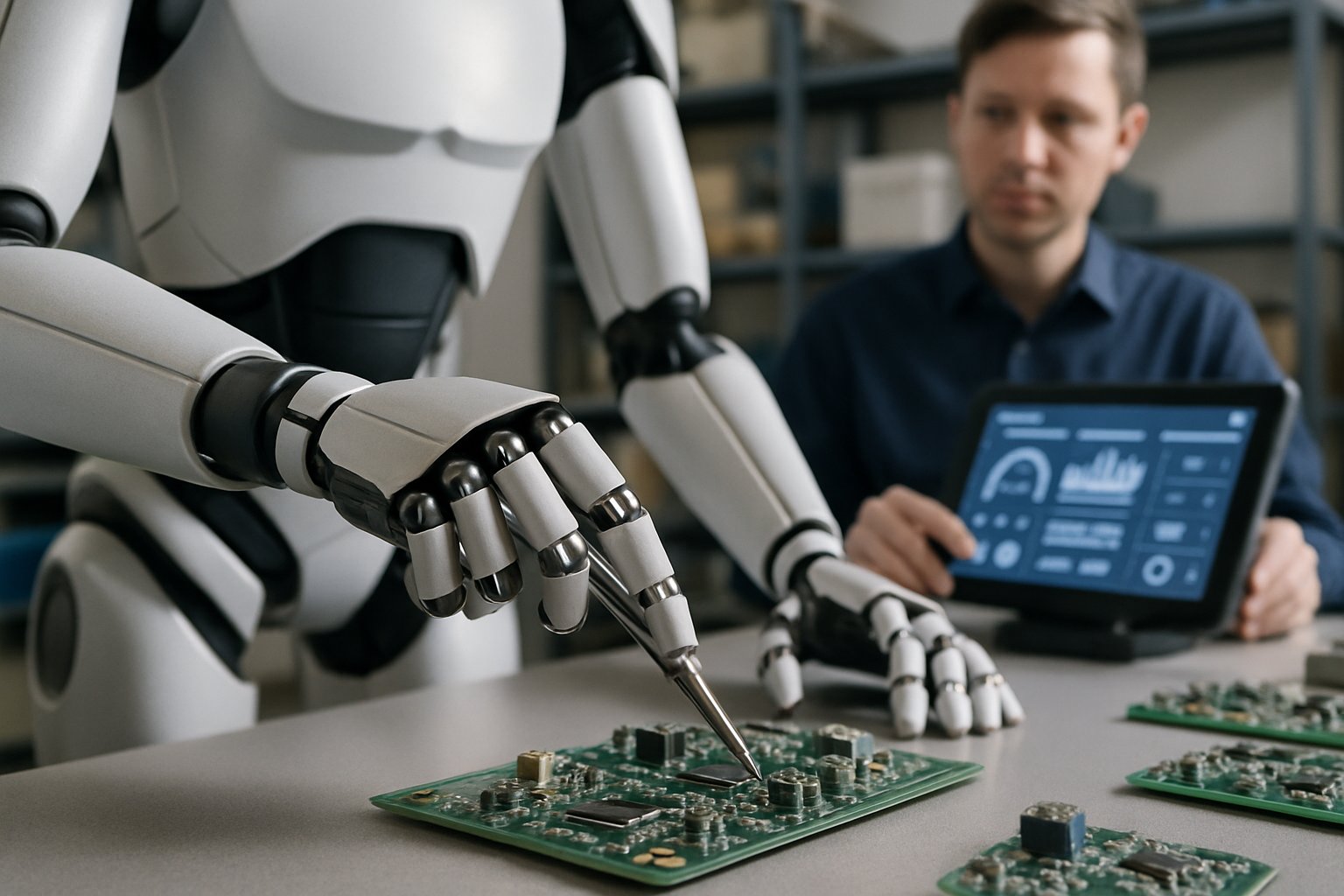
IFR data underscores the stakes. In 2024 China installed 295,000 industrial robots, more than half the global total. Meanwhile, domestic suppliers captured a 57% share, lowering hardware costs for integrators. Those numbers explain why Industrial Humanoid Automation now dominates boardroom discussions from Guangzhou to Detroit.
Nevertheless, the battle for market share pivots on execution, not slogans. Consequently, the next sections examine how Guchi Robotics deploys tools, patents, and deep learning to win contracts.
China Automation Surge Story
Across the mainland, every province is racing to upgrade assembly lines. Furthermore, Beijing’s tax incentives slash payback periods for new robot cells. In contrast, energy prices remain volatile, making efficiency gains vital. Takayuki Ito of IFR states, “China’s strategy to modernize its manufacturing base has reached a new milestone.”
The following figures capture the scale of investment.
- 2024 operational robot stock: 2.0 million units (IFR)
- Annual installations: 295,000 units, 54% global share
- Domestic supplier share: 57% of new installations
- Estimated market value by 2028: USD 5 trillion
Consequently, factories increasingly pursue Industrial Humanoid Automation to sustain competitiveness. Moreover, lower hardware costs free budgets for software, vision, and deep learning analytics. Therefore, integrators who master both mechanics and algorithms now command premium margins.
These statistics show unstoppable momentum toward smarter lines. However, strategy execution separates winners from hopefuls. The next section details how Guchi Robotics positions itself within this surge.
Guchi Robotics Strategy Snapshot
Guchi Robotics was incorporated in 2016 with 35.38 million RMB in registered capital. Additionally, the firm files tightening and installation patents yearly, with several publications released in 2025. Its digital-twin lab simulates entire lines before hardware ships, reducing commissioning days. Consequently, automotive clients value lower downtime during changeovers.
Moreover, the company appears on Automate’s prior exhibitor list, signaling global ambitions. In contrast, many local rivals remain domestic-only and lack English marketing. Meanwhile, Zhejiang operations generated over 100 million RMB output in 2024, according to municipal reports. Nevertheless, audited revenue remains undisclosed, so analysts await clearer figures.
Reports cite collaborations with Geely, BYD, Volkswagen, and Tesla. However, contract volumes have not been verified independently. Therefore, journalists continue seeking OEM confirmation.
Guchi Robotics differentiates through patents, simulation capacity, and foreign outreach. These pillars offer credible defenses against price competition. The following section explores the underlying technologies enabling that edge.
Technology Under The Hood
At the cell level, Guchi combines cobots, torque sensors, and vision cameras to manage fastening tasks. Furthermore, adaptive algorithms adjust speed and force in real time. This closed loop embodies Industrial Humanoid Automation by merging mechanical strength with digital cognition.
Deep learning models classify defects from high-resolution images captured post-assembly. Moreover, mis-torque events trigger automatic rework without human prompts. Consequently, quality escapes decline while traceability improves.
The digital twin mirrors every bolt, fixture, and sensor in software. Additionally, engineers validate cycle times virtually, then deploy proven parameters on the shop floor. Therefore, commissioning shrinks from weeks to days.
Key technical gains include the following:
- Cycle time reduction: up to 25%
- Defect rate drop: 40% on pilot lines
- Operator fatigue eliminated for repetitive tightening
- Real-time data feeds factory brain systems
Together, these innovations illustrate why Industrial Humanoid Automation delivers measurable ROI. However, external forces also influence adoption trajectories. The next section reviews those market dynamics.
Market Forces Shaping Adoption
Robot prices are falling as domestic manufacturers reach scale. Consequently, payback periods for mid-volume plants now approach two years. Meanwhile, aging demographics intensify factory labor shortages in coastal provinces.
Policy also matters. Moreover, the Made-in-China 2025 roadmap offers grants for Industrial Humanoid Automation projects that integrate AI quality assurance. In contrast, chip export restrictions could inflate edge computing costs.
Customer expectations are evolving as well. Deep learning dashboards now accompany almost every request for quotation. Therefore, integrators lacking data expertise risk exclusion from high-value bids.
Falling costs, policy carrots, and workforce gaps pressure executives toward automation. These forces align tightly with Guchi’s offering. Yet risks remain, as the next section explains.
Key Risks And Challenges
Automation displaces some factory labor, raising social concerns. Nevertheless, economists argue that higher productivity can spawn new service roles. Companies must still navigate local politics carefully.
Business risk also looms. Guchi Robotics appears in several 2024 contract dispute filings. However, the firm has not publicly commented on case outcomes.
Technology constraints add further uncertainty. In contrast to software, high-precision actuators still rely on overseas supply chains. Consequently, geopolitical restrictions could delay certain Industrial Humanoid Automation projects.
These challenges highlight integration complexity beyond press releases. However, workforce upskilling can mitigate several risks. The final section investigates that human dimension.
Upskilling The Factory Workforce
Human workers remain essential for exception handling and continuous improvement. Moreover, technicians able to program cobots earn wage premiums. Consequently, vocational institutes now add deep learning modules to maintenance curricula.
Professionals can enhance their expertise with the AI-Robotics Specialist™ certification. Furthermore, such credentials signal readiness to manage Industrial Humanoid Automation deployments.
Managers also pilot micro-credential programs focused on safety, troubleshooting, and data analytics. Meanwhile, Guchi Robotics offers on-site training bundles with each cell installation. Therefore, skill gaps shrink alongside hardware commissioning.
Upskilling efforts ensure humans complement machines, not compete with them. Consequently, sustainable value emerges for both shareholders and employees.
Guchi Robotics illustrates the new playbook for Chinese system integrators. Moreover, rising robot density, supportive policy, and powerful algorithms promise sustained growth. However, patent moats and transparent finances will decide long-term winners. Investors should therefore watch contract disclosures and court case resolutions. Meanwhile, manufacturers cannot ignore shrinking payback periods now available.
Consequently, early movers will capture quality gains and resilient supply chains. Professionals need verified skills to lead next-generation deployments. Consider enrolling in the AI-Robotics Specialist™ certification to strengthen your credentials. Act now, and join the engineers designing tomorrow’s factories.


