

AI CERTs
2 hours ago
India’s NVIDIA agents transform AI Supply Chain
India’s manufacturing sector is entering a pivotal phase. Moreover, the nation is weaving NVIDIA’s agentic platforms into an emerging AI Supply Chain. Consequently, integrators such as TCS, Tech Mahindra, Wipro, and Infosys now bundle Omniverse, Isaac, and NVIDIA AI Enterprise for shop-floor deployment. Meanwhile, hyperscale partners are racing to host thousands of GPUs. Analysts note that these moves align with CEO Jensen Huang’s 2024 call for India to “manufacture its own AI.” Therefore, executives view agentic AI as a cornerstone for Industrial digitization, Factory modernization, and national competitiveness within the AI Economy.
However, success hinges on more than hardware. Forward-looking leaders must fuse digital-twin simulation, cloud orchestration, and workforce upskilling. This article maps India’s strategy, benefits, and risks while tracking how the AI Supply Chain reshapes production networks.
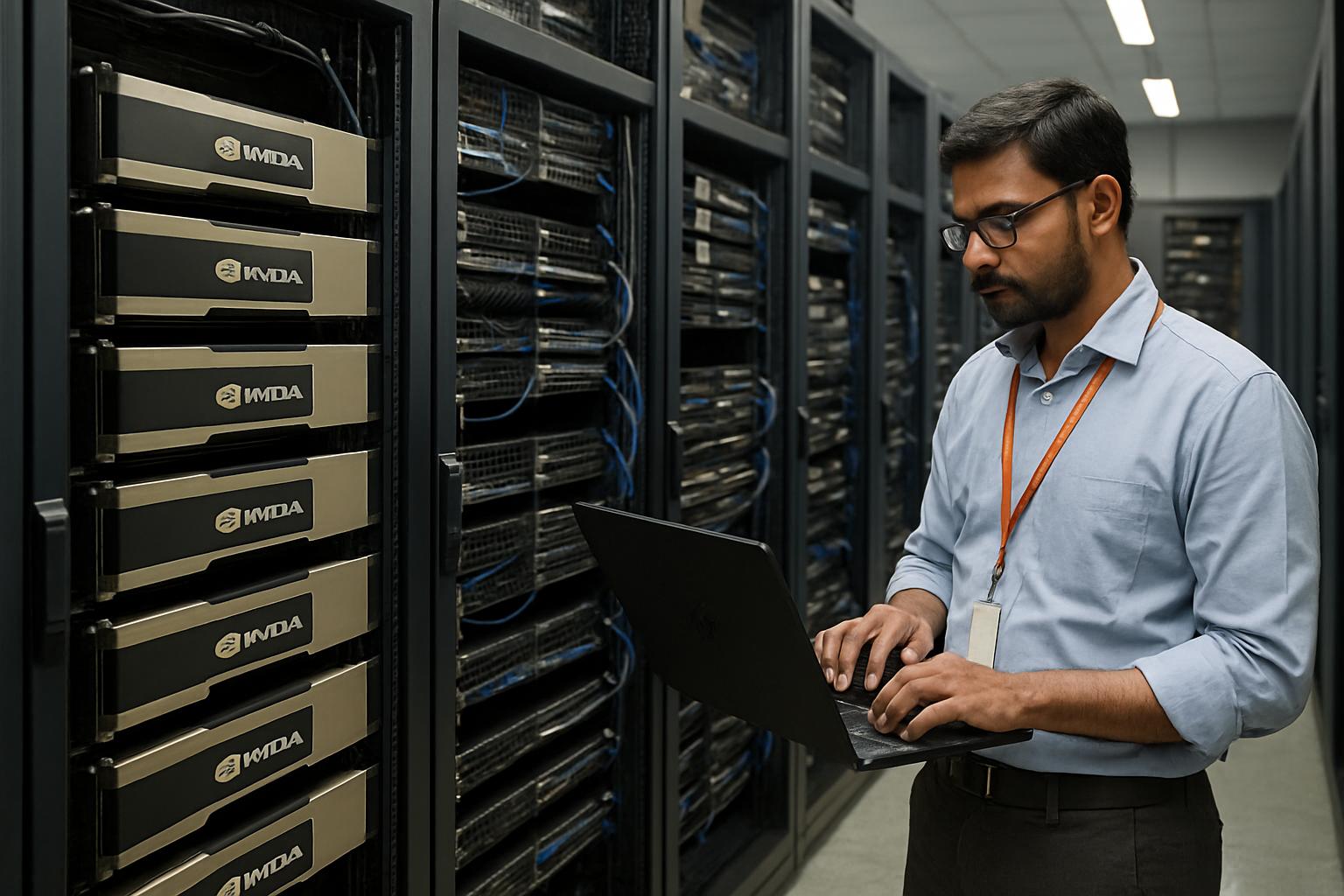
India's Agentic AI Push
October 2024 marked an inflection point. Subsequently, NVIDIA hosted its first Indian AI Summit, announcing broad adoption of “manufacturing agents.” TCS launched a dedicated NVIDIA business unit the next day. In contrast with earlier pilots, these programs target full production rollouts. Tech Mahindra’s Orion platform already touts 200 pre-built agents.
Press releases describe visual inspection, predictive maintenance, and layout planning scenarios. Additionally, the Digital Twindex report released during Hannover Messe 2025 framed digital twins as essential. Industrial leaders now treat simulation as a prerequisite rather than a novelty. Consequently, India’s government views agentic AI as strategic for export resilience.
These announcements illustrate momentum. However, pilots still outnumber live production lines. Therefore, independent verification remains vital before scaling the AI Supply Chain further.
Infrastructure Powers GPU Factories
Hardware availability often dictates project velocity. Consequently, Dell and NxtGen plan India’s largest AI factory with 4,000 Blackwell GPUs. Yotta has committed $2 billion for a Noida campus equipped with the same chips. Furthermore, Tata Communications and Reliance Jio already run GH200 clusters for Industrial clients.
- 4,000 Blackwell GPUs expected at the Dell-NxtGen site
- $2 billion earmarked by Yotta for hyperscale AI infrastructure
- 500,000 developers targeted for NVIDIA upskilling programs
- Pegatron reported 67% defect reduction using digital-twin agents
These figures underline scale. Moreover, hosted GPU “AI factories” enable medium-sized manufacturers to test agentic workloads without onsite capital expense. Therefore, compute democratization accelerates the AI Supply Chain. Nevertheless, concentration around one vendor raises resilience concerns.
Centralized capacity boosts accessibility. However, overreliance on a single ecosystem could constrain future Industrial innovation if export controls tighten.
Core Manufacturing Agent Uses
Agentic AI spans several operational layers. Visual agents flag defects in real time. Predictive agents analyze vibration telemetry to schedule maintenance before costly downtime. Additionally, planning agents run thousands of virtual iterations to optimize Factory layouts.
Digital twins provide the physics fidelity required for accurate policy transfer. Moreover, NVIDIA Omniverse synchronizes Computer-Aided Design with live sensor data. Consequently, engineers test Automation strategies virtually, refining them before physical deployment. Pegatron’s case study demonstrated a 40% cut in build time for a new line, illustrating Efficiency gains.
Indian integrators replicate these templates across automotive, electronics, and process industries. Therefore, the AI Supply Chain extends from simulation environments to edge appliances on the shop floor.
These applications deliver immediate value. Nevertheless, sim-to-real gaps may surface without rigorous calibration and continuous verification.
Benefits Show Early Promise
Vendor data suggests compelling returns. Furthermore, Pegatron reported a 7% labor cost drop per assembly line. TCS claims faster quotation cycles because generative agents draft process routes instantly. Additionally, predictive models reduce unplanned downtime, lifting Overall Equipment Effectiveness.
Industrial clients also gain environmental dividends. Digital twins minimize material waste during Factory reconfiguration. Consequently, sustainability metrics improve alongside Efficiency. Meanwhile, hosted GPU centers cut lead times for model training by eliminating procurement hurdles.
The following advantages resonate with executives:
- Higher first-pass yield through AI inspection
- Shorter commissioning cycles via virtual commissioning
- Continuous improvement loops powered by agent telemetry
These benefits validate investment narratives. However, independent audits remain scarce, and hype could outpace realism within the AI Supply Chain.
Risks Demand Pragmatic Governance
No transformation is risk free. Data governance tops executive worries. Moreover, sovereign-AI policies mandate that Industrial data stays within national borders. Therefore, integrators encrypt telemetry before sending it to cloud GPUs.
Secondly, workforce displacement can spark resistance. However, upskilling initiatives aim to convert operators into Automation supervisors, sustaining employment while boosting Factory Efficiency. Concentration risk is another concern. Consequently, CIOs build multi-cloud failovers to prevent single-vendor lock-in across the AI Supply Chain.
These challenges highlight critical gaps. Nevertheless, emergent standards and sandbox testing environments provide mitigation paths toward trusted production deployment.
Skills And Certification Paths
Human capital underpins technology success. Consequently, NVIDIA and consulting giants pledge to train half a million professionals. Engineers skilled in digital-twin orchestration and Industrial data pipelines command premium salaries.
Professionals can enhance their expertise with the AI Project Manager™ certification. Moreover, curricula emphasize project scoping, risk control, and multi-vendor coordination inside the AI Supply Chain. Additionally, universities now embed Omniverse modules into mechanical-engineering programs.
Upskilling secures organizational resilience. Therefore, companies that invest in continuous learning can adapt rapidly as new Automation frameworks emerge.
Strategic Outlook And Steps
India’s momentum appears durable. Furthermore, GPU supply partnerships reduce hardware bottlenecks, while integrators cultivate repeatable blueprints. Consequently, analyst consensus forecasts double-digit growth for Industrial AI spending through 2028.
Leaders evaluating next moves should:
- Audit current data quality and governance maturity
- Launch a low-risk pilot using hosted GPU services
- Define success metrics aligned with Efficiency and sustainability goals
- Invest in certified talent to manage change
These steps bridge vision and execution within the expanding AI Supply Chain. However, transparency in reporting outcomes will determine long-term credibility.
Momentum is clear. Nevertheless, iterative validation and open metrics remain essential to sustain trust as Industrial firms scale Automation agents nationwide.
Conclusion
India is knitting together chips, cloud, and agentic software to build a resilient AI Supply Chain. Moreover, early adopters see tangible boosts in Factory Efficiency, quality, and flexibility. However, risks around governance, vendor concentration, and workforce transition cannot be ignored. Therefore, executives must balance rapid experimentation with pragmatic oversight. Professionals seeking leadership roles should pursue certifications and continuous learning. Consequently, now is the moment to pilot, measure, and refine agentic strategies. Explore certifications, deepen domain expertise, and position your organization at the forefront of Industrial Automation.


