

AI CERTS
2 hours ago
India manufacturing congress charts AI-driven industry revolution
Congress president Mallikarjun Kharge nevertheless vows to lift that share to 20% within five years. Meanwhile, government incentive schemes and AI adoption accelerate plant modernisation. Furthermore, multinational brands diversify production out of China towards Indian sites. Professionals therefore ask a pressing question. Can political aspiration and technological momentum align to transform the sector? This article unpacks the signals, policy levers, technological drivers, and challenges. Readers will gain a clear view of opportunities, risks, and next steps.
Political Signals Gain Momentum
Kharge's May 2024 pledge startled policy analysts.
He asserted Congress would raise manufacturing from 14% to 20% of GDP within five years.
However, World Bank figures place the baseline nearer 12.5%.
This gap underscores the scale of the promised revolution.
Subsequently, party leaders echoed the target during 2025 rallies.
They framed the commitment as a patriotic strategy to create jobs and modern factories.
In contrast, government ministers defended existing Make in India programmes.
The rhetorical duel keeps the India manufacturing congress debate prominent in national media.
Political vows energise discussion yet still require actionable blueprints.
Consequently, policy incentives become the next focal point.
Policy Incentive Surge Continues
The government counters political criticism with expanding incentive schemes.
Moreover, Production-Linked Incentives have attracted about US$20 billion in committed investment.
Meanwhile, cabinet approvals in March and October 2025 accelerated electronics component funding.
- ₹229.19 billion plan for electronic components approved 28 March 2025.
- ₹1.76 lakh crore total PLI commitments reported by Commerce Ministry.
- 5,100 direct jobs expected from October approvals worth ₹5,500 crore.
Additionally, Budget 2025 announced a National Manufacturing Mission to streamline inter-state coordination.
Nevertheless, Reuters notes incentive disbursement lags commitments in several sectors.
The India manufacturing congress conversation therefore probes whether incentives convert to on-ground factories.
Reuters also recorded under-utilisation of budgeted payouts during early years.
Nevertheless, officials predict disbursements will speed up as projects reach production milestones.
Financial carrots appear impressive yet implementation gaps endure.
Therefore, technology adoption emerges as a critical catalyst.
Technology Drives Manufacturing Change
AI, robotics, and automation now penetrate Indian shop floors.
Furthermore, Gartner estimates global AI spending will hit US$1.5 trillion in 2025.
Industry leaders argue such tools deliver 20-40% efficiency gains.
For many presenters at the India manufacturing congress, AI represents the decisive differentiator.
SEMICON India 2025 showcased pilot chip lines, signalling semiconductor ambition.
Moreover, multinationals like Samsung praise the supportive incentive climate.
The India manufacturing congress narrative hence aligns technology with capital flows.
Automation also supports sustainability by reducing scrap and energy waste.
Consequently, factories improve margins while meeting global compliance norms.
Computer vision guides robotic arms for precision tasks previously impossible at scale.
Meanwhile, predictive algorithms schedule maintenance before costly breakdowns occur.
Technology lowers cost curves and raises quality simultaneously.
However, several structural barriers remain before benefits scale nationwide.
Challenges Demand Robust Strategy
Logistics costs still exceed those of competing Asian economies.
In contrast, land acquisition delays frustrate investors.
Moreover, supply chains for advanced components remain shallow.
Energy costs also climb when grid reliability falters during peak summer months.
Skills shortages intensify as technology adoption spreads across industry clusters.
Therefore, training frameworks need urgent reinforcement.
Analysts stress that any ambitious strategy must integrate infrastructure, skills, and finance.
The India manufacturing congress discourse recognises these headwinds yet maintains optimism.
Structural challenges demand coordinated, data-driven responses.
Subsequently, stakeholder gatherings in Pune provide practical guidance.
Pune Conference Offers Insights
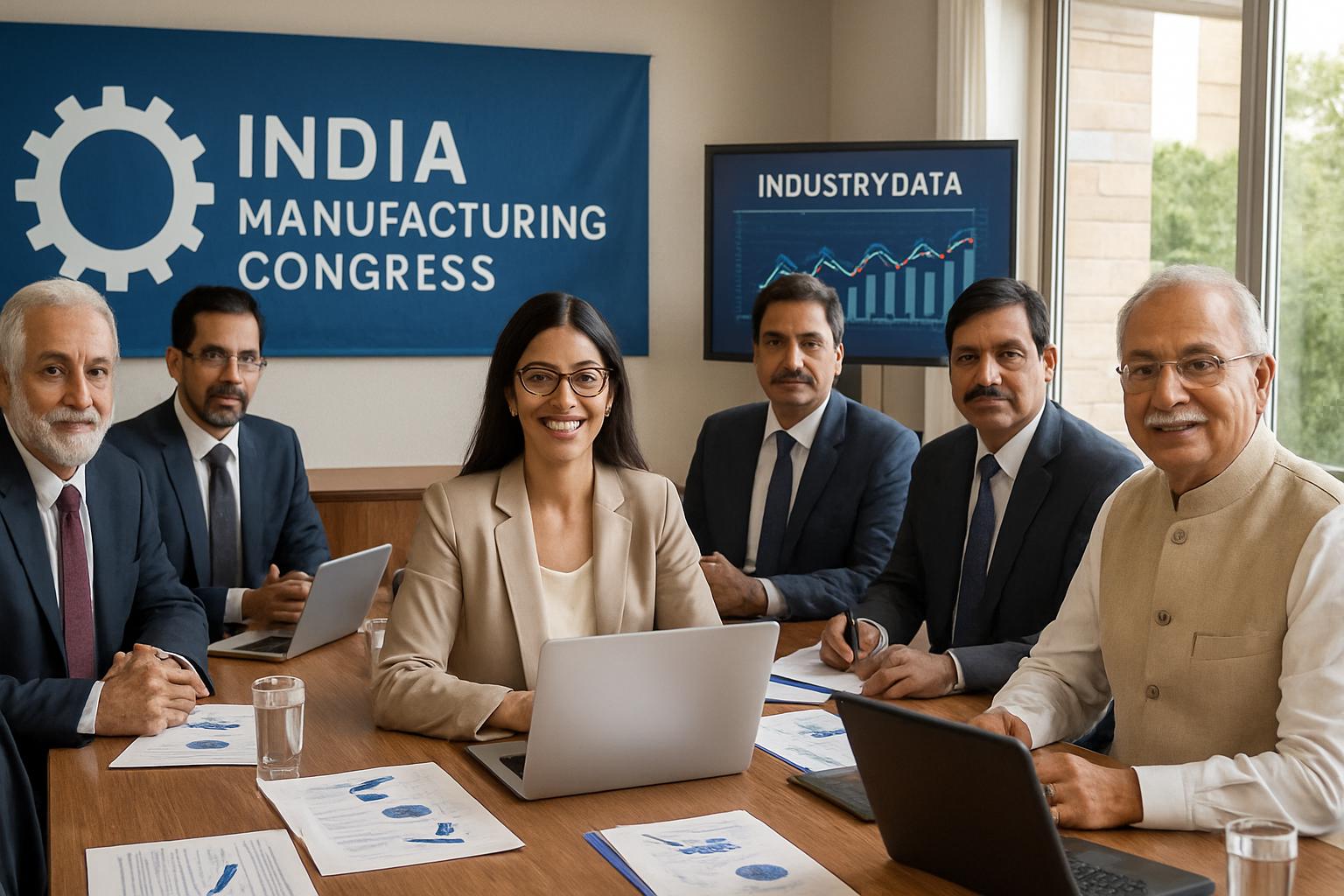
Pune hosted the India AI Manufacturing Congress on 12 December 2025.
Executives from Bajaj Auto, Nagarro, and Oliver Wyman shared factory case studies.
Additionally, they reported automation induced quality improvements of up to 30%.
Ganesh Sahai highlighted predictive maintenance that cuts downtime by 25%.
Meanwhile, Avinash Shinde emphasized real-time analytics boosting textile yield.
The India manufacturing congress spotlight therefore moved from policy to pragmatic toolkits.
Sathya Natarajan described digital twins that simulate production lines within minutes.
Local universities partnered with companies to launch micro-credential programmes following the event.
Delegates agreed that Pune can act as a regional lighthouse for smart factories.
Consequently, other clusters may replicate the model with suitable investment.
Conference insights translate lofty visions into measurable actions.
Next, workforce development determines whether momentum endures.
Skills And Certification Pathways
Human capital underpins every modern factory.
Furthermore, supervisors must master data interpretation, automation controls, and agile processes.
Professionals can enhance their expertise with the AI Project Manager certification.
This credential aligns with AI project lifecycles common on manufacturing floors.
Moreover, certified managers help firms accelerate return on technology investment.
The India manufacturing congress dialogue therefore now includes structured upskilling solutions.
Additionally, soft skills around change management become crucial when robots join human teams.
Workforce readiness complements fiscal and technological inputs.
Finally, strategic alignment of all levers decides the future trajectory.
Future Action Roadmap Ahead
Policy makers should publish transparent progress dashboards tracking incentive disbursement and output.
Industry captains must share advanced machinery playbooks and pooled training resources.
Transparent dashboards could publish disbursement ratios, employment numbers, and export volumes monthly.
Moreover, state governments ought to streamline land and utility approvals within fixed timelines.
Simplified tax procedures would further boost investor confidence.
Meanwhile, academic institutions can embed applied AI modules into engineering curricula.
The India manufacturing congress community can coordinate these initiatives through recurring forums and open data exchanges.
Cross-sector task forces may reconcile overlapping state and central regulations swiftly.
Consequently, India stands at a decisive crossroads.
Concerted action could raise manufacturing to one-fifth of GDP and spark a genuine revolution.
Nevertheless, execution requires unwavering focus, constant measurement, and adaptive strategy.
Readers eager to lead this transformation should explore the cited certification and deepen engagement with forthcoming India manufacturing congress events.


