

AI CERTS
1 hour ago
IAIFI Colloquium: Neural Networks Quantum Fields Frontier
Moreover, sessions stream live on YouTube, extending reach far beyond Cambridge classrooms. Industry engineers, NYU theorists, and venture capital scouts all appear in the chat. Meanwhile, NSF backing under Cooperative Agreement PHY-2019786 lends institutional weight. Viewers appreciate candid Q&A moments, rigorous slide decks, and pragmatic policy talk.
Consequently, the colloquium now shapes public narratives about AI-enabled discovery. This article maps the program’s origins, impact, and future direction. Additionally, it highlights certifications that help professionals ride the same wave.
IAIFI Colloquium Series Overview
IAIFI launched the Physics of AI Colloquium in late 2024 with a clear mission. Therefore, each Friday slot hosts a single, hour-long talk open to anyone. Sessions occur in MIT’s Kolker Room and stream live for remote scholars on YouTube. Archive playlists already hold more than fifty recordings, including February 2026 remarks by Roger Melko. Moreover, attendance averages seventy in-person seats, while online views often exceed 3,000 within a month. Consequently, the colloquium functions as the institute’s public window and recruitment funnel.
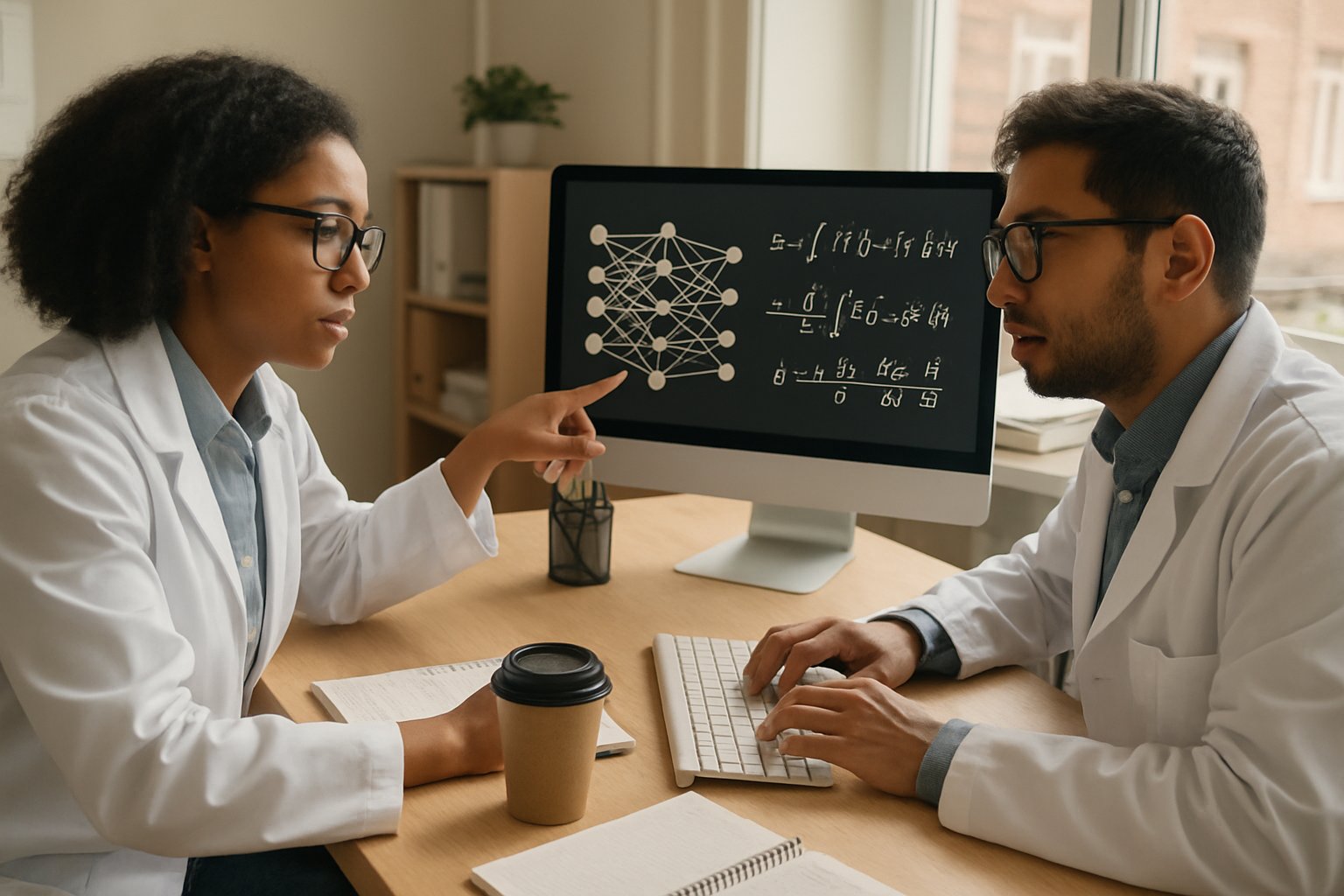
These statistics underline impressive engagement and steady growth. However, scale alone does not capture the technical depth on display. Next, we examine how physics ideas sculpt neural architectures.
Physics Inspires Model Design
Speakers often start with first principles from quantum field theory. Consequently, they translate symmetry constraints directly into layer operations. Equivariant networks, lattice-aware convolutions, and Kolmogorov-Arnold Networks exemplify the approach. Quanta Magazine highlighted KANs as a breakthrough for interpretable science models. Meanwhile, IAIFI researchers demonstrated that Neural Networks Quantum Fields synergy reduces training data by orders of magnitude. Therefore, algorithms respect conservation laws and can output formula-like predictions.
- Equivariant transformers handle LHC jets
- KANs reveal closed-form relations
- Diffusion models generate crystal lattices
Grokking Phase Transition Analogies
Jesse Thaler compares sudden accuracy jumps to phase transitions familiar from condensed-matter physics. Subsequently, such metaphors help students visualize loss-land topography. Therefore, the colloquium frames empirical surprises with rigorous theoretical language.
Physics-aware design sharpens efficiency and transparency. Nevertheless, even advanced models need rigorous validation. Consequently, the series also explores AI’s impact on real experiments.
AI Accelerates New Discoveries
Presentations reveal concrete wins across particle, astrophysics, and condensed-matter domains. For example, IAIFI fellows cut LHC simulation runtimes from hours to seconds. Additionally, Roger Melko showed language models mapping quantum phase diagrams with minimal supervision. NYU speaker Andrew Gordon Wilson detailed probabilistic kernels that calibrate astrophysical inferences. Further, IAIFI teams employ generative flows to design detector hardware configurations.
Neural Networks Quantum Fields alignment again surfaces, guiding hyperparameter choices toward physical realism. Therefore, downstream error bars shrink, boosting experimental sensitivity. The Virtuous Cycle white paper argues generative agents could autonomously suggest LIGO experiments. These physics outcomes are now replicated across multiple labs.
Impact metrics underscore genuine scientific acceleration. However, scaling these successes faces resource and policy pressure. Thus, funding and governance enter the discussion.
Policy Funding Infrastructure Gaps
NSF committed roughly $20 million over five years, yet GPU scarcity persists. Meanwhile, private labs court IAIFI talent with unmatched hardware budgets. In contrast, many public universities struggle to replicate training pipelines showcased on YouTube. The AI+MPS white paper therefore urges benchmark suites, shared clusters, and transparent reporting. Neural Networks Quantum Fields research demands large parameter sweeps, intensifying cost debates. Nevertheless, IAIFI leaders argue that rigorous validation outweighs expense.
Governance choices will shape equity and trust. Consequently, community forums remain vital. Upcoming speaker rosters embody this collaborative push.
Upcoming Talks And Speakers
The spring 2026 lineup features Yuan-Sen Ting, Fernanda Viégas, and Martin Wattenberg. Additionally, Katie Bouman will discuss inverse problems in astronomy. Speakers will provide slide decks before each session, allowing granular preparation. Sessions run Fridays at 2:00 pm ET and stream live for international viewers. YouTube reminders activate automatically 30 minutes before broadcast, ensuring attendance spikes. Neural Networks Quantum Fields will surface again during Wilson’s February session focused on Gaussian processes.
The packed agenda promises fresh technical depth. However, professionals also seek career-oriented guidance. Therefore, skill development opportunities deserve attention.
Practical Skills And Certifications
Continuous learning keeps experts competitive in this fast field. Consequently, the institute recommends structured credentials that cover both AI and quantum theory. Professionals can enhance their expertise with the AI+ Quantum Specialist™ certification. Moreover, this program aligns tightly with Neural Networks Quantum Fields fundamentals taught in the colloquium. NYU partners accept the credential as proof of cross-disciplinary capability. Furthermore, graduates join alumni Slack channels that post institute job openings and live project calls.
- Structured capstone on physics-aware ML
- Access to mentor network
- YouTube archive walkthrough sessions
Targeted certifications convert curiosity into measurable skill. Consequently, they bridge academia and industry. Finally, we recap core insights and next steps.
The IAIFI colloquium illustrates how Neural Networks Quantum Fields reshape research culture. Panelists proved that Neural Networks Quantum Fields collaboration shortens discovery cycles. Moreover, policy debates clarified compute shortages and reproducibility hurdles. Consequently, sustained funding will decide whether Neural Networks Quantum Fields remain inclusive. Professionals therefore should track talks live on YouTube and review archives. Finally, upgrading skills through the linked certification cements readiness for Neural Networks Quantum Fields projects ahead.


