

AI CERTS
4 hours ago
Hyperscale Compute Management: OpenAI’s Multi-Gigawatt Leap
Moreover, NVIDIA, Amazon, Microsoft, and SoftBank now jockey to supply hardware, cloud lanes, and cash. These moves promise unprecedented capacity yet raise new operational, energy, and governance questions. In contrast, analysts caution that letters of intent differ from iron-clad contracts. Meanwhile, local regulators wonder how grids will feed ten-gigawatt server farms. This article unpacks the numbers, players, and risks behind the industrialization drive. It also outlines practical steps for leaders charged with steering Hyperscale Compute Management programs across enterprises.
Industrial Scale Shift Opens
OpenAI’s compute appetite exploded over two years. Aug 2025 disclosures showed capacity up fifteenfold since 2024, fueled by 200,000 GPUs across 60 clusters. Furthermore, infrastructure chief Anuj Saharan told DatacenterDynamics that a single backbone now moves continent-sized traffic volumes. Such scale defines industrial computing, not academic experimentation. Therefore, partners speak in gigawatts rather than racks.
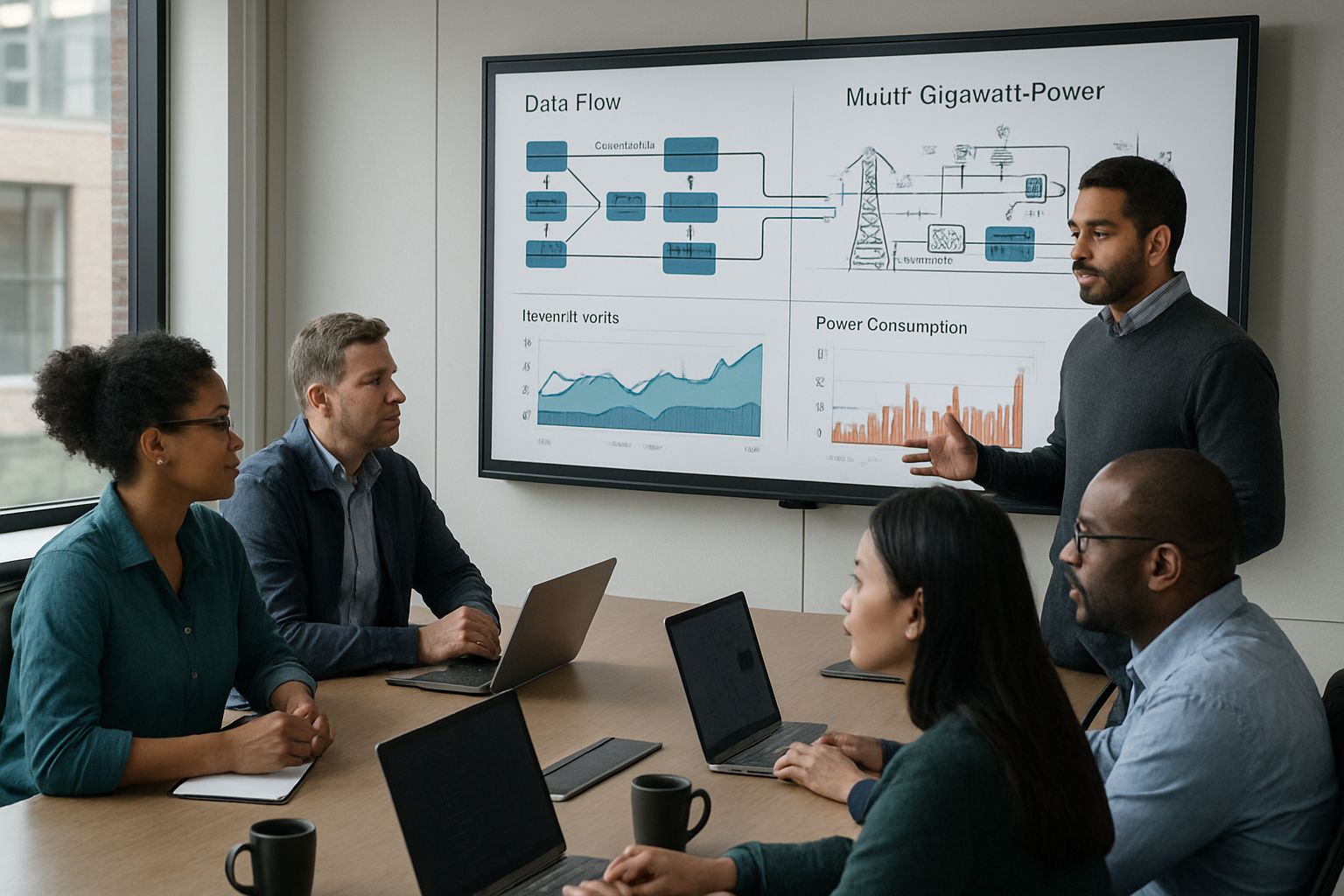
Sam Altman summarized the ambition succinctly. “We’re pushing the frontier across infrastructure, research, and products,” he wrote in February. Consequently, he pledged distinct 3 GW inference clusters and 2 GW training arrays on upcoming Vera Rubin systems.
OpenAI’s public numbers confirm a pivot from labs to factories. However, the energy intensity demands new funding strategies, which the next section explores.
Funding Powers Hyperscale Capacities
Capital is now arriving at record velocity. February’s $110 billion round featured Amazon, NVIDIA, and SoftBank in eye-watering tranches. Moreover, Microsoft refreshed its partnership in October 2025, locking in an additional $250 billion Azure commitment. NVIDIA separately signed a letter promising up to $100 billion as ten gigawatts get installed.
Key funding milestones include:
- $110 billion equity raise—Feb 2026
- $250 billion Azure services contract—Oct 2025
- Up to $100 billion NVIDIA hardware financing—Sept 2025 LOI
Consequently, OpenAI now controls the largest unbuilt data-center pipeline in history. Nevertheless, several pledges remain conditional, as NVIDIA executives recently acknowledged.
These inflows secure initial silicon and land. Yet implementation depends on disciplined Hyperscale Compute Management, discussed below.
Gigawatt Scale Metrics Explained
Engineers translate budget figures into gigawatt targets. One gigawatt can host roughly one million modern accelerators when cooling and redundancy are optimized. Additionally, the metric maps neatly onto utility planning documents, expediting permit reviews. In contrast, GPU counts change quickly as supply shifts. Such scale also stresses surrounding infrastructure, including substations and fiber routes.
OpenAI’s deal with NVIDIA specifies ten gigawatts of hardware, with the first gigawatt online by late 2026. Meanwhile, an Nscale project in Norway promises 100,000 GPUs, equal to roughly a tenth of that slice. Moreover, Microsoft’s Azure contract implies reserved capacity across multiple regions to support both training and inference. Intel also supplies networking ASICs supporting bandwidth to GPUs.
Professionals need precise definitions to budget workloads correctly. Therefore, Hyperscale Compute Management frameworks often pair gigawatt allocations with accelerator generation roadmaps.
Gigawatt metrics align financial, engineering, and regulatory conversations. However, governance of those assets requires careful policy, explored in the next section.
Hyperscale Compute Management Basics
At its core, the discipline balances performance, cost, sustainability, and security across dispersed sites. Moreover, governance models assign accountability for quotas, carbon budgets, and latency guarantees. Intel researcher Sachin Katti argues that transparent telemetry is vital when thousands of racks span vendors.
Consequently, leading enterprises adopt tiered control planes tracking power, water, and accelerator utilization in real time. Hyperscale Compute Management dashboards integrate vendor APIs, grid signals, and internal service-level objectives. Additionally, standards bodies push for portable metadata to ease multi-cloud migrations.
Sachin Katti further warns that algorithm updates can double thermal output overnight if guardrails lag. Therefore, Intel promotes predictive power models tied to compiler optimizations. Nevertheless, many operators still rely on manual spreadsheet tracking.
Effective frameworks cut waste while protecting uptime. The following section examines vendor contracts that shape those frameworks.
Operational Risks Quickly Surface
Huge ambition invites equally huge headaches. In August 2025, cooling failures at an Abilene Stargate site forced day-long inference throttling. Moreover, local commissioners delayed expansion permits until grid upgrades reached consensus. Hyperscale campuses demand flawless logistics across silicon, energy, and talent.
NVIDIA’s CFO later clarified that the $100 billion pledge remains subject to market demand and board approval. Consequently, analysts warn of supply crunches if other buyers pre-empt the same GPUs. In contrast, Microsoft holds a firmer contract, yet still depends on construction timetables outside its direct control.
Hyperscale Compute Management must therefore include contingency runbooks and multicloud failover drills. Additionally, teams should pre-position spare parts to reduce mean-time-to-repair. Sachin Katti suggests automated admission control that pauses noncritical jobs during thermal excursions. Legacy infrastructure often overheats when experimental workloads slip into production schedules.
Operational setbacks can derail even well funded schedules. However, strategic contracts and rehearsed playbooks mitigate the fallout, as the next section shows.
Strategic Talent Impacts Teams
Compute scale changes hiring patterns. Moreover, vendors now court power engineers alongside ML researchers. OpenAI posted dozens of roles for grid negotiations, carbon accounting, and large fleet reliability.
Intel training evangelist Sachin Katti notes that compiler specialists now receive similar compensation to model architects. Consequently, universities expand curricula covering accelerators, cooling, and Hyperscale Compute Management theories. Additionally, professionals can validate skills through the AI Cloud Architect™ certification.
Such credentials assure employers that candidates understand multigigawatt cost curves. Nevertheless, on-call rotations still teach realities impossible to replicate in classrooms.
Talent gaps widen when compute scales this fast. Therefore, upskilling remains critical before final capacity ramps considered in the last section.
Roadmap For Tech Leaders
Executives planning next-generation workloads should benchmark against OpenAI timelines. First, insist on transparent milestone payments tied to delivered gigawatts, not aspirational letters. Moreover, integrate Hyperscale Compute Management dashboards early rather than retrofitting after racks arrive.
Action checklist:
- Model demand under multiple GPU supply scenarios.
- Secure renewable energy agreements paralleling capacity buildouts.
- Create cross-functional crisis drills every quarter.
- Invest in accredited upskilling programs.
Additionally, collaborate with regulators to shorten interconnection reviews while meeting sustainability mandates. In contrast, ignoring outreach can delay ground-breaking by months.
Hyperscale Compute Management success finally requires clear exit criteria for deprecated hardware. Consequently, plan auction or reuse strategies before next generations ship.
Disciplined roadmaps turn giant capital projects into sustainable advantage. However, leaders must commit now as upgrade cycles accelerate continuously.
OpenAI’s megaprojects illustrate the new reality of industrial AI. Moreover, billions in capital mean little without disciplined capacity governance guarding uptime, cost, and carbon. Infrastructure leaders should internalize gigawatt math, vendor conditionality, and operational playbooks discussed here. Consequently, now is the moment to upskill teams before construction cranes arrive. Professionals can deepen expertise through the earlier mentioned AI Cloud Architect™ program. Act today and ensure your organization thrives across the coming exascale frontier.


