

AI CERTS
2 hours ago
Hugging Face probes AI Carbon Footprint disclosure
This article unpacks the new AI Energy Score, the ChatUI-Energy demo, and the research behind them. It also reviews key statistics, limitations, and next steps for stakeholders seeking lower-impact artificial intelligence. Moreover, we examine how task-specific systems outperform general models in both CO2 and cost. We close with actionable guidance and certification resources for professionals driving greener deployments. In contrast, unchecked growth could push data centers toward double-digit grid shares within five years, researchers warn.
Why Energy Transparency Matters
Electric demand from AI may hit 100 TWh this year, according to the new leaderboard materials. Moreover, projections reach 1,370 TWh by 2035, rivaling medium-sized nations. Therefore, transparency enables early intervention before infrastructure strains society. Dr. Sasha Luccioni says the score "addresses a key blocker for reducing AI's environmental impact". Consequently, enterprises finally gain a common language for sustainability clauses in contracts.
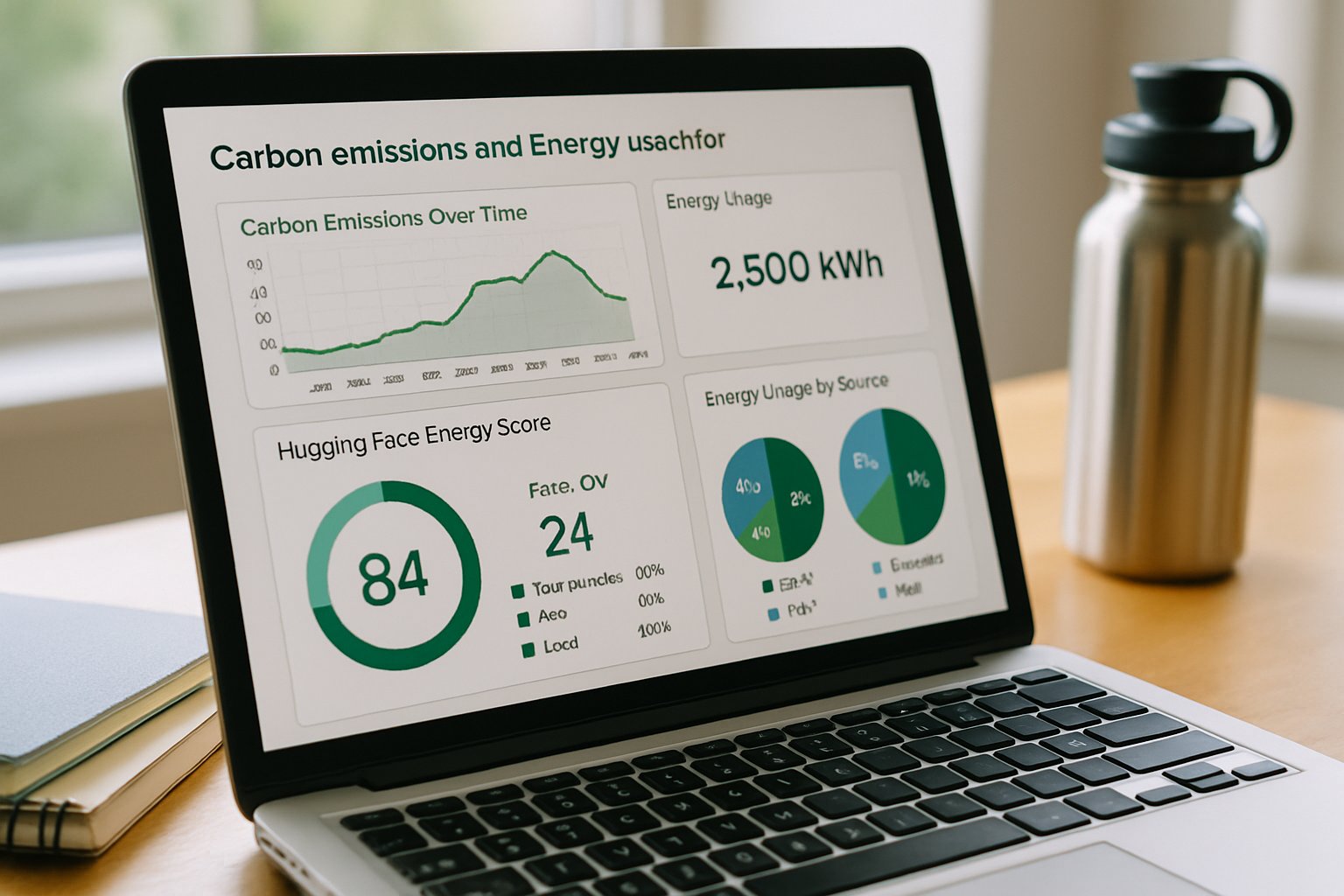
Yet visibility alone will not curb the absolute AI Carbon Footprint if demand grows unchecked. In contrast, labeling must pair with pricing signals and procurement rules to avoid rebound effects. These insights underline transparency's importance and its limits. Furthermore, understanding the scoring system itself clarifies where numbers originate.
Inside AI Energy Score
The AI Energy Score rates 166 models across ten tasks using a five-star scale. Benchmarks run on H100 GPUs with standard datasets, while CodeCarbon infers power draw and CO2 equivalents. Moreover, the leaderboard publishes watt-hours, star ratings, and hyperlinks to underlying runs for replication. Independent academics helped refine protocols, boosting credibility. Ultimately, the metric lets teams estimate their AI Carbon Footprint before deployment.
Consider extractive question answering. A narrow model emitted 0.3 g carbon-dioxide equivalent per thousand calls; a multi-purpose alternative emitted 10 g. Consequently, businesses gain a tangible metric for energy return on investment.
- Models benchmarked: 166 across 10 tasks
- Electricity context: 100 TWh annual AI demand
- Star range: one to five based on kWh per task
- Data center share: up to 12% U.S. grid by 2028
These numbers illustrate scale and urgency. However, front-end visibility also matters to steer user behavior. Subsequently, Hugging Face shipped a real-time counter for every chat request.
Per-Chat Energy Insights Tools
ChatUI-Energy estimates electricity while users type, echoing nutrition labels for software. Clément Delangue argues that ingredient-style disclosure will build pressure for efficient design. Additionally, developers can wire the widget into their own front ends with minimal code changes.
Early testers report surprise when general chat models draw more power than task-specific bots. Meanwhile, water usage appears in the report because cooling systems devour significant litres per kilowatt-hour. Consequently, responsible teams must track heat as well as carbon dioxide. A dynamic banner visualises the AI Carbon Footprint per conversation, nudging users toward greener models. These live insights close the awareness gap.
ChatUI-Energy embeds sustainability into daily workflows. Next, we explore why narrow models often win the efficiency race.
Task Specificity Energy Advantage
The FAccT paper shows dramatic differences between narrow and general architectures. For summarization, researchers recorded a ten-fold emissions gap using identical hardware and datasets. Moreover, precision grows because small vocabularies reduce unnecessary token generation. Therefore, choosing specialized checkpoints slashes both latency and the AI Carbon Footprint.
However, managers sometimes prioritise flexibility over efficiency. A balanced portfolio may combine small expert models with fallback general systems.
- Specialized model: 0.3 g carbon-dioxide equivalent per 1,000 calls
- General model: 10 g carbon-dioxide equivalent for the same workload
- Energy ratio: ~30× lower for narrow approach
Nevertheless, continuous monitoring remains essential because traffic patterns shift. With measurement covered, we must examine remaining blind spots.
Measurement Limits And Gaps
The AI Energy Score focuses solely on inference. Training energy, hardware manufacturing emissions, and supply chain water usage stay outside scope. Furthermore, power usage effectiveness, regional grid mix, and batching strategies vary widely. Consequently, real deployments may deviate from leaderboard rankings.
Estimation tools like CodeCarbon approximate CO2 based on average hardware draw, introducing uncertainty. In contrast, on-chip sensors or utility meters would yield higher fidelity. Rebound effects also threaten progress because efficiency savings can spark higher demand. Ignoring training inflates accuracy metrics while hiding a sizable share of the AI Carbon Footprint.
These limitations caution against overconfidence in any single metric. Nevertheless, policy momentum may bridge several gaps.
Policy Momentum And Risks
European regulators already draft rules requiring lifecycle disclosures for large models. Moreover, enterprise procurement teams use the AI Energy Score templates to request emissions data. Consequently, vendors without numbers risk exclusion from climate-aligned contracts. However, inconsistent standards could confuse buyers and inflate compliance costs.
Cloud providers lobby for flexible baselines, citing water usage variations across regions. Meanwhile, researchers push for unified digital product passports that include training CO2, inference, and hardware impact. Proposed EU labels would print the AI Carbon Footprint beside other resource indicators. Balancing ambition with feasibility will define the next regulatory cycle.
Momentum is real, yet fragmentation threatens effectiveness. Therefore, collaborative roadmaps become the logical next step.
Next Steps For Stakeholders
Developers should run the open benchmarks on their own hardware to validate scores. Additionally, cloud architects can tune batching, quantization, and caching to lower the AI Carbon Footprint further.
Procurement leads ought to embed energy clauses referencing the leaderboard and per-chat counters. Meanwhile, policymakers must harmonize definitions of CO2, emissions, and water usage across jurisdictions.
Professionals can enhance credibility with the AI Researcher™ certification. Moreover, certified experts gain tools for continuous measurement and governance.
These actions translate research into operational gains. Consequently, the collective AI Carbon Footprint can trend downward.
Conclusion
Greener intelligence demands data, discipline, and disclosure. Hugging Face’s investigation delivers the data and a roadmap. Moreover, live chat counters and star ratings empower both engineers and executives. Nevertheless, training energy, rebound effects, and policy fragmentation still threaten real progress. Therefore, ongoing measurement and certified expertise will decide whether the AI Carbon Footprint shrinks or balloons. Additionally, share your findings to accelerate industry learning and collective action. Take the next step by auditing your workloads and pursuing advanced sustainability credentials today.


