

AI CERTs
2 hours ago
Hubble AI Scan Reveals 1,300 Anomalies in 35 Years of Data
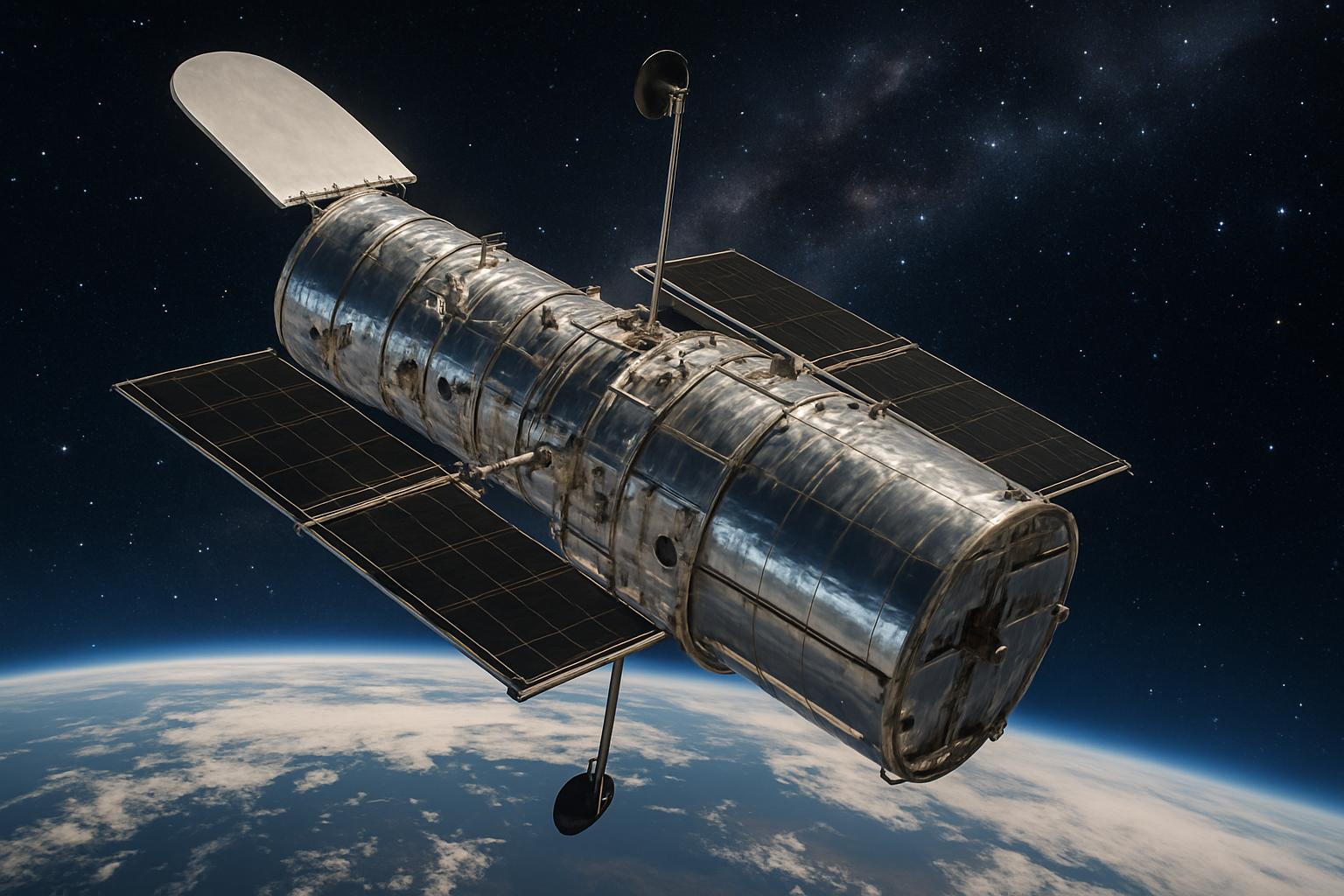
Thirty-five years of Hubble observations once sat dormant in archives. Nevertheless, astronomers David O’Ryan and Pablo Gómez have now mined that trove using an automated pipeline. Their Hubble AI scan examined 99.6 million image cutouts in under three days and flagged more than 1,300 unusual objects. Consequently, long-hidden lenses, mergers, and other curiosities emerged for the first time. This news excites survey planners, data scientists, and business leaders focused on scalable analytics. Moreover, the study previews how artificial intelligence will handle even larger sky surveys arriving soon.
Peer reviewers have accepted the work for Astronomy & Astrophysics. The catalog, imagery, and code sit openly on Zenodo and arXiv, inviting immediate follow-up. Meanwhile, ESA and NASA press teams highlighted the speed and breadth of the results. The Hubble AI scan story therefore illustrates AI’s growing role in research operations and data monetization.
Archival Goldmine Unlocked Fast
Hubble’s Legacy Archive holds processed frames from 1.5 million observations. Previously, manual searches covered only fractions of that corpus. However, AnomalyMatch changed the scale equation. The neural network ranked each 150×150-pixel stamp by its deviation from training data. Additionally, active learning let human reviewers steer the model toward genuine oddities while reducing false positives.
The full sweep finished in roughly 60 computing hours. In contrast, inspecting the same volume by eye would need centuries. Therefore, combined human-machine workflows now unlock legacy archives for fresh science. These gains underline the economic value of automated data curation. The approach also signals future commercial opportunities in other industries that manage vast unstructured image stores.
AnomalyMatch’s success emphasizes one takeaway. Speedy archival mining boosts the return on expensive instrumentation investments. However, rigorous vetting must still follow every candidate.
These efficiency gains set the stage for deeper analysis. Consequently, stakeholders demanded concrete numbers, which the next section supplies.
Inside AnomalyMatch AI Pipeline
The authors built AnomalyMatch around semi-supervised convolutional networks. Furthermore, they injected active learning loops that presented the strangest cutouts to experts after each training round. This feedback pruned artefacts and refined decision boundaries.
The model ingested images in a single filter, F814W, standardizing inputs. Subsequently, it generated anomaly scores across the 99.6 million set. Engineers then reviewed the top 0.002% ranked tiles. Each accepted object entered an 18-class taxonomy, ranging from strong lenses to jellyfish galaxies.
Implementation ran on modest GPU clusters, highlighting practical accessibility. Moreover, inference pipelines interfaced directly with the Hubble Legacy Archive API, reducing storage shuffling. Therefore, similar systems can attach to other mission archives with minimal retooling.
This technical architecture delivered the headline catalog quickly. Nevertheless, single-filter limitations constrain immediate physical interpretation, as discussed later. Yet, the pipeline blueprint already guides teams preparing for Euclid and Rubin’s multi-petabyte flows.
Efficiency and adaptability define AnomalyMatch’s core strengths. Consequently, the project draws cross-industry interest in image anomaly detection.
Key Findings And Counts
Exact totals vary by dataset version. ESA’s press note cites “more than 1,300” anomalies, while the initial Zenodo drop lists 1,255. Regardless, the scale impresses scientists accustomed to double-digit discoveries in previous surveys.
- Candidate strong gravitational lenses: 138–219
- Mergers or interacting galaxies: about 400–630
- Jellyfish galaxies: 18–37 rare examples
- Objects unseen in literature: over 800 entries
These numbers represent candidates needing confirmation. Additionally, the catalog assigns confidence scores for triage. Researchers can download thumbnails, cross-match positions, and propose spectroscopic follow-up.
Moreover, business analysts see another benefit. Public-domain discoveries lower entry barriers for citizen science platforms and ed-tech content. Consequently, new engagement models could arise around curated anomaly sets.
Overall, the breadth of Hubble AI scan results demonstrates AI’s capacity for large-scale cosmic discoveries. However, data limitations require cautious interpretation, as the next section explains.
Benefits For Future Surveys
Euclid, Rubin Observatory, and NASA’s Roman Telescope will generate nightly data torrents. Therefore, automated anomaly detection becomes mission-critical. AnomalyMatch offers a proven template, with open code enabling quick replication.
Furthermore, early classification accelerates community science. Teams can schedule follow-up time on smaller telescopes before transients fade. Meanwhile, large datasets teach models subtler astrophysical patterns, improving future precision.
Enterprise technologists should note the transferable lessons. Active learning reduces annotation budgets, while semi-supervised methods exploit unlabeled pools. Consequently, operational cost curves bend downward.
The Hubble AI scan also validates metadata pipelines vital for compliance in regulated sectors. For example, medical imaging archivists wrestle with privacy-preserving anomaly detection. In contrast, public Hubble data lifts that constraint, allowing rapid experimentation.
These forward-looking benefits highlight strategic urgency. Nevertheless, users must respect current shortcomings before wholesale adoption.
Scaling With NASA Images
Future missions will eclipse current NASA images volumes by orders of magnitude. However, the AnomalyMatch logic scales linearly across distributed GPUs. Consequently, capacity planning appears manageable.
Moreover, open catalogs enrich training sets, seeding better priors for new instruments. Therefore, cross-mission synthesis becomes feasible, nurturing even broader cosmic discoveries.
This synergy marks a pivotal moment for data-driven astronomy. Yet, limitations still temper expectations, as outlined next.
Limitations And Cautions Explained
Several caveats accompany the excitement. Firstly, the catalog relies on single-filter greyscale stamps. Consequently, redshift estimates and physical parameters remain uncertain.
Secondly, versioning changes shift object counts, confusing casual readers. However, transparent release notes mitigate that risk. Additionally, the authors welcome independent verification.
Algorithmic bias poses another concern. Training data may underrepresent certain morphologies, inflating anomaly scores artificially. Nevertheless, human vetting reduced obvious artefacts.
Finally, many candidates overlap crowded fields. Therefore, spectroscopic or multi-band imaging must confirm each classification. Until then, headlines should avoid definitive labels.
These constraints remind practitioners to pair AI methods with domain expertise. Consequently, balanced strategies emerge that maximize discovery while guarding against hype.
Expert Reactions And Context
Leading astronomers laud the achievement. “This is a fantastic use of AI to maximise the scientific output of the Hubble archive,” Gómez noted. Moreover, independent researchers view the work as a dress rehearsal for Rubin’s nightly stream.
Industry analysts echo that sentiment. They observe parallels with finance, security, and healthcare anomaly detection workflows. Furthermore, open data releases shorten innovation cycles across sectors.
Meanwhile, ESA communications lead Bethany Downer framed the project as an “archival goldrush.” Journalists covering NASA images now reference the dataset when illustrating AI’s transformative impact.
Overall, the discourse signals growing appreciation for interdisciplinary teams blending astrophysics, machine learning, and scalable engineering.
These endorsements reinforce confidence in AnomalyMatch. However, professionals still seek actionable guidance, delivered in the final section.
Practical Takeaways For Professionals
Data leaders can apply three immediate lessons:
- Automate archival audits early, leveraging semi-supervised models.
- Embed active learning to prioritize human review efficiently.
- Release interim catalogs to crowdsource validation and adoption.
Furthermore, professionals can enhance their expertise with the AI Robotics™ certification. The coursework covers anomaly detection pipelines, GPU acceleration, and ethics—skills showcased by the Hubble AI scan.
Adopting these practices drives competitive advantage across markets handling massive imagery. Consequently, organizations improve insight velocity and foster novel cosmic discoveries within their own domains.
These actionable points equip readers for immediate experimentation. Shortly, the conclusion will consolidate the article’s essential insights.
Conclusion
The Hubble AI scan converted decades of dormant data into a catalog rich with scientific promise. Additionally, the AnomalyMatch pipeline showcased scalable, semi-supervised techniques that slashed processing time. Researchers uncovered hundreds of new lenses, mergers, and other anomalies inside familiar NASA images, revealing unexpected cosmic discoveries. However, single-filter constraints and candidate status necessitate cautious follow-up. Nevertheless, the project offers a transferable template for forthcoming surveys and commercial applications alike. Ready to harness similar capabilities? Explore the linked certification and start building your own anomaly detection success stories today.


