

AI CERTs
2 months ago
How spatial interior intelligence platforms elevate smart offices
Hybrid work, climate imperatives, and cost pressure are colliding. Consequently, facility leaders now seek data-rich answers, not guesswork. Spatial interior intelligence platforms deliver those answers by fusing 3D capture, live sensors, and AI analytics into a single spatial model. Moreover, the approach links geometry with behaviour, revealing how every square foot performs. Early adopters report faster decisions and lower energy bills, yet many executives still ask what the technology really offers. This article explains the market, technologies, vendors, benefits, and pitfalls surrounding spatial interior intelligence platforms.
Rapid Market Momentum Drivers
Several macro trends push adoption. Firstly, real estate teams face persistent vacancy and rising energy costs. Future Market Insights values the broader spatial computing sector at USD 168.6 billion for 2025, growing 18.2% annually. Secondly, CoStar’s 2025 acquisition of Matterport signals heavyweight belief in spatial interior intelligence platforms as a revenue catalyst. Moreover, Microsoft is commercialising Places, integrating occupancy inputs into Teams and Copilot workflows.
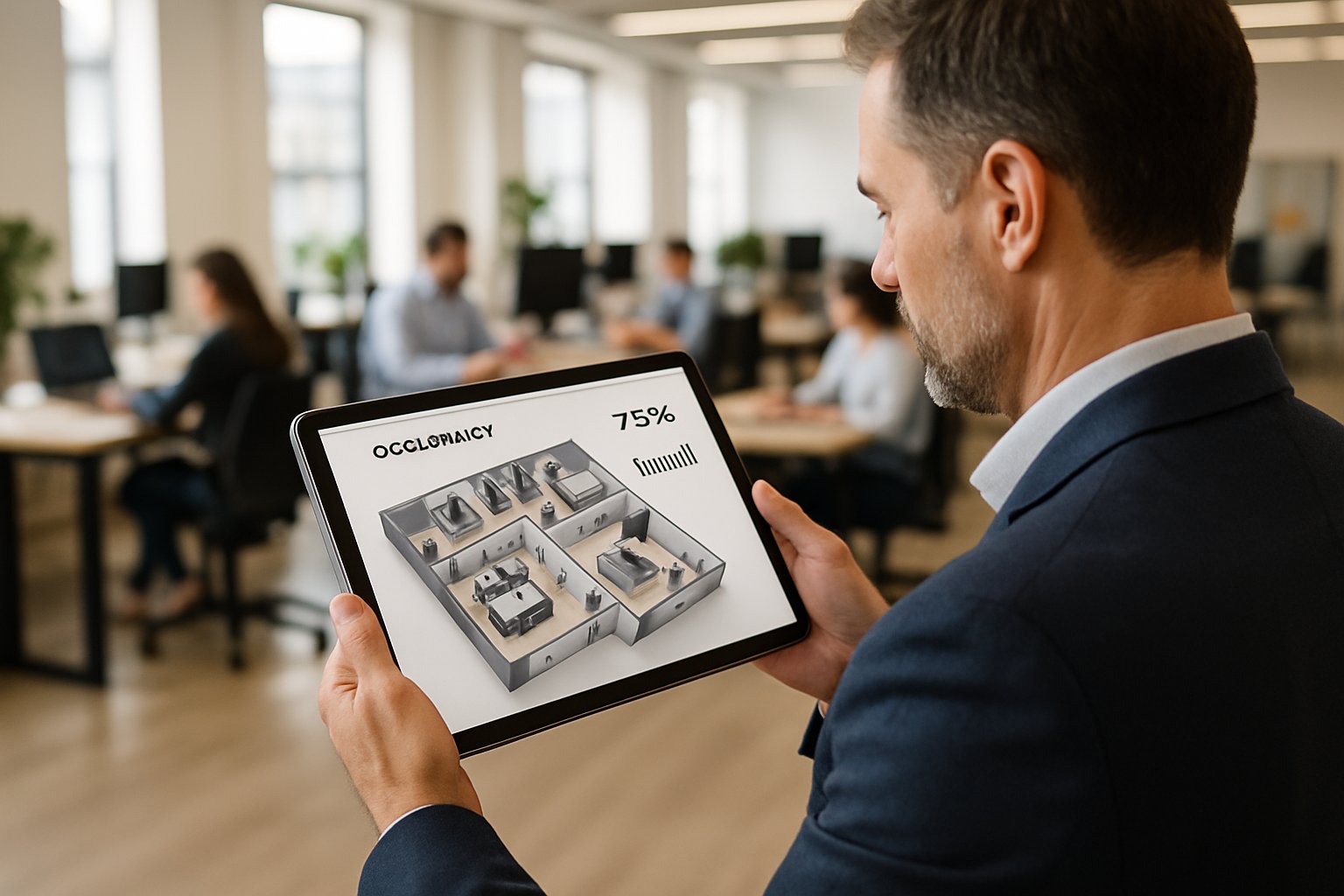
Meanwhile, analysts forecast the building digital twin segment hitting between USD 3.1 billion and USD 6.4 billion this year. Variance stems from hardware scope and service assumptions. Nevertheless, double-digit growth appears consistent across reports.
- Vendor reach: Matterport claims 50 billion+ sqft digitised.
- Dataset depth: VergeSense models train on 200 million sqft of occupancy data.
- ROI claims: Consulting studies cite up to 30% maintenance savings.
These indicators highlight accelerating demand. However, buyers still evaluate risk. Therefore, understanding the technology stack is essential.
These drivers set an urgent context. Consequently, the next section unpacks the enabling architecture.
Evolving Core Technology Stack
Capture technologies come first. Matterport pairs LiDAR with photogrammetry, while NavVis offers backpack scanners. Additionally, smartphone LiDAR democratises small surveys. Edge devices follow. VergeSense’s Infinity sensor delivers on-device AI and ten-year batteries, while Butlr opts for anonymous thermal arrays.
Middleware glues the puzzle together. Autodesk Tandem exposes a Data API linking BIM objects to live telemetry. In contrast, Azure Digital Twins models spatial topology for queryable relationships. Consequently, AI space planning algorithms can test seating layouts instantly.
Finally, application layers turn raw signals into actions. Microsoft Places recommends desk bookings through Copilot. Energy platforms drive demand-controlled ventilation when zones empty. Hence, spatial interior intelligence platforms orchestrate full loops from capture to automation.
Core components form a layered system. Moreover, interoperability challenges demand careful vendor selection, discussed next.
Key Vendor Landscape Overview
Platform competition intensifies across categories. CoStar now merges listing data with Matterport twins for immersive marketing. Meanwhile, Autodesk courts facility managers through Tandem’s monitoring beta. Microsoft anchors its ecosystem around Places and Teams integrations.
Specialists also expand scope. VergeSense now bundles Meridian predictive planning to extend beyond counting heads. Butlr champions privacy-first heat sensing. Facilio, Redleaf, and Akila weave spatial intelligence into CMMS dashboards, pushing commercial design automation workflows.
Service giants shape rollouts. JLL built tools to auto-convert floor plans into Apple’s IMDF, accelerating Microsoft Places deployments. CBRE and Procore pursue similar integrations, ensuring clients avoid data re-entry.
The vendor matrix keeps evolving. Therefore, procurement teams must align strategy with long-term roadmaps.
Understanding providers clarifies options. However, value lies in use cases, explored next.
Use Cases And ROI
Organisations deploy spatial interior intelligence platforms across diverse scenarios. Real-estate brokers embed 3D tours within listings, shortening deal cycles. Construction firms cut survey effort by up to 70% when digitising as-built conditions. Moreover, occupancy analytics underpin AI space planning that right-sizes portfolios.
Energy savings drive another wave. HVAC schedules now reference live zone utilisation, lowering consumption when wings sit idle. Additionally, cleaning rounds optimise based on verified traffic rather than static calendars.
- Marketing immersion boosts click-through rates by double digits, according to Matterport case studies.
- Predictive planning tools model exit versus reuse scenarios within minutes instead of weeks.
- Demand-driven ventilation contributes to 10-30% energy reductions in pilot sites.
Professionals can deepen expertise through the AI+ Engineer™ certification, positioning themselves for platform deployment roles.
These benefits illustrate tangible value. Nevertheless, deployment remains challenging, as the next section explains.
Major Implementation Hurdles Ahead
Data fragmentation tops the list. Vendors still use incompatible schemas, impeding cross-tool workflows. Furthermore, building owners wrestle with labour approvals because occupancy sensing raises privacy questions.
Cost presents a parallel obstacle. Capture hardware, sensor networks, and integration services can exceed initial budgets. Consequently, pilots often stall at one floor rather than scaling portfolio-wide.
Independent benchmarking also lacks maturity. Vendor accuracy claims rarely face peer-reviewed validation. Meanwhile, facilities teams struggle to model baseline metrics, making ROI attribution difficult.
Challenges threaten momentum. However, regulatory clarity can mitigate risk, discussed below.
Regulatory And Privacy Considerations
Europe’s GDPR and several US state laws restrict biometric data use. Therefore, many buyers prefer thermal or edge-processed vision systems that avoid identifiable footage. Microsoft documented works-council consultations before internal Places rollout, offering a playbook.
Moreover, transparent data retention policies build employee trust. Anonymisation, aggregation, and role-based access controls should appear within procurement checklists. Subsequently, facilities leaders must align with IT security and HR colleagues during planning.
Clear policies can unlock adoption. Nevertheless, future innovation still shapes long-term trajectories.
Future Outlook And Actions
Analysts predict continued double-digit growth as hybrid work stabilises. Additionally, large language models will soon query spatial twins conversationally, blending AI space planning with commercial design automation in real time. CoStar’s data trove plus Matterport imagery foreshadows data-driven leasing ecosystems.
Meanwhile, open standards efforts gain momentum. JLL’s IMDF tooling hints at format consolidation. Moreover, sensor hardware costs trend downward, reducing entry barriers.
Leaders should pilot narrowly, document baseline metrics, and advocate privacy-first architectures. Consequently, teams will capture early ROI while preparing for scale.
These trends close the strategic loop. The following conclusion summarises core insights and next steps.
Spatial interior intelligence platforms now sit at the convergence of sensing, AI, and real estate strategy. They power AI space planning, enable commercial design automation, and deliver measurable savings. However, fragmentation, cost, and privacy remain real hurdles. Nevertheless, forward-looking organisations that pair disciplined pilots with strong governance will capture outsized value. Professionals should therefore explore the linked certification, deepen technical fluency, and position themselves at the forefront of spatial intelligence transformation.


