

AI CERTs
3 months ago
How Insurance Claims Triage Engines Slash Settlement Time
Severe weather, rising repair costs, and digital-first consumers are squeezing U.S. carriers. Consequently, management teams are hunting for technologies that shorten painful settlement cycles. Among the most promising tools are insurance claims triage engines powered by advanced artificial intelligence. These engines screen incoming losses, predict complexity, and route simple cases straight to payment. Furthermore, vendors now pair computer vision with large language models to push decisions even faster. Early adopters report cycle times collapsing from weeks to hours for low-severity auto and property claims. Meanwhile, regulators warn that algorithmic shortcuts can embed bias if left unchecked. This article examines the market drivers, core technologies, benefits, risks, and practical steps for deployment. Therefore, we explore real performance data and regulatory expectations shaping adoption through 2026. By the end, readers will know where to invest and how to govern next-generation claims operations.
Market Forces Accelerate Adoption
U.S. insurers spent an estimated $3 billion on AI claims software in 2025, according to Fortune Business Insights. Moreover, analysts project compound annual growth above 30 percent through 2030.
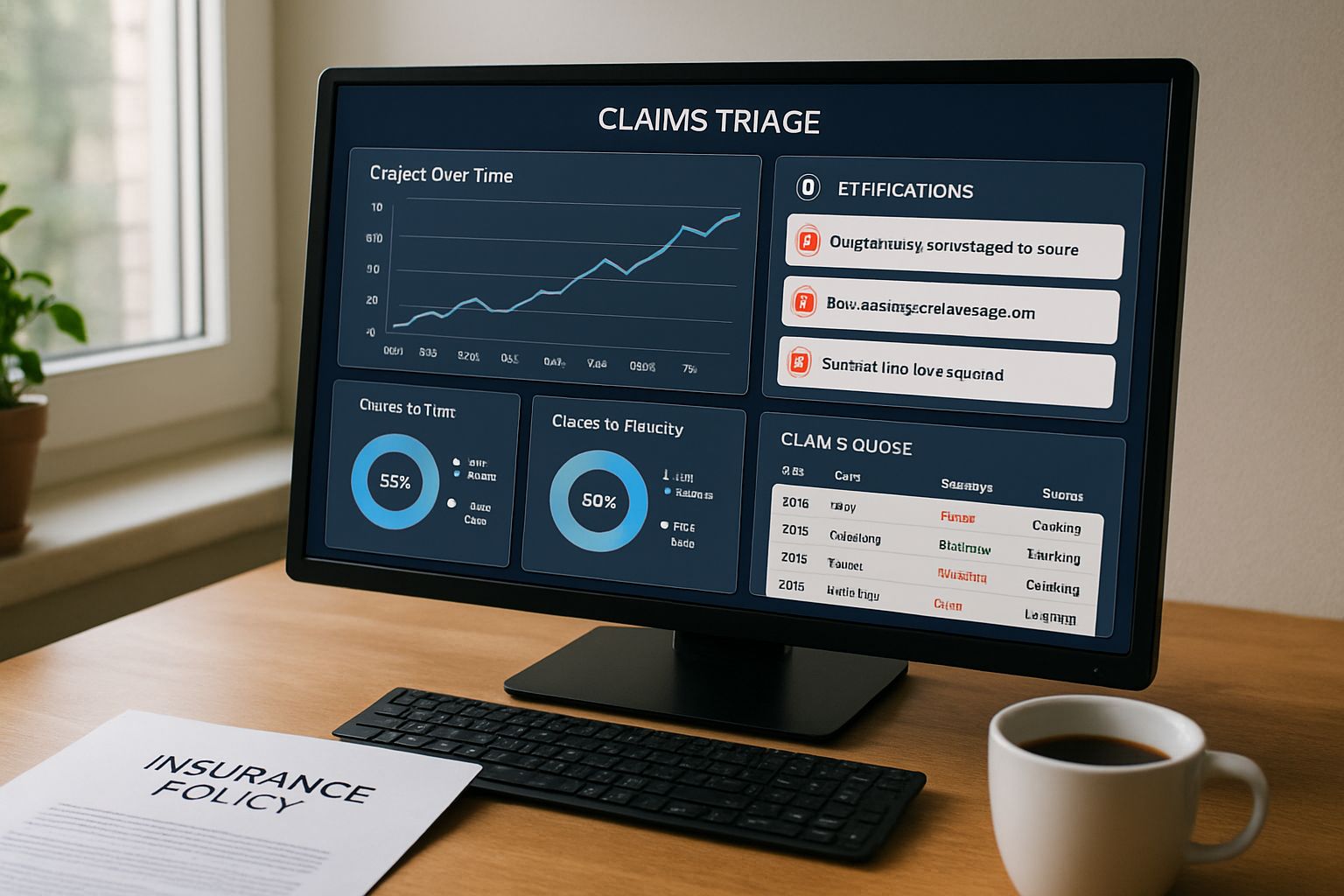
Several converging pressures explain the spending surge. Firstly, customer surveys from J.D. Power show time-to-settle as the strongest loyalty driver. Secondly, repair networks still face parts shortages, making triage speed critical for shop scheduling.
Insurance claims triage engines satisfy both demands by removing idle days between process handoffs. Consequently, carriers such as Lemonade advertise instant decisions on a subset of renters claims. Traditional giants also accelerate; Allstate and State Farm highlight digital FNOL uptake in earnings calls.
Vendors feel the pull. Shift Technology launched agentic decision modules, while Tractable expanded computer-vision property models during 2024.
Demand signals show no signs of slowing. However, success depends on the underlying technology stack, which we review next.
Core Technology Components Explained
Modern triage solutions blend several AI disciplines into one orchestrated workflow. Computer vision models parse damage photos and estimate repair costs within seconds. Meanwhile, large language models summarize adjuster notes and vendor invoices.
A predictive layer forecasts time-to-settle, fraud probability, and reserve needs. Furthermore, loss assessment AI scores severity using geolocation, weather feeds, and policy history. These scores guide insurance claims triage engines when choosing touchless or human workflows.
Another essential piece is claims automation middleware that connects core systems with third-party APIs. Guidewire, Verisk, and CCC sell connectors that push AI assessments into payment queues.
Finally, audit logs and explainability layers record every model decision for regulator review. Therefore, carriers can trace an output back to the exact data point if challenged.
Each component must integrate seamlessly. Subsequently, carriers unlock the cycle-time gains promised by these systems. Yet, technology alone is insufficient without clear regulatory guardrails.
Regulators Tighten Oversight Rules
State insurance departments have rushed to adopt NAIC’s 2023 model bulletin. Consequently, over twenty states now demand written AI governance programs from carriers.
Commissioners require documentation whenever insurance claims triage engines influence coverage or payment decisions. Moreover, carriers must test for disparate impact and disclose meaningful factors to policyholders.
Maryland’s Kathleen Birrane argues the bulletin balances innovation with consumer protections. Nevertheless, many CIOs admit their monitoring tools remain immature.
Failure to comply carries tangible risk. Recent litigation challenges alleged improper reliance on claims automation algorithms for denials. Therefore, boards are funding audit capacity and ethics training aggressively.
Regulators have set clear expectations. In contrast, technical teams must now operationalize those expectations at scale. The payoff makes the effort worthwhile, as the next section explains.
Business Benefits And Costs
Faster settlement directly drives customer satisfaction. J.D. Power links each shaved day to measurable Net Promoter Score increases.
Insurance claims triage engines also reduce loss adjustment expense by freeing adjusters for complex claims. Moreover, Tractable reports partners saving up to two weeks per auto claim.
Cost advantages extend beyond labor. Loss assessment AI improves reserve accuracy, lowering capital buffers. Shift Technology shows fraud scoring catching suspicious patterns earlier, preventing leakage.
- Same-day payouts on 30 % of renter claims at Lemonade
- Up to 15 % LAE reduction in Tractable partner pilots
- 80 % faster fraud triage using Shift agentic tools
However, savings come with integration and licensing costs that vary by carrier scale. Guidewire connector fees and cloud compute charges can erode margins if volumes remain low.
Straight Through Processing Impact
Touchless workflows deliver the most dramatic cycle compression. Yet, current straight-through rates seldom exceed 15 % portfolio-wide, according to industry surveys. Consequently, many carriers first target glass, tow, or minor water claims where rules are simple.
Insurance claims triage engines raise STP rates by flagging only ambiguous files for human review.
Financial upside grows as STP expands. Subsequently, managers must weigh risks that could offset those gains. Operational hazards and mitigation tactics follow in the next section.
Operational Risks And Controls
Bias represents the most visible threat. In contrast, over-correction can slow genuine claims, hurting brand reputation.
Models trained on skewed data may undervalue minority neighborhoods during photo appraisal. Therefore, firms run fairness tests before each release and monitor live drift signals.
Explainability dashboards show which pixels drove a decision, satisfying emerging rules. Additionally, human review triggers activate when confidence scores fall below configured thresholds.
Scaling these controls requires disciplined vendor oversight. Insurance claims triage engines often depend on third-party models that update weekly. Consequently, carriers must approve each change and maintain rollback plans.
Good governance preserves speed without sacrificing trust. Meanwhile, a practical roadmap helps teams embed controls efficiently. The following section outlines such a roadmap.
Implementation Roadmap For Carriers
Successful rollouts start with problem definition, not technology selection. Teams first map claim categories by volume, severity, and data availability.
Next, a pilot introduces loss assessment AI and claims automation within a narrow scope. Therefore, leaders can measure baseline cycle time and accuracy before scaling.
Data governance runs in parallel. Written AI policies, model inventories, and third-party risk assessments satisfy most state requirements. Professionals can enhance their expertise with the AI Ethical Hacker™ certification.
Scaled deployment follows once metrics hit predefined thresholds. Moreover, continuous monitoring dashboards alert teams if model drift or queue backlogs spike. Insurance claims triage engines then operate as part of everyday workflows rather than side projects.
A phased roadmap mitigates risk. Subsequently, leadership can shift focus to future innovation. We now explore that future.
Future Outlook And Action
Industry pundits expect touchless settlement rates to double by 2028. Generative agents will orchestrate subrogation, salvage, and litigation triage within a single console.
Additionally, cross-carrier data pools promise sharper fraud detection across complex networks. Loss assessment AI will integrate satellite imagery, giving instant catastrophe exposure views.
However, emerging privacy laws may constrain data sharing. Consequently, insurers must design federated learning architectures from the outset. Insurance claims triage engines that support modular upgrades will fare best in this environment.
Future trends favor adaptable platforms. Therefore, decisive investment today secures tomorrow’s competitive edge.
AI is reshaping the claims value chain faster than many predicted. Market momentum, regulatory clarity, and maturing data ecosystems now align. Insurance claims triage engines stand at the center of this transformation. Carriers deploying loss assessment AI, computer vision, and claims automation gain measurable speed, cost, and fraud advantages. However, governance rigor remains non-negotiable as oversight tightens. Consequently, executives should establish phased roadmaps, invest in skilled talent, and monitor fairness continuously. Readers ready to deepen their skill set can explore the linked AI Ethical Hacker™ credential and related resources. Moreover, early pilots show stakeholder satisfaction rising alongside financial gains. Therefore, now is the moment to move from exploration to scaled execution.


