

AI CERTs
2 months ago
How factory throughput optimization engines cut plant downtime
Downtime now ranks among the costliest threats facing manufacturing executives. However, many leaders still rely on reactive fixes that leave millions in lost output on the table. Consequently, a new generation of factory throughput optimization engines is gaining traction. These integrated software stacks fuse scheduling, model-predictive control, simulation, and analytics. Moreover, they feed real-time telemetry back into closed-loop controls that keep lines running near constraint limits. Independent analysts see the approach as the fastest route to higher overall equipment effectiveness (OEE) without major capital projects. Meanwhile, incumbents such as Emerson, Siemens, Rockwell, and Honeywell are productizing the concept to capture rising demand. This article examines the forces driving adoption, the technology building blocks, and the practical realities that determine payback.
Optimization Engines Drive Adoption
Several market shifts are accelerating deployment. Firstly, global demand volatility requires flexible throughput boosts rather than new plants. Secondly, decarbonization targets push operators to extract more product per kilowatt. Additionally, tightening labor markets magnify the impact of unplanned stops. Therefore, vendors emphasize engines that automatically raise setpoints while safeguarding quality and safety constraints.
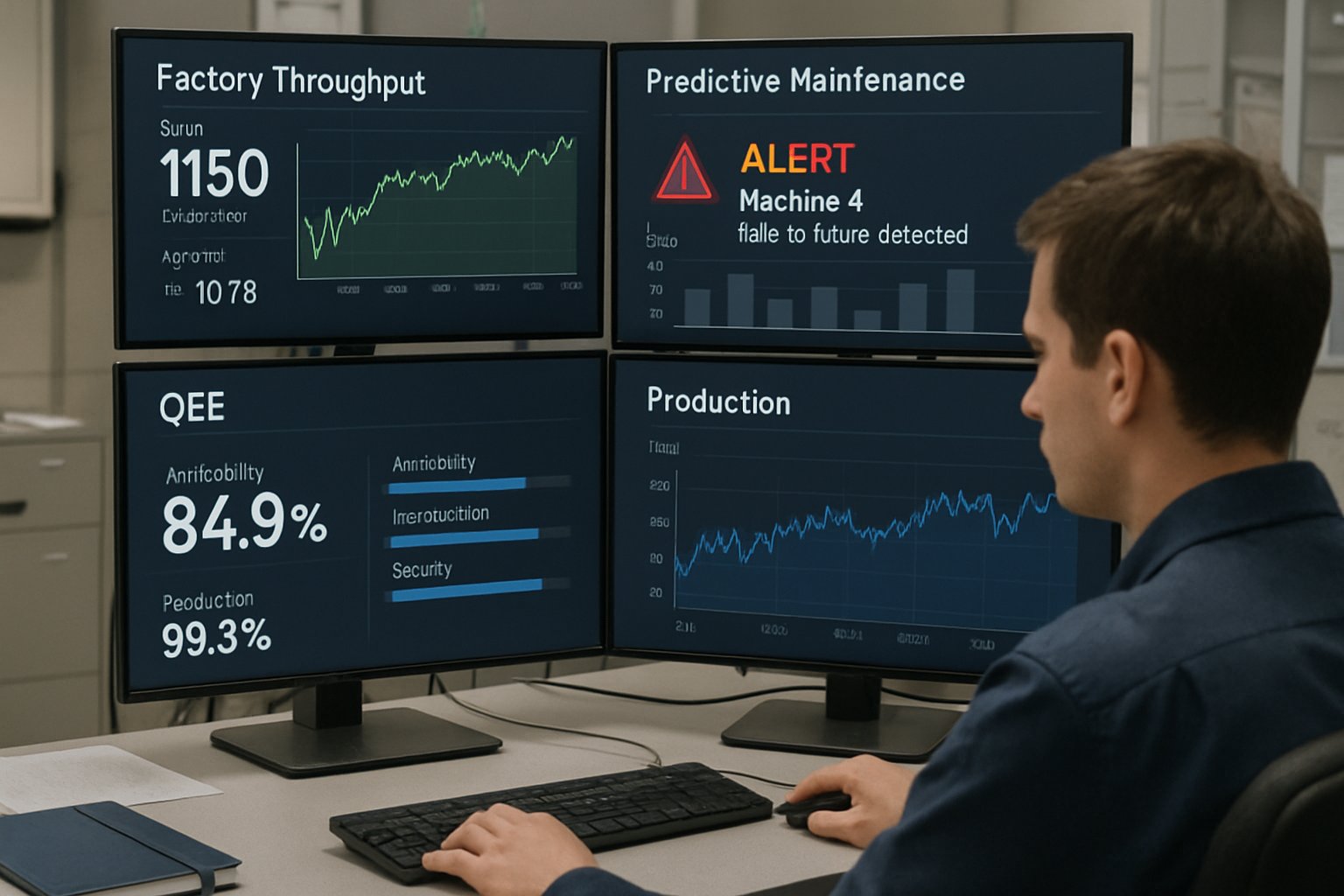
Market researchers value manufacturing analytics at roughly USD 11 billion for 2025 with double-digit growth. In contrast, the predictive-maintenance segment follows a similar curve but defines scope differently. Nevertheless, both segments converge inside modern factory throughput optimization engines. AspenTech CEO Antonio Pietri recently framed optimization as “the control layer for profitability and sustainability.” Meanwhile, Jensen Huang highlighted digital twins as the missing simulation link during Siemens’ CES 2026 keynote.
These converging narratives set expectations. However, plant managers still demand proven results before signing multi-year licenses. The next section deconstructs the underlying components delivering those outcomes. These drivers reveal why adoption momentum will likely continue.
Core Engine Components Explained
Every engine follows a similar layered blueprint. At the base, industrial IoT gateways stream contextualized sensor data into historian or lakehouse stores. Subsequently, data-ops pipelines cleanse tags, align time stamps, and expose events to modeling layers.
Above the data plane sit physics-based digital twins coupled with machine-learning predictors. These twins test thousands of what-if scenarios without risking production. Moreover, model-predictive control algorithms compute optimal moves over future horizons while honoring hard constraints.
A high-level scheduler then reconciles customer orders, maintenance windows, and energy tariffs. Consequently, the prescriptive layer issues setpoint changes or operator advisories in near real time. Finally, feedback dashboards visualize key performance indicators and explain model confidence levels.
This technical stack enables the signature promise of factory throughput optimization engines: sustained high throughput with reduced variability. The architecture also embeds predictive maintenance models that flag incipient faults early, further protecting uptime. These building blocks set the stage for intense vendor competition, explored next.
Vendor Strategies Compared Clearly
Incumbent automation giants hold deep control footprints. Emerson now bundles AspenTech’s process models into its Project Beyond platform. Furthermore, Siemens leverages NVIDIA Omniverse to render photo-realistic digital twins for commissioning tests. Rockwell positions PavilionX MPC as a quick-impact layer on existing PLC code. Meanwhile, Honeywell adds asset performance modules within Forge to unite process and equipment analytics.
Specialist vendors attack speed-to-value. Oden promises pilot deployment in 90 days using cloud orchestration. Augury combines Seebo’s process AI with its vibration-based predictive maintenance library, aiming to cross-sell both functions. Additionally, hyperscalers provide infrastructure primitives—AWS IoT TwinMaker or Azure Digital Twins—letting system integrators assemble custom engines.
Competitive differentiation now hinges on integration effort and operator trust. Therefore, successful vendors minimize rip-and-replace requirements, deliver transparent model explanations, and support hybrid cloud topologies that respect security policies. These approaches directly influence measurable business outcomes.
Measured Business Outcomes Evident
Real-world benchmarks are steadily emerging. McKinsey reports that combined analytics and digital twins can cut unplanned downtime by 25–50 percent. Likewise, vendor case studies cite throughput lifts ranging from four to twenty percent after engine rollout.
The following list summarizes headline metrics drawn from published references:
- Rockwell MPC pilots: 4–12 percent throughput gain on cement and chemical lines.
- Siemens digital twin trials: double-digit OEE increase at a beverage plant.
- Oden deployments: 20 percent monthly output rise through failure prevention.
- Honeywell Forge users: 30 percent reduction in maintenance costs alongside uptime gains.
Consequently, CFOs see rapid ROI when baseline variability is high. Moreover, energy intensity often falls as processes run closer to optimum conditions. These wins attract board-level interest, yet several hurdles still hinder universal success. The next section addresses those barriers.
Implementation Hurdles Persist Today
Legacy automation layers complicate integration. In contrast to greenfield plants, brownfield sites feature mixed PLC generations and paper-based workflows. Therefore, middleware and protocol translation consume significant project time.
Data quality presents another obstacle. Incomplete tags, drifting sensors, and undocumented naming conventions can derail model accuracy. Moreover, McKinsey warns that immature predictive maintenance models may trigger false alarms that erode operator confidence.
Skills gaps further slow scaling. Process engineers rarely code Python, while data scientists may lack domain intuition. Consequently, successful teams embed cross-functional pods and invest in upskilling. Professionals can enhance their expertise with the AI Educator™ certification.
Cybersecurity remains a board priority. Increased connectivity widens attack surfaces, compelling zero-trust architectures and rigorous governance. Nevertheless, structured playbooks mitigate many of these risks, as the next section outlines.
Best Practice Playbook Emerges
Experienced integrators follow a staged roadmap. Initially, they baseline uptime, throughput, and constraint maps using historian data. Subsequently, they deploy limited-scope pilots on bottleneck assets to prove value within 90 days.
Data stewards then standardize tag hierarchies, ensuring scalable pipelines. Meanwhile, change-management programs involve operators early, providing simulation sandboxes that visualize model decisions. Additionally, governance boards review false-positive rates before enabling automated setpoints.
Finally, teams embed continuous improvement loops that retrain models, incorporate energy prices, and align with sustainability dashboards. These disciplined steps convert early wins into durable enterprise capability. The final section looks ahead to emerging trends.
Future Outlook Summary Brief
Through 2028, analysts expect autonomy layers to extend from single lines to plant networks. Moreover, cloud and edge convergence will let factory throughput optimization engines process millisecond feedback while sharing strategic insights globally.
Additionally, generative AI will simplify model maintenance by auto-documenting logic and suggesting update intervals. Meanwhile, vendors will embed carbon-intensity constraints, turning compliance into another optimization variable. Consequently, organizations mastering the discipline now will enjoy compounding competitive advantages.
These trends underscore a simple reality: data-driven throughput is no longer optional. However, success demands rigorous execution, credible metrics, and continuous skills development.
Therefore, forward-thinking leaders should evaluate pilot opportunities, benchmark real impacts, and invest in certifications that equip teams for autonomous operations.


