

AI CERTs
2 months ago
How clinical trial matching engines accelerate recruitment
Clinical trial matching engines promise to slash the toughest bottleneck in drug development. However, many sponsors still struggle with slow eligibility screening and uneven enrollment rates. Recent peer-reviewed data and acquisitions suggest the technology may finally be maturing. Consequently, executives in life sciences AI are watching early adopters closely.
This article analyzes evidence, market shifts, technology choices, and practical risks. Moreover, it clarifies how clinical teams can exploit patient stratification advantages without amplifying bias. Meanwhile, it offers a checklist for evaluating vendor claims and regulatory readiness. Professionals can enhance their expertise with the AI Marketing certification.
Evidence Of Time Savings
TrialGPT, an NIH large language model pipeline, provides the strongest peer-reviewed proof to date. In November 2024, researchers reported a 42.6% cut in clinician screening time. Additionally, the algorithm reached 87.3% criterion-level accuracy and over 90% recall on benchmarks. In contrast, manual chart reviews remain laborious and error-prone.
Vendor studies echo similar gains, yet most lack independent audits. Deep 6 AI, now part of Tempus, cited oncology trials where true positives soared while false positives plummeted. Nevertheless, sample sizes were small and single-site. The figures below summarize current evidence:
- 42.6% screening time reduction in TrialGPT pilot.
- 87.3% accuracy on expert-annotated pairs.
- 30-80% time saved in vendor demonstrations of clinical trial matching engines.
- $4B global recruitment services market in 2024.
These metrics indicate real efficiency wins. However, scalability across diverse EHR systems still requires validation. Consequently, investors are hunting for platforms that can scale.
Market Consolidation Trends Rise
Tempus shook the landscape by buying Deep 6 AI in March 2025. Furthermore, eClinical giants such as Medidata and IQVIA keep embedding matching modules into broader suites. Analysts estimate software revenue will jump from $342 million in 2023 to $832 million by 2030. Therefore, consolidation favors vendors controlling both data pipelines and clinical trial matching engines.
Meanwhile, hospitals seek partners offering secure on-prem or hybrid deployments. In contrast, smaller startups focus on niche therapeutic areas and patient stratification algorithms. Venture investors cite life sciences AI synergies as justification for rising valuations. The trend suggests competitive pressure will accelerate feature integration and price competition. Hospitals adopting clinical trial matching engines report competitive advantages in grant funding.
Market consolidation appears inevitable. However, strategic differentiation remains possible through specialty data or workflow depth. That competitive backdrop shapes technical design decisions explored next.
Matching Engine Technology Explained
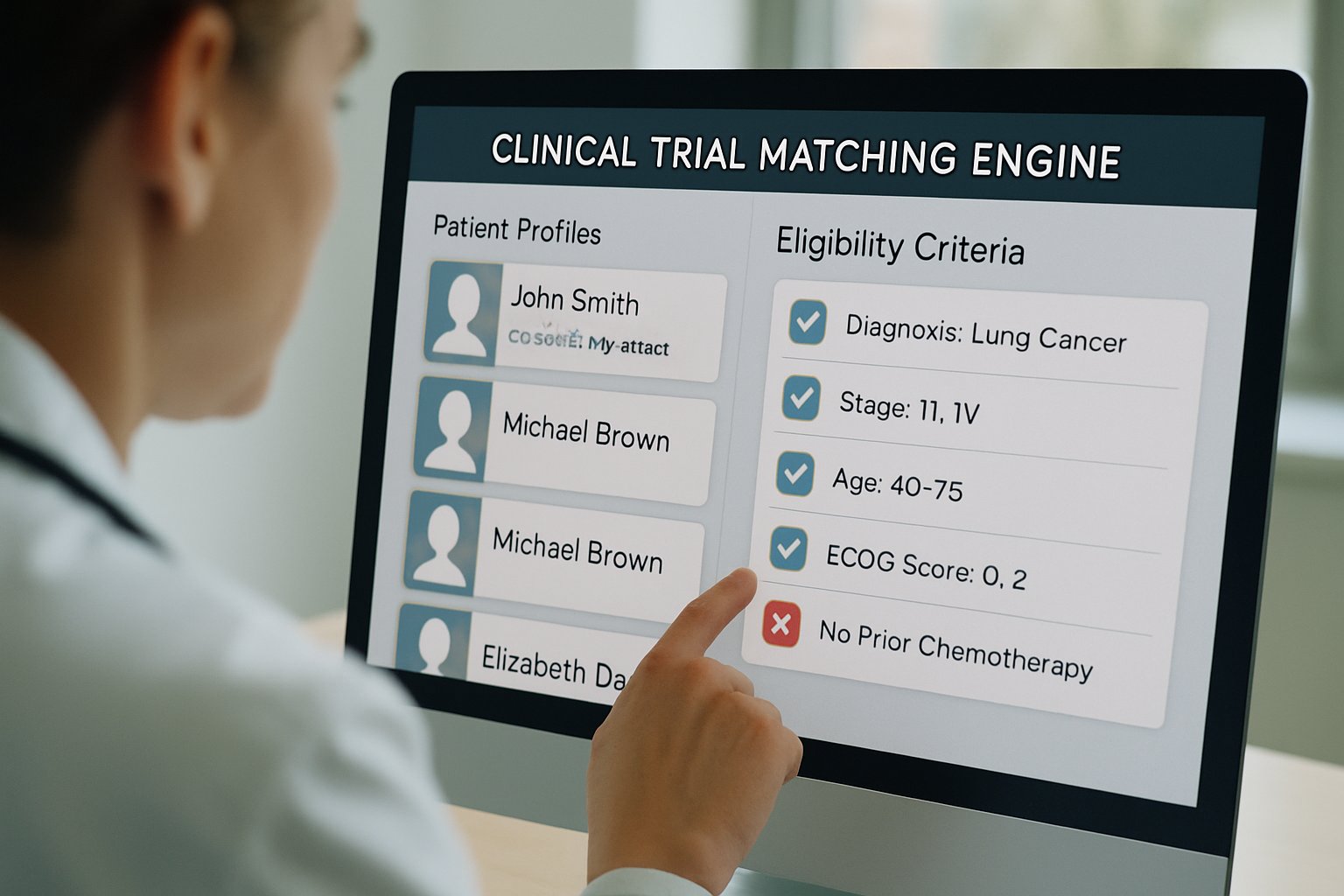
Modern clinical trial matching engines rely on layered pipelines combining retrieval and reasoning. Initially, structured EHR fields provide diagnoses, labs, and demographics. Subsequently, natural language processing extracts signals buried in progress notes and pathology reports. Moreover, large language models interpret protocol criteria expressed in free text.
Retrieval-augmented generation links patient snippets to eligibility rules, producing human-readable rationales. Privacy remains paramount; therefore many deployments tokenize identifiers before model access. Multimodal extensions even parse imaging or genomic sequences. Nevertheless, data quality can throttle accuracy, especially when notes contain outdated information.
Performance also hinges on patient stratification schemas aligned with study endpoints. To reduce hallucinations, teams constrain model outputs with rule-based checks. Life sciences AI engineers now automate continuous validation dashboards for safety monitoring. Technology stacks are becoming sophisticated. However, operational integration presents distinct obstacles addressed below. Next, we examine real-world barriers hindering adoption.
Integration Barriers And Risks
Despite impressive demos, deployment inside hospital workflows is rarely plug-and-play. CIOs must vet security, data governance, and regulatory classifications. Additionally, Epic or Cerner integration demands custom APIs and interface builds. Clinicians often resist new screens that interrupt care routines. Consequently, change-management planning is essential.
Bias presents another hurdle. In contrast to structured rules, LLMs may underrate underserved populations if training data lack representation. Therefore, teams should audit outputs across race, ethnicity, and geography. FDA guidance on AI decision support remains evolving, leaving compliance teams cautious. Meanwhile, vendor marketing sometimes exaggerates enrollment gains, confusing executives.
Independent evidence comparing clinical trial matching engines to manual methods across multiple sites is still scarce. Life sciences AI stakeholders need transparent metrics before approving budgets. Integration barriers are technical and cultural. Nevertheless, rigorous governance frameworks mitigate many risks. That necessity leads decision makers to demand structured evaluations.
Evaluating Vendor Claims Carefully
Procurement teams should request detailed study protocols before accepting ROI promises. Moreover, absolute numbers beat percentages. Ask vendors to reveal charts showing patients screened, matches confirmed, and enrollments completed. Subsequently, compare screen-to-enroll ratios with historical baselines.
Ensure ground truth labels were adjudicated by blinded clinicians. Furthermore, examine demographic performance splits to assess patient stratification fairness. Data governance documentation matters; therefore verify tokenization methods and BAA coverage. Independent peer review provides extra credibility. Companies developing clinical trial matching engines should publish results in respected journals. Nevertheless, site pilots remain valuable when metrics are transparently shared.
- Study design: prospective, multi-site, controlled.
- Numerators and denominators disclosed.
- Equity analysis reported.
- Data hosting and security clarified.
A structured checklist protects budgets and patients. Consequently, stronger evidence standards will uplift the entire market. Looking forward, strategic planning can future-proof recruitment operations.
Future Proofing Recruitment Efforts
Sponsors should embed technology roadmaps into protocol planning cycles. Moreover, flexible APIs allow swapping components as regulations evolve. Collaborating with health systems early secures data access agreements. Meanwhile, continuous learning loops refine models using post-launch feedback.
Integrating clinical trial matching engines with outreach tools converts matches into enrolled volunteers. Additionally, diversity campaigns ensure life sciences AI benefits reach broader populations. Training staff through micro-credentials reinforces adoption. Professionals can enhance their expertise with the AI Marketing certification. Consequently, organizations build resilient capabilities that survive platform shifts.
Proactive planning aligns technology with study demands. Nevertheless, leadership must keep measuring outcomes to secure lasting gains.
Consequently, clinical trial matching engines now command board-level attention. However, rigorous validation and thoughtful integration remain prerequisites for success.
Ultimately, organisations leveraging clinical trial matching engines gain faster recruitment, richer patient stratification, and stronger data foundations. Moreover, those benefits compound as life sciences AI capabilities mature. Therefore, stakeholders should pilot responsibly, monitor equity, and invest in continuous improvement. Ready teams can explore certifications, deepen skills, and lead the next generation of data-driven trials.


