

AI CERTs
2 hours ago
How Brand Sentiment Intelligence Models Reduce Reputation Risk
A single tweet can sink billions in market value within hours. Consequently, communications leaders crave real-time visibility across every digital channel. Brand Sentiment Intelligence Models now promise that superpower with enterprise scale. However, accuracy, governance, and data access complicate adoption. This article unpacks market momentum, technology foundations, vendor moves, and emerging best practices. Moreover, we highlight actionable steps for teams aiming to prevent reputation shocks. Expect concise analysis backed by recent funding rounds, surveys, and product launches. Industry professionals will also find certification resources for sharpening design and governance skills. Meanwhile, MarketsandMarkets expects AI in social media to quintuple by 2029. Therefore, failing to invest early risks strategic irrelevance. Regulators and investors increasingly scrutinize response speeds. The stakes could not be higher.
Market Momentum Rapidly Accelerates
During 2025, funding surged for vendors building Brand Sentiment Intelligence Models and companion analytics suites. Signal AI alone secured $165 million to expand real-time risk capabilities. Moreover, Meltwater, Sprinklr, and Dataminr unveiled upgrades targeting sub-second alert latency.
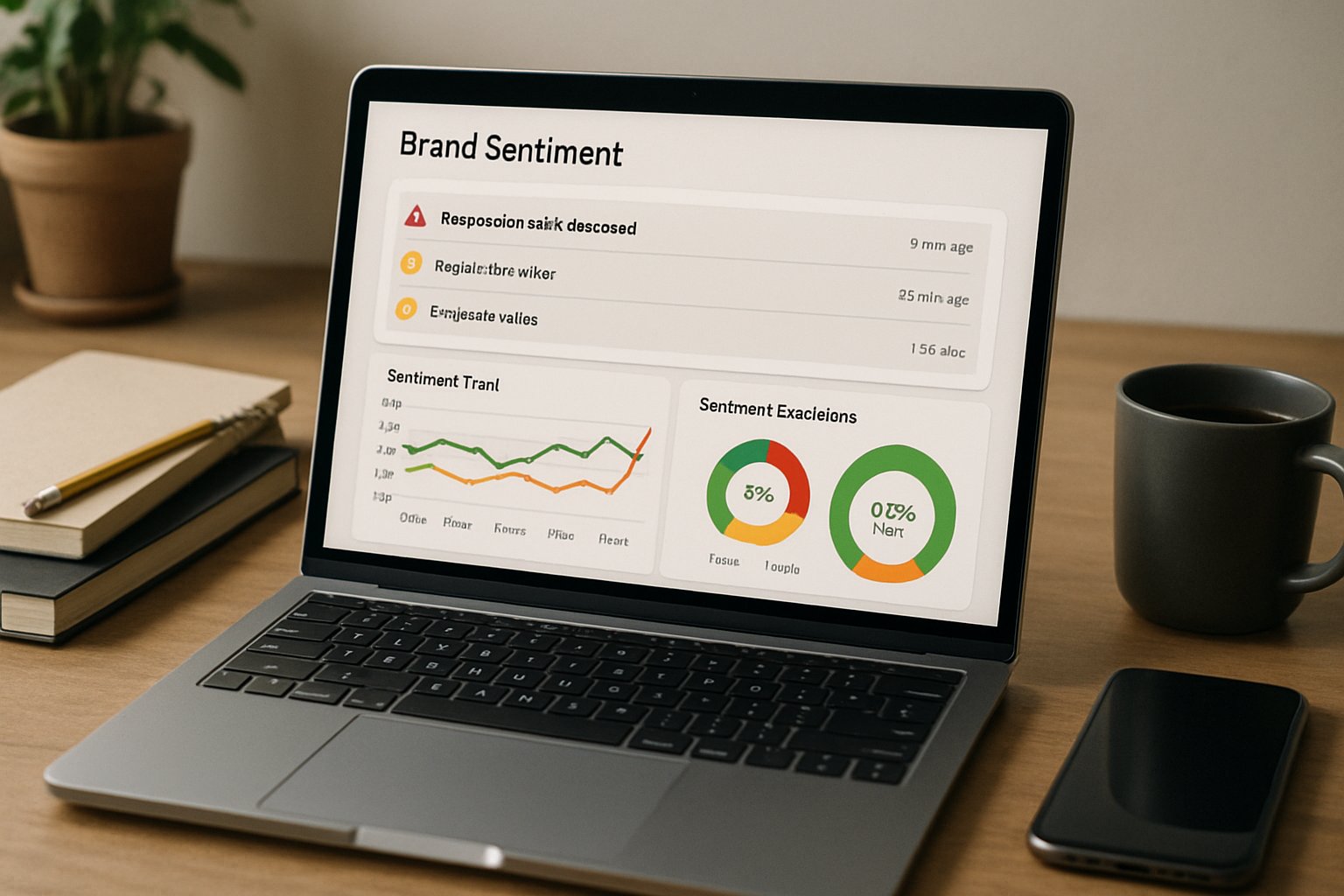
- Social listening market: $10.23B in 2024; projected $12.99B in 2025.
- AI in social media: forecast $10.33B by 2029, 32% CAGR.
- Vendors ingest up to 5M items daily across 75 languages.
These numbers confirm investor confidence. Nevertheless, executives care more about narrative detection speed than valuations. Consequently, platform latency remains a core differentiator. Let’s examine the technology enabling that race.
PR industry surveys reveal that 78% of communications leaders deploy at least one AI monitoring tool. However, only 32% feel fully crisis ready.
Brand Sentiment Intelligence Models
Technology Under The Hood
Modern pipelines start with distributed crawlers harvesting news, social, forums, and assistant outputs. Subsequently, streaming services perform language detection, tokenization, and vectorization for NLP monitoring. Latency targets hover around two seconds for English content, slightly longer for low-resource languages. Transformer classifiers then label sentiment, emotion, and intent within milliseconds.
Multimodal encoders such as CLIP variants parse memes, logos, and video captions. In contrast, older lexicon systems missed sarcasm and visual references. Therefore, accuracy has improved, yet error rates persist for niche dialects. Additionally, provenance checks tag original upload sources to flag potential deepfakes.
Crisis detection AI layers watch for volume or sentiment anomalies using statistical and neural ensembles. Consequently, alerts reach Slack, ServiceNow, or executive dashboards almost instantly. At the core, Brand Sentiment Intelligence Models supply the sentiment vectors feeding those anomaly engines. GPU acceleration using quantized models reduces inference costs by 40% in recent benchmarks. These advances set the stage for autonomous briefings, discussed next.
Emerging Agentic Feature Sets
Signal AI’s Ask AIQ exemplifies agentic design. Furthermore, the assistant chains retrieval, classification, and summarization micro-agents into one conversational workflow. Users ask a question and receive a cited risk brief in seconds. Therefore, executives can pivot strategy before mainstream coverage erupts.
Meltwater’s GenAI Lens pushes monitoring into ChatGPT, Gemini, and Claude outputs. Meanwhile, Sprinklr bundles similar copilots within its Unified-CXM stack. Consequently, comms teams now watch the very assistants executives use. Subsequently, automated meeting summaries push next steps into project trackers.
These agentic layers lean on Brand Sentiment Intelligence Models to generate decision-grade narratives. Moreover, many tools simulate scenario cascades to estimate financial exposure. Blackbird.AI classifiers score coordinated campaigns and surface source clusters within dashboards. Therefore, disinformation can be quarantined before it trends. These capabilities accelerate insight delivery, yet they amplify governance demands. Vendor diversity further influences buying decisions.
Vendor Landscape Overview 2026
Competition spans incumbents and specialists. Signal AI, Meltwater, Sprinklr, Brandwatch, and Dataminr dominate enterprise deployments. In contrast, Blackbird.AI and Vinesight focus on narrative manipulation and misinformation detection.
- Signal AI: Ask AIQ, 200+ markets, 75 languages.
- Meltwater: GenAI Lens, LLM output analytics.
- Sprinklr: Smart Alerts, store-level insights.
- Dataminr: Intel Agents for security incidents.
Meanwhile, startups such as Cyabra offer API-first modules that integrate with existing dashboards. Consequently, buyers can mix specialist and platform tools without vendor lock-in.
Case studies from Walgreens and 3M show local alert routing within five minutes. Moreover, enterprises cite improved service recovery and reduced call volume after integrating alerts. Brand Sentiment Intelligence Models underpin each success story despite vendor branding differences. The landscape looks vibrant; nevertheless, hurdles remain.
Persistent Challenges Still Persist
Sarcasm, slang, and code-switching still trick top models. Academic benchmarks report double-digit error rates on multilingual sarcasm. Consequently, false positives flood dashboards, eroding trust. Machine irony and emoji blends continue to stump classifiers, especially in gaming communities.
Data access also tightens as platforms lock down APIs and raise fees. In 2023, Twitter’s restrictions forced several vendors to curate alternate firehoses. Therefore, incomplete NLP monitoring coverage can mask emerging threats. Moreover, paid licensing for premium news feeds inflates total cost of ownership.
Governance frameworks lag behind technical progress. Meanwhile, crisis detection AI amplifies alert volume without guaranteed response discipline. These challenges threaten ROI. Brands must address them before scaling further. Governance guidance follows.
Governance And Strategy Essentials
Effective programs start with clear thresholds for escalation. Moreover, cross-functional playbooks prevent knee-jerk statements that worsen crises. Leadership should mandate human review of high-severity alerts generated by Brand Sentiment Intelligence Models.
Regular red-team exercises validate NLP monitoring pipelines and crisis detection AI thresholds. Consequently, teams build muscle memory for rapid, factual responses. Professionals can enhance their expertise with the AI+ UX Designer™ certification. The course covers responsible prompt design, bias evaluation, and stakeholder communication.
Periodic audits should compare vendor claims with independent datasets. In contrast, blind reliance invites regulatory scrutiny and shareholder lawsuits. Moreover, procurement teams must secure contractual access to critical sources before renewal dates.
Governance anchors long-term value. Future prospects appear both exciting and demanding. Nevertheless, disciplined measurement frameworks convert raw alerts into measurable reputation ROI.
When integrated properly, Brand Sentiment Intelligence Models become a force multiplier for communications, legal, and security teams.
GDPR fines loom if personal data appears in unredacted dashboards. Consequently, privacy reviews must accompany every new data source.
Brand Sentiment Intelligence Models are becoming indispensable as narrative speed accelerates. Consequently, early adopters gain the precious minutes needed to shape public perception. However, technology alone cannot guarantee protection. Clear governance, cross-functional drills, and certified talent remain mandatory.
Therefore, organizations should audit coverage, test accuracy, and codify responses before the next headline strikes. Teams embracing this rigor, supported by Brand Sentiment Intelligence Models, will navigate crises with confidence. Visit the certification portal today and future-proof your reputation strategy.


