

AI CERTs
2 months ago
How autonomous workload prioritization systems transform work
IT leaders spent years tuning dashboards and Gantt charts. However, manual triage still consumed hours weekly. Today, autonomous workload prioritization systems promise a different path. Moreover, Gartner lists agentic AI as a top technology trend for 2025. Consequently, executives now ask whether bots can safely decide who tackles what and when. This article examines the market surge, vendor strategies, benefits, and ongoing gaps.
Autonomous Workload Prioritization Systems
These systems combine large language models, orchestration engines, and contextual graphs. Therefore, they can rank tasks, assign owners, and trigger actions across calendars, tickets, and documents. In contrast to simple assistants, they act with minimal prompts and can learn from history. Gartner predicts such agents will handle 15% of day-to-day decisions by 2028. The primary keyword appears here again: autonomous workload prioritization systems currently sit at the center of enterprise AI roadmaps.
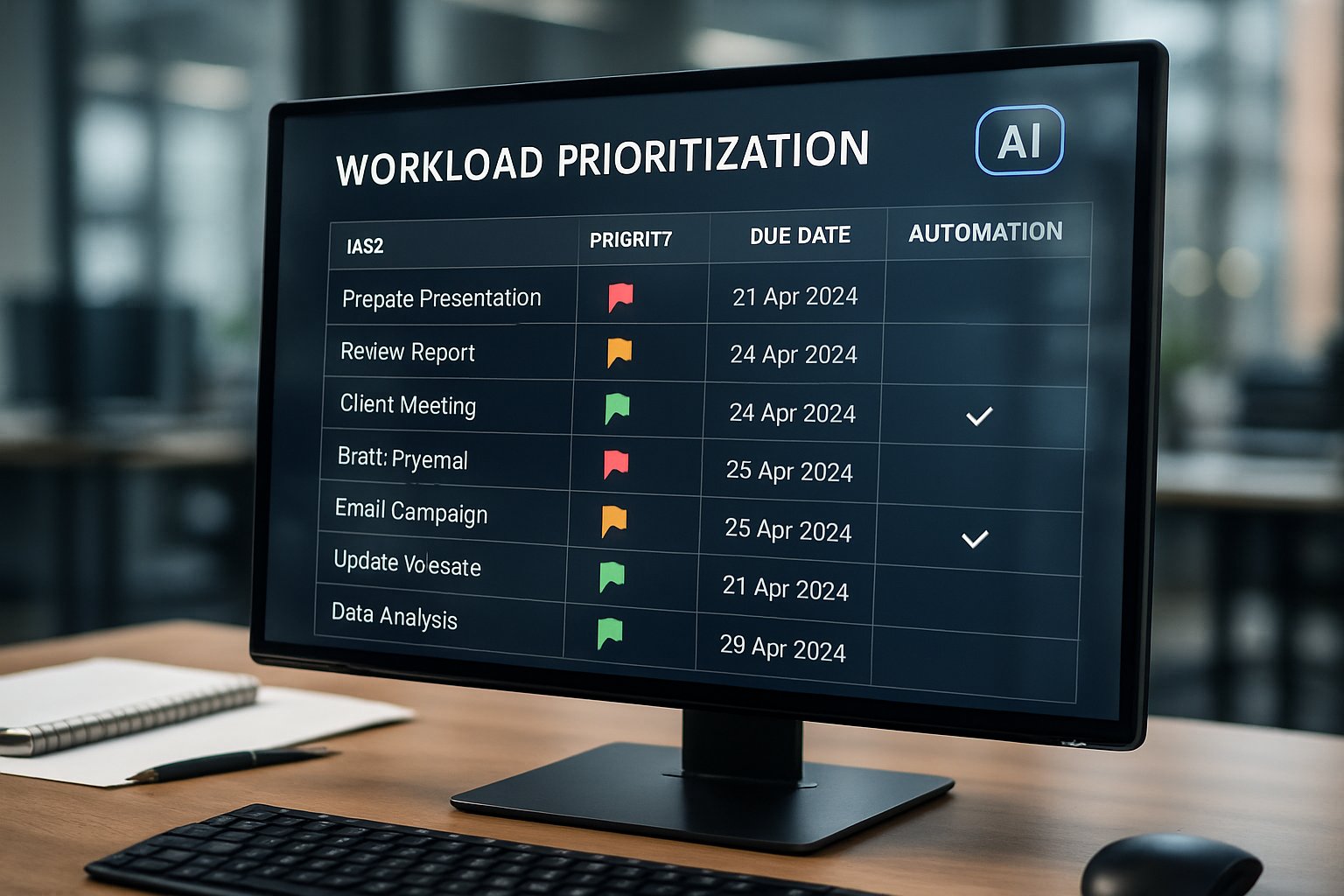
Nevertheless, full autonomy remains optional. Vendors increasingly emphasize human-in-the-loop checkpoints to limit risk. Asana calls its AI “teammates,” while Microsoft embeds approval gates into Copilot Studio. Subsequently, buyers gain confidence without ceding total control.
Market Momentum Grows Fast
Funding for hyper-automation climbed sharply. Mordor Intelligence valued the market at USD 15.6 billion in 2025. Furthermore, Gartner expects 40% of enterprise applications to ship with task-specific agents by 2026, up from 5% last year. Those projections give enterprise productivity AI programs board-level urgency.
Moreover, pandemic-driven remote work exposed scheduling pain points. Consequently, organizations accelerated pilot programs that integrate workflow automation with conversational interfaces. The result is another mention of autonomous workload prioritization systems as a vehicle for scaling lean teams without adding headcount.
These drivers confirm sustained momentum. However, the next section shows which vendors captured early mindshare.
Key Vendor Milestones Achieved
Several launches shaped the competitive landscape. Asana released AI Teammates in September 2025. The feature uses the Work Graph to maintain context while rebalancing project queues. Microsoft followed with Copilot Actions, enabling multistep flows across Outlook, Teams, and Planner. Notion 3.0 introduced Agents that create and organize pages autonomously.
Meanwhile, Zapier expanded Agents to orchestrate thousands of SaaS connectors. Integrators like UiPath and ServiceNow stitched these pieces into IT service desks. Therefore, autonomous workload prioritization systems now span work management, collaboration, and robotic process platforms.
Nevertheless, Carnegie Mellon’s TheAgentCompany benchmark reported only 24% task completion across leading agents. Consequently, buyers weigh flashy demos against empirical limits.
That reality frames the benefits-versus-risk equation explored next.
Benefits Drive Adoption Rates
Despite reliability worries, enterprise pilots report clear upside. Moreover, survey data links agentic rollouts to measurable time savings and morale gains.
- Cycle time cut by up to 60% on repetitive ticket routing
- Dynamic capacity balancing reduced weekend overtime by 35%
- Managers reclaimed four weekly hours from manual prioritization
- LLM usage costs averaged under USD 0.04 per automated action
Additionally, enterprise productivity AI teams cite improved transparency because agents log every decision. Therefore, leadership gains a real-time audit trail. These improvements stem directly from autonomous workload prioritization systems embedded within scheduling workflows.
The benefits appear compelling. However, benchmark failures highlight persistent gaps, as shown below.
Benchmarks Reveal Reliability Gaps
Academic researchers stress caution. In March 2025, Carnegie Mellon tested 20 agents against realistic office scenarios. The best model completed only one quarter of tasks unaided. Moreover, success rates dropped to 7% for complex, multi-step sequences. Consequently, unguarded deployment of autonomous workload prioritization systems risks mis-routed emails, duplicated records, or worse.
Furthermore, guardrails sometimes reduce success further. Safety filters block unsafe actions yet also block legitimate steps. Nevertheless, vendors now expose administrative toggles to tune aggressiveness, reflecting lessons learned.
These findings underline the need for governance, which the next section details.
Governance And Compliance Essentials
Regulated industries demand robust oversight. Therefore, Microsoft shipped Copilot Control System with audit trails, role-based access, and cost dashboards. Asana built checkpoints that pause agents for human approval at critical junctures. Consequently, organizations can throttle autonomy to match risk tolerance.
Data residency also matters. Agents ingest calendars, CRM notes, and ticket logs. In contrast, legacy macros rarely touched personal data. CISOs therefore insist on encryption, retention controls, and verifiable deletion logs before green-lighting workflow automation projects.
Professionals can enhance their expertise with the Chief AI Officer™ certification. That program covers policy frameworks and AI risk management.
Effective governance contains pitfalls. However, best practice steps accelerate safe rollouts, as the next section explains.
Future Outlook And Recommendations
Industry momentum shows no sign of slowing. Gartner forecasts 80% autonomous resolution for common customer service issues by 2029. Meanwhile, vendors continue refining planning algorithms and guardrail tooling. Therefore, enterprises should follow a phased approach.
First, benchmark agents against internal workflows before buying. Secondly, deploy in shadow mode to gather performance baselines. Thirdly, add human approval gates for high-impact actions. Additionally, track interventions per thousand actions to quantify reliability.
Moreover, align initiatives with wider enterprise productivity AI strategies. Integrating process mining, RAG retrieval, and workflow automation multiplies ROI. Remember to budget for change management and upskilling.
With these measures, autonomous workload prioritization systems can mature from promising pilots to production-grade teammates.
These recommendations close our analysis. Nevertheless, success depends on continuous monitoring and transparent governance.
Conclusion: Autonomous workload prioritization systems already reshape task management by automating triage, rebalancing capacity, and logging every action. Furthermore, market data validates rising demand, while benchmarks remind us of current limitations. Consequently, leaders should combine phased deployment, strict governance, and ongoing metrics. Finally, consider specialized credentials to guide strategy. Explore the linked certification and start building a safer, smarter automation roadmap today.


