

AI CERTS
3 hours ago
How AMD EPYC CPUs Elevate AI Cloud Efficiency
Meanwhile, cloud operators weigh trade-offs among price, power, and workload agility. Therefore, decision makers need clear guidance that blends marketing with measured reality. Read on for an evidence-driven tour of efficiency, sustainability, and financial impact. Finally, informed hardware choices determine competitiveness.
AI Efficiency Drivers Explained
Modern AI inference mixes small CPU paths with GPU-accelerated stages. However, host processors still gate pipeline throughput. AMD’s latest architecture increases core counts to 192 and widens memory bandwidth. Moreover, larger caches reduce I/O stalls, boosting thread availability for preprocessing. These architectural shifts translate to higher performance per watt across diverse x86 workloads. AMD EPYC CPUs also integrate advanced power states for idle efficiency.
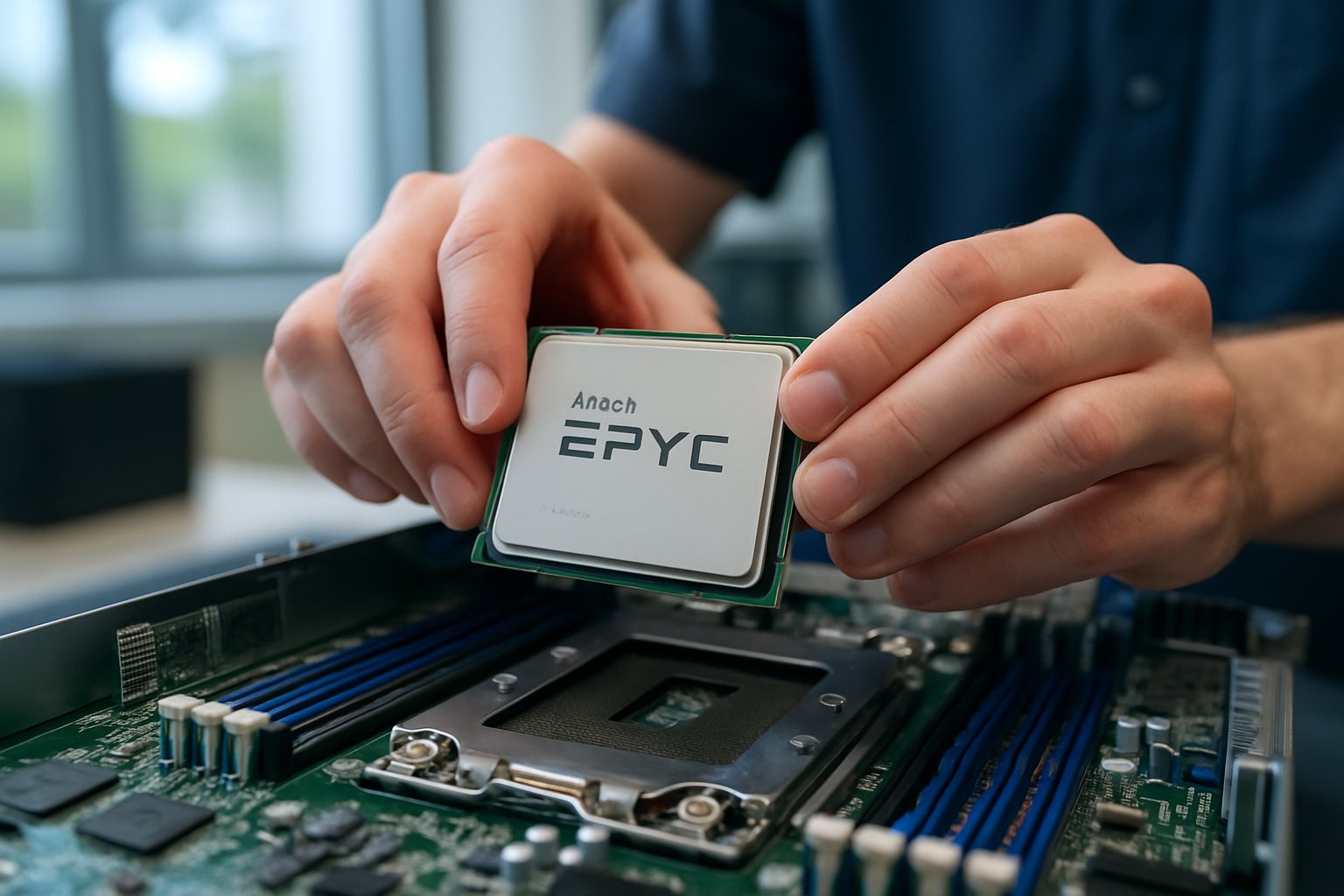
Vendor testing claims up to 86% fewer servers versus legacy dual-socket Xeon 8280 configurations. In contrast, power draw can shrink 69% in those controlled comparisons. Consequently, operators can reclaim rack space and cooling headroom, lowering Cloud spend. Such consolidation also unlocks direct cost savings in licensing and maintenance budgets.
In short, silicon density drives both raw throughput and operational efficiency. Next, we examine how the CPUs enhance GPU hosting duties.
Host CPU Value Proposition
GPU clusters often idle when starved by limited host bandwidth. Therefore, selecting potent hosts maximizes expensive accelerator utilization. AMD EPYC CPUs employ 128 PCIe Gen5 lanes, enabling high-speed GPU connections without bridges. Furthermore, CXL memory pooling appears on Turin SKUs, boosting aggregate capacity. ServeTheHome reports measurable latency reductions when EPYC hosts MI300X GPUs under ROCm. Many hyperscalers standardize on AMD EPYC CPUs for consistent host behavior.
Independent labs observed 5-10% higher tokens per second compared with similar x86 hosts. Additionally, Oracle Cloud measured double generation-over-generation performance at flat pricing. Such results indicate immediate savings on every inference job. Efficient hosting amplifies accelerator ROI and moderates Cloud spend growth. However, benchmark context remains vital, as the next section highlights.
Benchmark Data Highlights Today
MLPerf submissions give standardized insight into real workloads. Moreover, MangoBoost reported 103,182 tokens per second offline with a 32-GPU MI300X cluster. Those systems used AMD EPYC CPUs as hosts, confirming synergy at scale. Meanwhile, a four-node configuration trained a Llama2-70B LoRA model in 10.92 minutes.
Key 2025 results include:
- Time-to-train: 10.92 minutes on four nodes (submission 5.0-2025-MB-001).
- Offline inference: 103k tokens/sec, 16% less energy than baseline H100 run.
- FP4 precision: Maintained accuracy within 0.2% of FP16 reference.
Consequently, efficiency innovation appears across hardware and software stacks. ServeTheHome notes that proper BIOS tuning further improves performance by 3-4%. Lab notes confirm AMD EPYC CPUs maintained linear scaling up to 400 watts TDP. Nevertheless, comparisons must consider cooling, PUE, and rack design.
Benchmarks verify vendor narratives yet highlight configuration sensitivity. Next, we explore expanding cloud offerings built on these chips.
Cloud Instance Momentum Grows
Major providers now ship fifth-generation EPYC instances across several regions. Oracle leads with E6 Standard virtual machines and bare-metal shapes. Additionally, AWS plans M8a adoption later this year, according to roadmap leaks. Google extends Tau T2D positioning to AI inference workloads.
Oracle claims twice the performance of prior E5 models at identical price points. Therefore, customers realize immediate savings without migration penalties. In contrast, Arm alternatives focus on lower Cloud spend for CPU-only loads. However, GPU-dense racks still require robust x86 hosts for driver ecosystem compatibility. OCI offers bare-metal instances based on AMD EPYC CPUs with up to 256 cores.
Cloud availability confirms ecosystem readiness and supports multi-vendor strategies. Subsequently, sustainability considerations enter procurement dialogs.
Examining Sustainability Claims Carefully
Energy efficiency drives environmental and financial outcomes. AMD reports a 38× node efficiency gain since the 2020 baseline. Moreover, the company targets 20× rack efficiency by 2030. Koomey Analytics validates the calculation methodology but cautions about PUE assumptions. Energy dashboards reveal AMD EPYC CPUs often remain below advertised TDP during inference bursts.
Independent reviewers show real perf-per-watt advantages yet smaller than marketing maxima. Nevertheless, higher power density increases cooling complexity, potentially eroding part of the savings. Consequently, operators must evaluate facility capabilities before large EPYC deployments.
Holistic assessments combine chip metrics with infrastructure overhead to manage Cloud spend. The final section delivers practical guidance for such assessments.
Adoption Guidance And Risks
Start with workload profiling to gauge CPU versus GPU bottlenecks. Then model node-level perf-per-watt using vendor specs and independent lab numbers. Additionally, request MLPerf submission IDs matching proposed configurations.
Consider the following checklist:
- Compare instance hourly rates to calculate projected savings.
- Validate x86 software stack readiness, including ROCm versions.
- Plan for liquid cooling when rack power exceeds 40 kW.
- Train staff through the AI Executive™ certification for holistic AI governance.
ServeTheHome advises staggered rollouts to monitor thermal behavior under peak loads. Moreover, contract SLAs should include firmware update cadence for AMD EPYC CPUs hosts. Nevertheless, diversified hardware fleets reduce vendor lock-in and hedge component shortages.
Informed planning secures tangible savings, stable throughput, and sustainable growth. Consequently, organizations can pursue ambitious AI goals confidently.
Fifth-generation AMD EPYC CPUs reshape the economics of AI infrastructure. High core density, ample I/O, and proven efficiency drive fewer servers and lower Cloud spend. Benchmarks from MLPerf and independent labs validate vendor narratives while revealing configuration nuances. Moreover, expanding cloud instances reduces adoption friction and speeds experimentation. Nevertheless, sustainability gains require careful facility planning and cooling investment. By following the assessment checklist, teams unlock measurable savings and throughput advantages. Additionally, professionals can sharpen strategic oversight via the linked certification. Finally, start evaluating pilot nodes today to see the difference firsthand.


