

AI CERTs
2 months ago
How AI Patient Triage Prioritization Systems Ease ER Overload
Overcrowded emergency departments have become a stubborn global challenge. Consequently, clinicians juggle limited beds, anxious families, and strict quality metrics. Meanwhile, hospitals search for scalable relief beyond traditional staffing fixes. AI-driven patient triage prioritization systems now promise a fresh approach. These platforms analyze vital signs, free-text notes, and historical patterns within seconds. Moreover, they advocate quicker escalation for hidden high-risk cases while reallocating resources from low-acuity visits. Early adopters report shorter waits, improved throughput, and reduced staff burnout. However, evidence remains uneven and governance questions persist. This article unpacks the technology, evidence, and practical steps that leaders need when evaluating patient triage prioritization systems.
Emergency Rooms Under Strain
Pressures on emergency rooms escalate every year as visit volumes climb and inpatient beds stay scarce. In contrast, staffing budgets rarely keep pace.
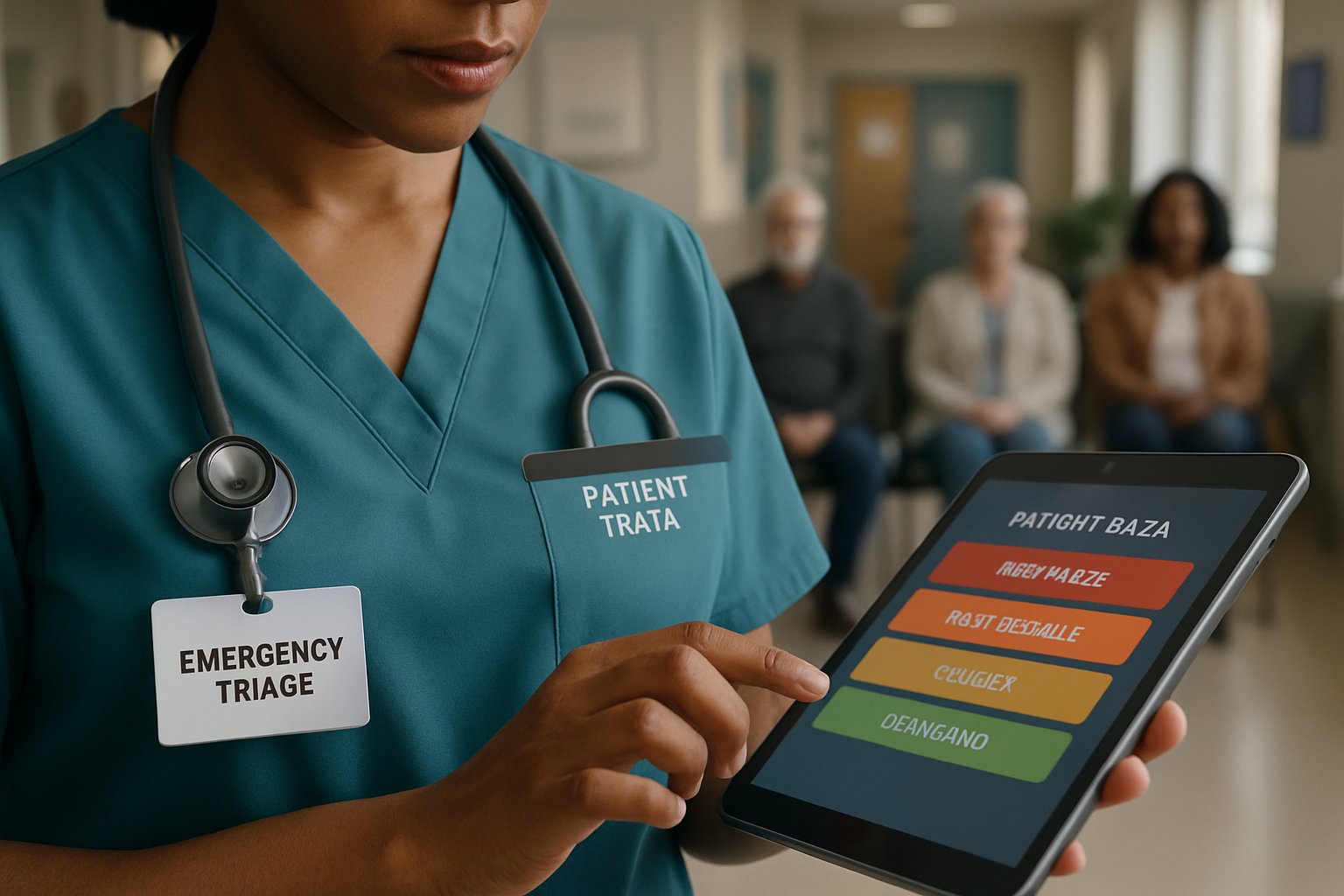
National data show median ED waits exceeding 45 minutes for moderate acuity cases, with left-without-being-seen rates touching five percent. Consequently, boarding of admitted patients blocks stretchers, delays imaging, and lengthens clinician shifts. Several systems now pilot patient triage prioritization systems as a first defensive line.
These dynamics threaten quality, finances, and staff morale. Therefore, technology teams explore intelligent relief. Next, we examine how AI improves triage accuracy.
AI Enhances Triage Accuracy
Traditional Emergency Severity Index scoring relies on limited vitals and nurse judgment. Consequently, subtle risk patterns can remain hidden.
Modern patient triage prioritization systems ingest hundreds of variables and learn risk signatures from millions of prior encounters. Moreover, machine learning models regularly achieve area-under-curve values above 0.80 for predicting admission or ICU transfer.
JAMA Network Open researchers fed 251,000 visit notes to ChatGPT-4. Subsequently, the model chose the sicker patient 89 percent of the time, slightly outperforming physicians.
Overall, AI can flag high-risk patients earlier than traditional scales without added data entry. Nevertheless, accuracy alone does not guarantee operational improvement, which we explore next.
Operational Patient Flow Improvements
Downstream metrics often matter more to executives than raw algorithm scores. Therefore, vendors pair models with workflow nudges that unlock beds faster. AI-powered patient triage prioritization systems support these flow gains through real-time alerts.
In a multicenter chest-pain study, an AI tool cut median length of stay by 76 minutes and shaved 205 minutes from procedure times. Similarly, Qventus reports twenty percent fewer excess inpatient days after discharge prediction deployment, translating into sizeable health ops savings.
- Faster door-to-provider episodes improve mortality for time-sensitive conditions.
- Fewer boarded patients release stretchers for incoming ambulances.
- Lower wait times reduce left-without-being-seen incidents.
- Improved throughput drives care delivery optimization across departments.
Collectively, these gains show how algorithms translate numeric risk into tangible capacity. Consequently, decision makers demand strong evidence before scaling.
Evidence From Recent Studies
Peer-reviewed trials now provide clearer signals. For example, TriageGO reduced chest-pain length of stay without increasing thirty-day mortality. The strongest evaluations of patient triage prioritization systems remain cohort-specific yet illuminate operational benefits.
The adjusted reduction reached 76 minutes for hospitalized patients and 205 minutes for invasive procedures in the July 2024 study. Moreover, systematic reviews covering 50 papers note machine learning triage tools outperform classical scores in 80 percent of comparisons. These outcomes tie directly to hospital care delivery optimization goals.
Researchers caution that patient triage prioritization systems still require multicenter validation. Nevertheless, reviewers highlight single-site bias, heterogeneous outcomes, and limited subgroup reporting.
Evidence therefore looks promising yet incomplete. In contrast, implementation risks cannot be ignored, as the next section details.
Implementation Risks And Governance
Failure to audit models for bias can worsen disparities for racial or language minorities. Furthermore, unclear liability arises when automated decisions influence triage but clinicians override recommendations.
FDA guidance on Predetermined Change Control Plans now requires documented monitoring and update protocols for adaptive patient triage prioritization systems. Meanwhile, poor EHR integration forces double documentation and erodes clinician trust, jeopardizing health ops efficiency gains.
- Validate locally with prospective trials before full launch.
- Stratify metrics by race, sex, and language.
- Provide explainer dashboards for frontline clinicians.
- Define rollback triggers within governance charters.
Robust governance thus underpins safe adoption. Subsequently, leaders should craft a phased roadmap.
Strategic Adoption Roadmap Guidance
Successful programs start with clear objectives tied to throughput, quality, and care delivery optimization targets. Additionally, project managers map workflows with triage nurses to avoid surprise disruptions.
Professionals can enhance their expertise with the AI Human Resources™ certification, improving cross-functional change management. Consequently, seasoned change agents translate algorithm insights into daily health ops playbooks.
A pilot phase should measure how patient triage prioritization systems affect wait times, boarding hours, and staff satisfaction. Iterative pilots enable rapid tuning without large capital risk. Therefore, attention now turns toward future research and regulation.
Conclusion And Next Steps
AI-driven patient triage prioritization systems already shorten waits, enhance care delivery optimization, and bolster health ops efficiency. Moreover, peer-reviewed studies confirm tangible length-of-stay and procedure-time reductions. Nevertheless, evidence gaps, bias risks, and regulatory duties demand disciplined governance. Consequently, leaders should adopt phased pilots, rigorous monitoring, and transparent equity audits. Professionals seeking broader impact should pursue the linked certification to strengthen change management skills. Ultimately, informed implementation will convert promising code into sustainable clinical capacity.


