

AI CERTs
2 months ago
How agentic API orchestration layers dominate multi-model stacks
A new software layer is crystallizing within the generative AI stack.
Industry observers now call it agentic API orchestration layers.
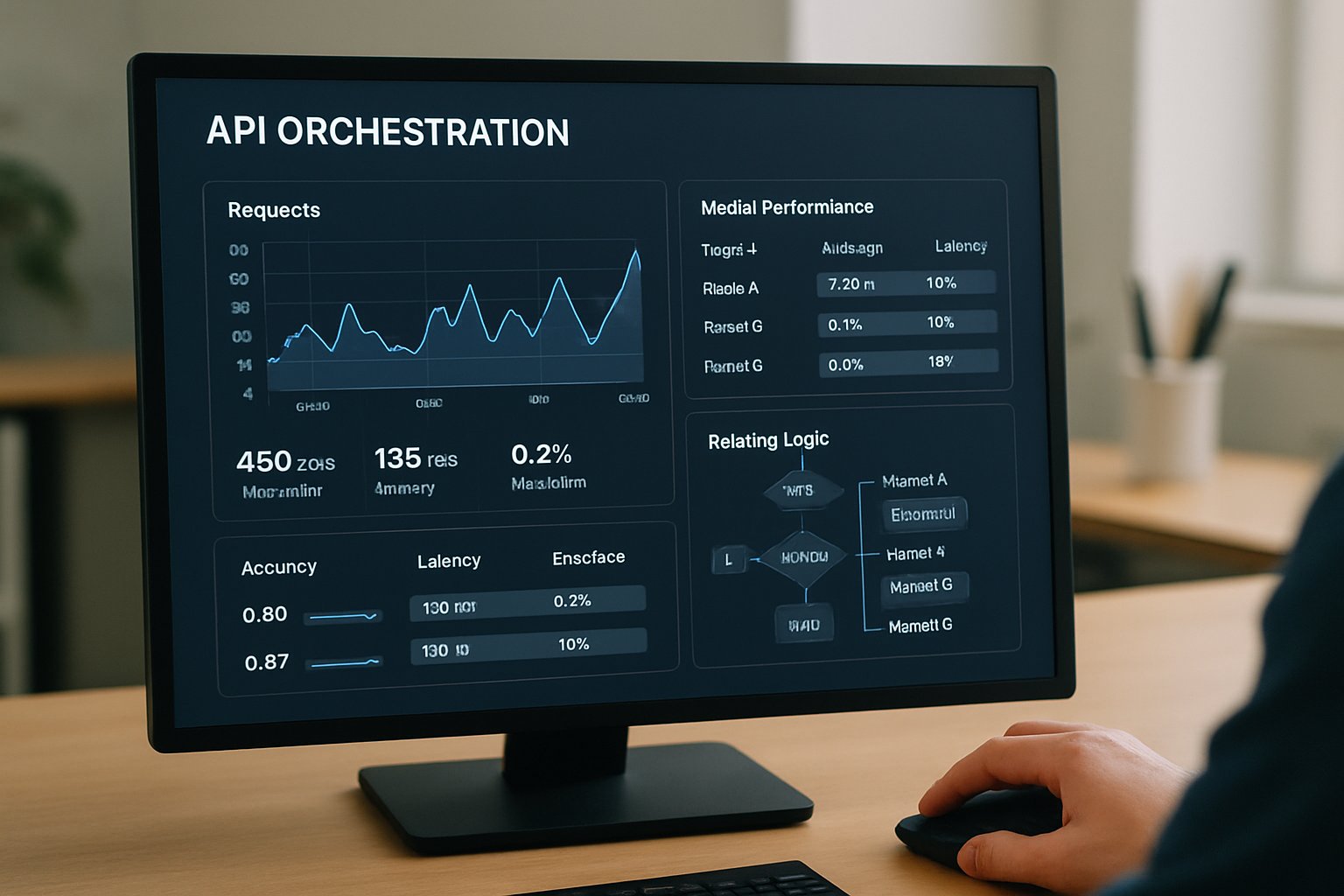
This layer sits between raw models and business code, coordinating diverse capabilities.
Consequently, teams can blend many models and external tools without reinventing infrastructure.
Moreover, market growth forecasts suggest strong commercial traction for this abstraction.
Grand View Research estimates orchestration revenues could reach USD 30.23 billion by 2030.
Meanwhile, open-source projects such as LangChain log tens of millions of monthly downloads.
Therefore, technical leaders must understand why this layer matters and how to implement it.
Additionally, academic routing benchmarks demonstrate measurable accuracy gains over single-model setups.
Such evidence reinforces the urgency for robust orchestration strategies.
Major Market Growth Drivers
Capital inflows underscore the momentum. LangChain raised USD 125 million to build an agent engineering platform. Moreover, venture analyses highlight acquisitions centered on execution layers instead of frontier models.
MarketsandMarkets predicts the AI orchestration segment will surge from USD 11.02 billion in 2025 to USD 30.23 billion by 2030. Consequently, cost pressure and compliance requirements push enterprises toward agentic API orchestration layers.
Furthermore, LangChain reports 90 million monthly downloads and claims 35 percent of the Fortune 500 use its libraries. In contrast, incumbent cloud providers still promote single-model endpoints, illustrating a strategic gap.
These indicators reveal accelerating demand for orchestration middleware. However, architecture details decide whether promised efficiency materializes, as the next section clarifies.
Core Architecture Fundamentals Explained
An orchestration layer performs three essential jobs. First, it translates high-level intents into structured tool calls. Secondly, it manages stateful workflows across multiple steps. Moreover, it enforces governance through observability and scoped permissions.
Therefore, agentic API orchestration layers expose machine-discoverable verbs instead of opaque endpoints. The AgenticAPI specification proposes the ACTION taxonomy, which groups common tasks into five categories:
- Acquire – gather data or context
- Compute – invoke models or algorithms
- Transact – commit changes downstream
- Orchestrate – chain multi-step workflows
- Notify – emit final events
Meanwhile, LLM routing selects the optimal model for each Compute action, balancing accuracy and cost. Additionally, developer tooling wraps these patterns inside concise SDKs, letting engineers declare workflows rather than script glue code.
This architecture abstracts complexity while preserving flexibility. Subsequently, tooling ecosystems have emerged to operationalize the pattern, as the next section details.
Key Tooling Landscape Map
Several open-source and commercial projects implement the architecture. LangChain provides the LangGraph runtime and LangSmith observability for tracing agent behaviors. Moreover, Hugging Face offers Inference Endpoints that bundle model hosting, autoscaling, and lightweight routers.
Consequently, builders can mix proprietary and open models under one policy engine. Manus and other startups focus exclusively on execution layers, betting that portability across providers will outlast individual models.
For capability discovery, model profile catalogs describe streaming support, function calling, and token limits. Meanwhile, LLM routing libraries on Hugging Face ship pretrained reasoning routers that decide between cheap and premium models dynamically. Additionally, developer tooling extensions integrate with VS Code, offering step-through debugging for agent graphs.
Skills remain a bottleneck despite maturing platforms. Professionals can enhance their expertise with the AI Prompt Engineer™ certification. Such programs align with agentic API orchestration layers and teach prompt design, schema planning, and safety testing.
The ecosystem therefore supplies rich components plus education resources. Nevertheless, quantifiable business value drives real adoption, which the next section explores.
Business Benefits Unpacked Fast
Cost optimization ranks as the top benefit. Enterprises can route lightweight tasks to economical models and reserve advanced models for complex reasoning. Consequently, internal studies report up to 40 percent cost savings after deploying LLM routing.
Reliability improves as well. Server-side chaining, retries, and checkpointing reduce the blast radius of transient failures. Moreover, centralized observability yields audit trails that satisfy legal teams.
Performance also rises. Academic benchmarks such as RoBoN show multi-model orchestration adds 3.4 percentage points absolute accuracy over single-model baselines. Therefore, agentic API orchestration layers deliver quality gains alongside savings.
- Lower latency through parallel tool calls
- Governance via scoped OAuth and logs
- Faster iteration with visual developer tooling
These advantages create compelling ROI narratives. In contrast, several challenges still threaten deployments, as the following section outlines.
Persistent Challenges Remain Clear
Orchestration introduces its own complexity surface. Misconfigured routers can degrade accuracy or escalate costs. Additionally, chained agents may propagate malicious instructions across workflows.
Moreover, vendor lock-in worries decision-makers. Proprietary tracing backends and deployment engines restrict portability, despite open APIs. Consequently, some enterprises favor self-hosting, accepting higher operational burden.
Security and compliance present further hurdles. Action-capable agents can trigger unintended transactions if scopes are lax. Therefore, rigorous testing and runtime guards remain mandatory around agentic API orchestration layers.
These challenges highlight critical gaps. Nevertheless, emerging implementation patterns are addressing them, as the next section illustrates.
Strategic Implementation Patterns Guide
Successful teams apply several best practices. They store durable state outside the agent runtime, often using vector databases or document stores. Consequently, workflow recovery becomes straightforward after failures.
Secondly, they treat LLM routing as a pluggable microservice. A/B testing routers against static baselines quantifies gains and prevents regressions. Meanwhile, feature flags allow safe rollouts.
Thirdly, developer tooling automation speeds feedback loops. Continuous evaluation harnesses synthetic tasks to catch drift. Moreover, observability dashboards correlate cost, latency, and accuracy across every invocation.
Finally, teams enforce least-privilege scopes on external tools. The AgenticAPI model maps scopes to ACTION verbs, limiting blast radius. Therefore, agentic API orchestration layers remain auditable and secure.
These patterns mitigate most operational risks. Subsequently, attention shifts toward future evolution and strategic positioning.
Future Outlook And Actions
Market signals suggest rapid maturation ahead. Venture capital continues to fund orchestration startups, and open governance standards progress. Moreover, research on adaptive routers promises further efficiency gains.
Consequently, agentic API orchestration layers look poised to become standard middleware across sectors. Simultaneously, developer tooling ecosystems will expand, reducing learning curves and broadening adoption.
Nevertheless, decisions taken today influence long-term flexibility. Teams should pilot layered architectures early, benchmark LLM routing strategies, and invest in staff training.
Therefore, embracing agentic API orchestration layers now can secure competitive advantage. Professionals can start by exploring the linked certification and experimenting with open-source runtimes.
Agentic API orchestration layers now anchor the multi-model software conversation. They abstract volatile model choices, deliver cost savings, and reinforce governance. Moreover, LLM routing and robust developer tooling already demonstrate tangible performance dividends. Nevertheless, complexity, security risks, and vendor dependence require disciplined engineering practices. Consequently, teams should adopt proven patterns, benchmark routers, and enforce least-privilege scopes early. Professionals seeking structured guidance can pursue the highlighted certification and join open communities to refine skills. Take these steps today to convert orchestration ambitions into production success.


