

AI CERTS
3 months ago
HBM Supply Crunch: Why AI Memory Shortage Lasts Until 2027
Meanwhile, inventory at DRAM vendors has fallen to mere weeks. Prices for server Chips have doubled year over year. Consequently, CTOs face material budget surprises during AI expansion. The following report dissects the drivers, risks, and possible remedies.
Demand Curve Explodes Fast
Hyperscalers already commit multi-year contracts that outstrip projected node capacity. Furthermore, TrendForce shows DRAM inventory shrinking from 17 to 4 weeks. OpenAI’s Stargate alone could consume 900,000 wafers each month of HBM Supply. In contrast, global HBM wafer starts today hover near 350,000. Therefore, gap analysis suggests two full fabs would still fall short. SK Hynix executives concede 2026 output is almost entirely allocated already.
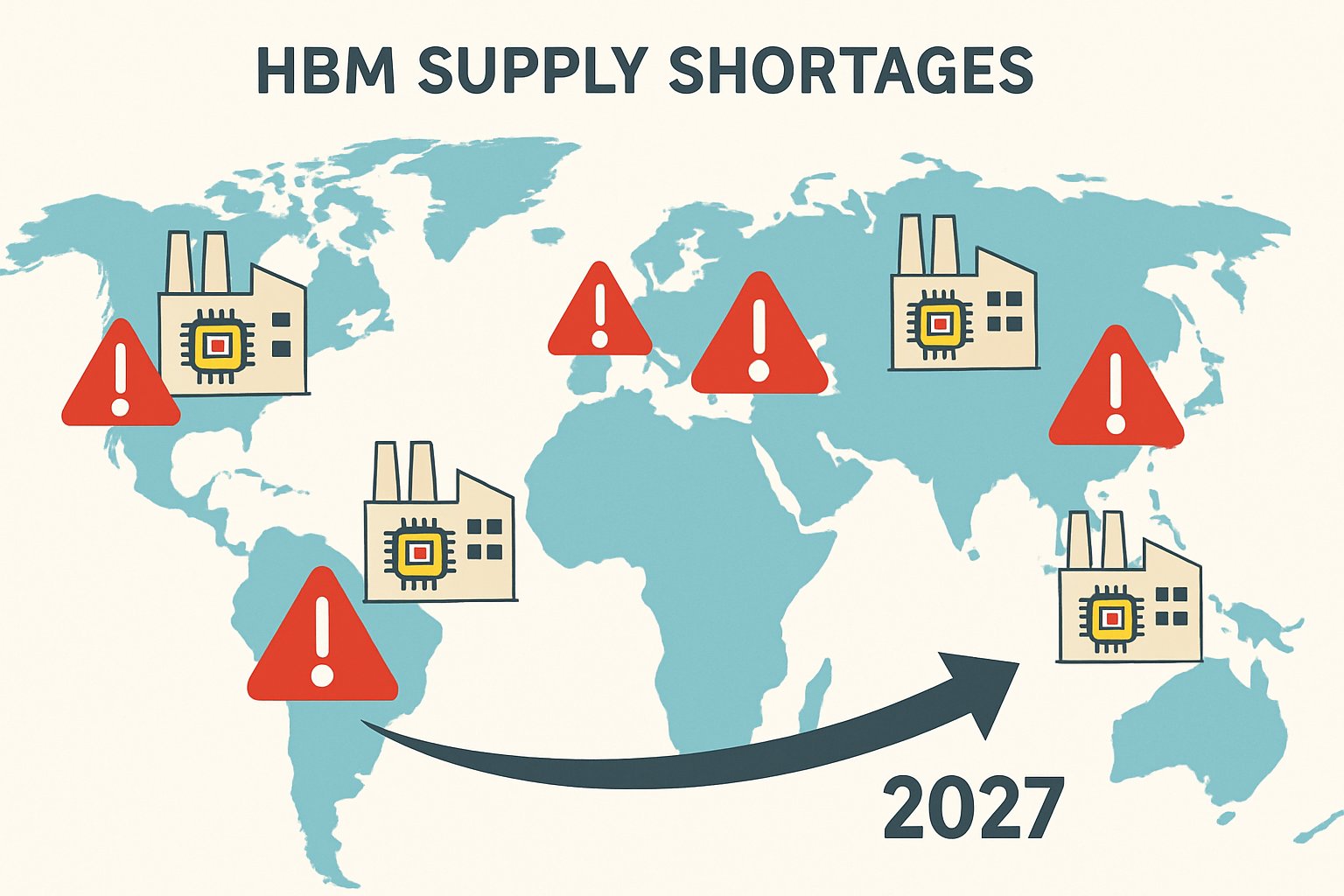
Moreover, Samsung and Micron redirected consumer lines toward lucrative AI parts. This pivot intensifies Scarcity in smartphones and PCs. Consequently, suppliers leverage pricing power across memory tiers.
Demand continues eclipsing foreseeable supply additions. However, subsequent capacity plans remain years away.
Foundry Lines Strain Hard
Foundries operate at record utilization across 3-nanometer and 5-nanometer nodes. Additionally, TSMC CEO C.C. Wei admits capacity remains three times short of demand. Advanced packaging, especially CoWoS, stalls every new GPU tape-out. Consequently, GPUs sit idle awaiting substrate and bonding slots. HBM Supply remains pointless without matching die output and packaging throughput. Samsung Foundry plans extra lines, yet equipment lead times exceed 18 months. Expanded contracts still chase scarce HBM Supply across every calendar quarter. Moreover, EUV tool shortages at ASML slow ramp schedules further. Disruptions from export controls add unpredictable permitting delays.
Node and packaging limits lock in extended Scarcity. Therefore, memory investments must synchronize with broader Production expansion.
Packaging Bottlenecks Persist Everywhere
HBM stacks demand through-silicon vias and precision bonders with low yield tolerance. Meanwhile, only a handful of vendors make those machines. HANMI cites twelve-month backlogs for multi-layer bonders. Additionally, substrate makers face material shortages.
Without substrates, HBM Supply cannot reach assembling lines, prolonging accelerator shortages. TSMC’s CoWoS expansion targets 25% higher output by late 2026. However, AI demand is growing faster than that projection.
Packaging is now the loudest bottleneck alarm. Consequently, investors watch substrate announcements closely before funding new Chips.
Market Impact Widens Globally
Retail memory prices in Seoul surged 60% during 2025. In contrast, GPU lease rates on cloud platforms doubled. Furthermore, smartphone builders warn of component Scarcity heading into holiday seasons. Bain & Company flags macroeconomic risk from persistent component inflation.
Nvidia passes higher HBM Supply costs directly to data-center customers. Consequently, AI service providers adjust pricing models and rollout priorities. Disruptions ripple through hiring plans as budget ceilings tighten.
- DRAM supplier inventory: 2-4 weeks, TrendForce October 2025
- Stargate projected wafers: 900,000 monthly, Reuters October 2025
- HBM contract price increase: up to 60%, Reuters December 2025
- Global fab capacity: 33.7 million wpm, SEMI 2025 forecast
These statistics reveal broad downstream stress. However, policy incentives may still shift regional Production footprints.
Risk Balance Debated Intensely
Some analysts fear a classic boom-bust if multiple fabs open simultaneously. Moreover, capital intensity reaches billions before one dollar of revenue arrives. Consequently, boards hesitate on greenfield decisions despite lucrative margins.
Others argue HBM Supply tightness signals durable demand fundamentals. Greyhound Research calls the shortage a macroeconomic risk not a blip. Nevertheless, geopolitics can derail forecasts through export or subsidy Disruptions.
Debate will continue until new capacity proves itself profitable. Subsequently, Production planners will refine valuations and risk premiums.
Strategies And Outlook Ahead
Memory suppliers pursue tiered allocation favoring high ASP customers. Additionally, Samsung, SK Hynix, and Micron accelerate advanced node roadmaps. Government incentives in the United States and South Korea lower financing hurdles. Meanwhile, hyperscalers co-invest to secure supply commitments.
Professionals can enhance expertise through the AI Human Resources™ certification. Such upskilling aids capacity planning and cross-functional coordination. Moreover, multi-sourcing strategies diversify HBM Supply risks. Nvidia explores alternate stack designs that optimize bandwidth per die.
Strategic alignment across design, Production, and procurement will decide winners. Therefore, disciplined roadmaps become critical as uncertainty persists.
Key Figures Recapped Briefly
Market numbers illustrate the scale of the challenge. SK Hynix forecasts 150,000 HBM wafers monthly by 2025. Samsung targets 170,000 while Micron ramps smaller volumes. However, combined totals still trail Stargate demand by a wide margin.
SEMI expects global wafer capacity to grow 7% in 2025. Nevertheless, leading-edge share remains limited. Prices climbed 60% for DRAM and even higher for specialized stacks. Consequently, HBM Supply tightness enters its third year.
The statistics confirm a multi-year mismatch. In contrast, relief will rely on flawless execution across the chain.
HBM Supply, advanced nodes, and packaging remain interdependent bottlenecks. Consequently, hyperscalers, vendors, and governments race to expand capacity. Moreover, volatile demand and geopolitical Disruptions complicate risk models. Nevertheless, coordinated investment and skilled talent can ease Scarcity over time. Leaders should monitor vendor guidance, packaging breakthroughs, and policy shifts weekly. Act now, reskill teams, and secure memory contracts before queues lengthen further. Additionally, diversify Chips architecture roadmaps to reduce single-source exposure. Explore certifications and further analysis to stay ahead in the turbulent market.


