

AI CERTS
2 hours ago
Hardware Speed Breakthrough: Tsinghua’s 12.5 GHz Optical Engine
The project, dubbed OFE2, performs matrix-vector diffraction in just 250.5 picoseconds. Moreover, the full optical-to-electronic chain clocks 82.21 nanoseconds, beating tuned FPGA baselines. Such gains come with 2.05 TOPS per watt efficiency and 9.71 picojoules per multiply.
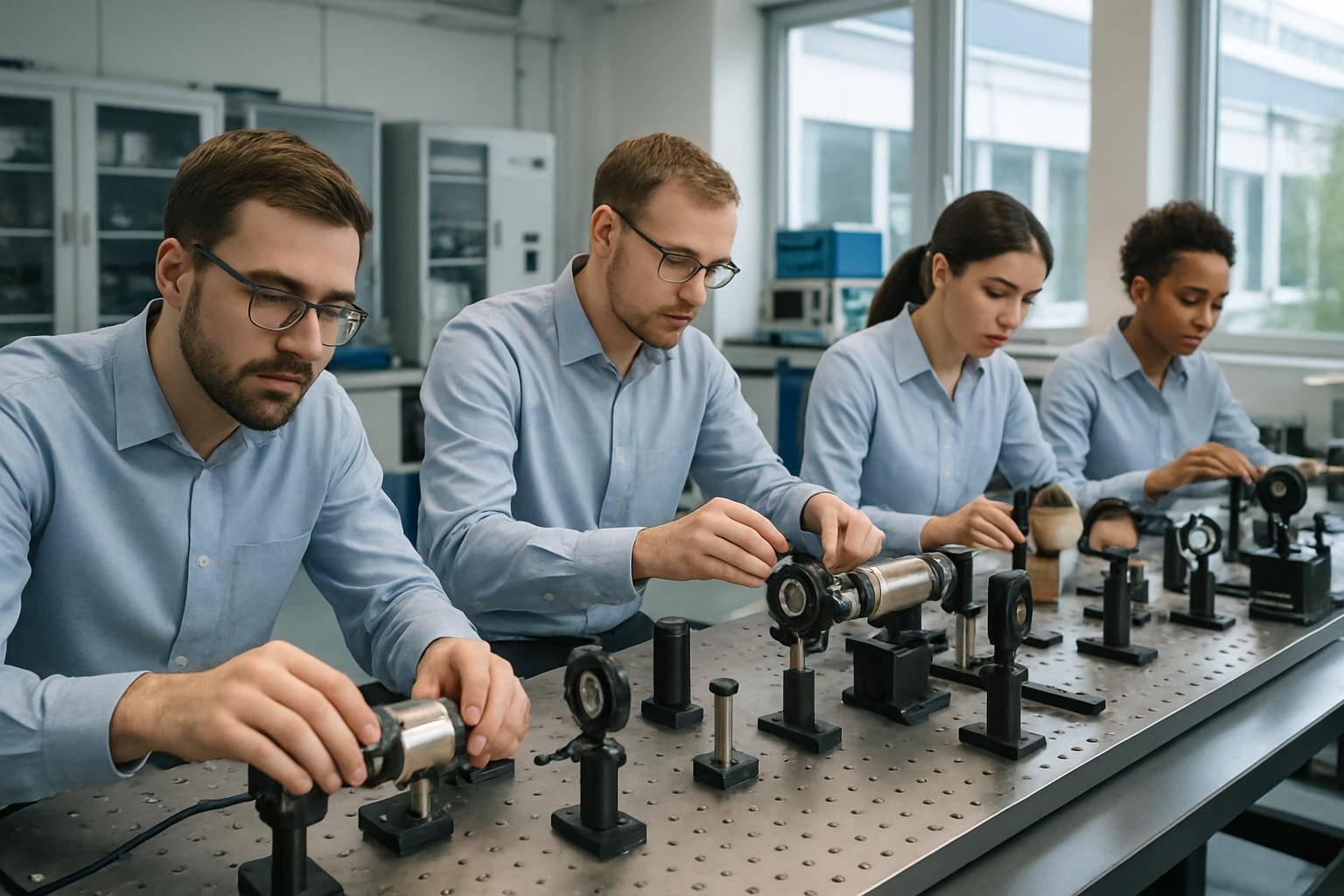
This article unpacks the technology, benchmarks, and commercialization path behind the record. Additionally, it contrasts OFE2 with broader Light based photonics efforts reshaping data centers. Read on to understand where the breakthrough stands and what hurdles remain.
Finally, we outline skills leaders need to exploit optical acceleration. Professionals can deepen expertise through the AI Product Manager™ certification. Meanwhile, investors are watching photonics forecasts that project multi-billion growth this decade.
Breaking Optical Latency Barriers
Photonic propagation happens at the speed of light, bypassing transistor switching delays. Therefore, OFE2 capitalizes on diffraction to compress compute latency into a quarter-nanosecond core step. That figure drives Hardware Speed gains unseen in purely electronic preprocessors.
The engine accepts serialized optical input, splits it, aligns phases, then diffracts the bundle through a microstructured mask. Consequently, parallel outputs already encode the desired feature map before electronics sample intensities. Total chain latency, including detectors, reaches only 82.21 nanoseconds in the publication tests.
Sub-nanosecond optical math redefines front-end possibilities. However, realizing repeatable performance across temperatures demands precise phase control, addressed next.
Inside The OFE2 Chip
Tsinghua researchers etched waveguides, delays, and power splitters onto a silicon photonic die for OFE2. Additionally, they integrated a 32-channel diffraction operator and germanium detectors for direct electrical readout. The compact layout ensures minimal path length variance, safeguarding Frequency stability across channels.
A tunable phase array corrects fabrication drift by adjusting refractive indices with micro-heaters. Meanwhile, custom drivers serialize digital pixels into amplitude-modulated laser pulses delivered by fiber pigtails. OFE2 thus eliminates bulky bench optics that burden earlier diffraction demos.
This tight integration translates research optics into practical Hardware Speed gains for packaged hardware. Nevertheless, similar precision must scale to commercial foundries and packaging lines, examined in the next section.
Comparing Competing Light Solutions
Silicon-photonics vendors such as Ayar Labs and Marvell focus on optical I/O rather than compute. In contrast, startups Lightmatter and Lightelligence embed interferometric meshes to implement neural layers wholly in Light. OFE2 occupies a middle ground as a fixed preprocessor accelerating early convolutions.
Furthermore, OFE2 hits 12.5 GHz Frequency, boosting Hardware Speed and eclipsing earlier photonic accelerators near 5 GHz. However, competing platforms offer programmable weights, a feature diffraction masks lack without mechanical swaps. Therefore, system architects may pair OFE2 with reconfigurable Light meshes or digital GPUs for full networks.
Choosing between platforms depends on workload structure and latency budgets. The following metrics help frame that decision.
Key Metrics And Tradeoffs
Peer-reviewed tables report 250 GOPS throughput and 2.05 TOPS per watt at room temperature. Moreover, a single matrix multiply consumes only 9.71 picojoules, impressive by any electronic yardstick. Nevertheless, power figures exclude the external laser, which future product sheets must disclose.
- Latency: 250.5 picoseconds core, 82.21 nanoseconds total.
- Operating Frequency: 12.5 GHz sustained over 32 channels.
- Energy: 9.71 picojoules per multiply, 2.05 TOPS/W efficiency.
- Footprint: monolithic silicon die under 1.5 cm².
These numbers showcase why investors cite photonics as a key Hardware Speed lever. Still, metrics can mislead without market context, addressed next.
Market Momentum And Forecasts
MarketsandMarkets projects the broader photonics sector climbing past USD 1.48 trillion by 2030. Furthermore, FutureMarketInsights estimates photonic integrated circuits hitting several billions within two years. Double-digit CAGR predictions stem from bandwidth, energy, and Hardware Speed constraints in AI clusters.
Industry announcements reinforce those forecasts. Ayar Labs demoed UCIe optical chiplets, while Marvell showed 1.6-terabit Light engines for switches. Consequently, board designers already plan optical lanes near compute dies.
Forecasts appear rosy, yet manufacturing realities still loom. The following section explores those practical hurdles.
Integration Challenges And Timelines
Hybrid optical–electronic systems demand precise thermal control, calibration, and packaging alignment. Moreover, analog drift can degrade Frequency response, undermining Hardware Speed advantages without vigilant calibration. Tsinghua addressed some drift using on-chip heaters, but industrial design must automate the process.
Manufacturability also hinges on foundry PDK support for photonic elements and low-loss waveguides. Meanwhile, co-packaged optics standards like COUPE and UCIe guide substrate routing and reliability tests. Experts expect three to five years before OFE2 style engines ship within mainstream accelerators.
Engineering time means leaders must plan early pilot projects. Next, we distill strategic recommendations.
Strategic Takeaways For Leaders
First, map latency-critical kernels where Hardware Speed yields direct revenue impact. Secondly, evaluate whether fixed diffraction weights fit model update cadence. In contrast, dynamic workloads may prefer programmable Light meshes until diffraction masks become reconfigurable.
Third, budget for optical interface power that current papers exclude. Consequently, compare holistic wattage against advanced GPUs, ASICs, and FPGA baselines. Finally, cultivate internal photonics expertise.
Professionals seeking structured knowledge can pursue the earlier mentioned AI Product Manager™ program. That course covers roadmap planning, vendor evaluation, and go-to-market tactics for optical accelerators.
Conclusion
OFE2 demonstrates that photons can smash long-standing electronic barriers with 12.5 GHz Frequency and 250-picosecond math. Moreover, its 2 TOPS/W places Hardware Speed gains alongside real energy savings. Nevertheless, large-scale fabrication, calibration, and software integration remain non-trivial. Consequently, early adopters should run pilot tests while monitoring packaging standards and foundry roadmaps. To stay prepared, explore training and join industry consortia shaping photonic compute.
Meanwhile, technology journalists will track independent labs attempting to replicate the published benchmarks. Subsequently, broader system comparisons will reveal where optical preprocessors fit within AI pipelines. Keep watching this space as light-based engines race traditional electronics for the next leap. Your strategic advantage hinges on acting before the ecosystem fully crystallizes. Act now to convert optical discovery into tangible Hardware Speed leadership.


