

AI CERTS
3 hours ago
Guardian Joins AI Journalism Protection Coalition
Coalition Launch Signals Shift
SPUR’s open letter warned that widespread scraping erodes journalism’s economic base. Moreover, founding publishers stressed that their archives fuel AI products without payment. The group, currently self-funded, operates eight work streams. Tim Davie, Anna Bateson, and peers pledged to create machine-readable licences. Meanwhile, the Guardian highlighted support from two million readers across 180 countries. That audience scale gives the coalition negotiating heft.
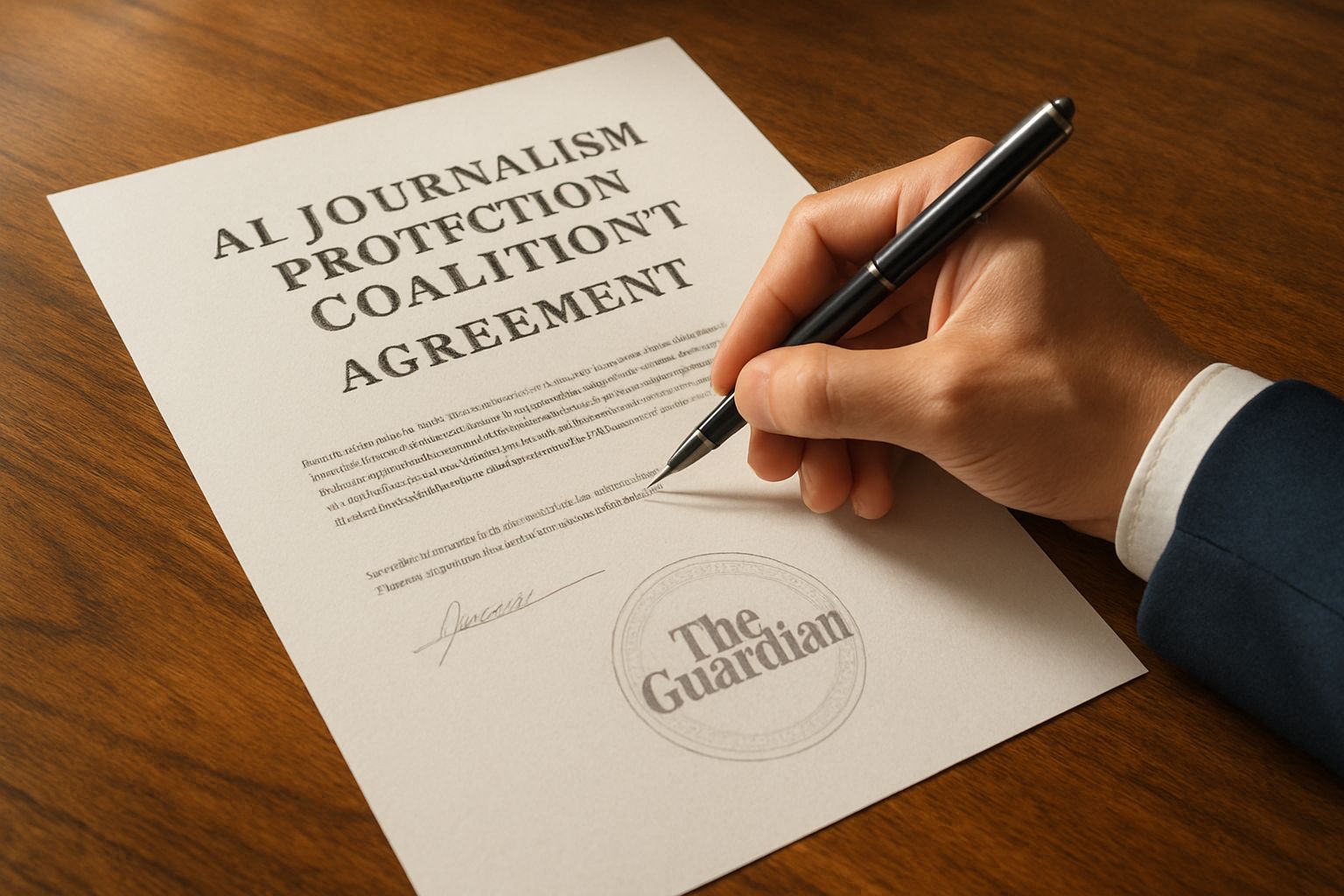
These launch details show rising momentum. Nevertheless, concrete standards remain unpublished, leaving developers guessing about compliance.
However, the coalition promises rapid milestones in coming months, setting up the next debate.
Why Standards Matter Now
Publishers crave certainty. Therefore, shared signalling metadata could let AI labs ingest stories legally. Standardised tags would declare allowed uses, fees, and attribution. In contrast, today’s patchwork forces bilateral negotiations or legal threats. Earlier Financial Times and Associated Press deals with OpenAI illustrate both opportunity and fragmentation. Furthermore, 88% of respondents to a UK consultation backed mandatory copyright licences for training models.
Key advantages expected from SPUR include:
- Clear, scalable licensing pipelines for AI firms
- Reduced transaction costs for individual newsrooms
- Stronger audit trails that deter covert scraping
- Transparent provenance bolstering public trust in generated content
These benefits could realign value flows. Consequently, smaller outlets may also gain leverage once standards exist.
The promise of interoperability drives urgency. Yet adoption by major AI vendors remains the critical unknown.
Regulatory Pressure Mounts Fast
The UK government must deliver an economic impact report on AI and copyright by 18 March 2026. Policymakers are weighing opt-out mining against compulsory licensing. Meanwhile, parallel debates rage in Brussels and Washington. Consequently, SPUR’s framework could influence legislative language. Anna Bateson argued that coordinated industry signals will help regulators “see viable market solutions.”
However, AI developers lobby hard for broad exceptions, claiming innovation risks. Nevertheless, parliament faces voter pressure to protect creators’ intellectual property. Therefore, coming weeks will clarify whether law or market forces lead.
Regulatory deadlines sharpen commercial timelines. Subsequently, SPUR must publish concrete drafts before policy hardens.
Business Models Under Debate
Licensing shapes revenue futures. Some publishers already earn from AI firms; others pursue litigation, like the New York Times. Moreover, analysts warn of “divide and conquer” tactics that erode collective bargaining. SPUR insists it is not a collective licensing house. Instead, it will provide frameworks so each newsroom strikes its own terms.
Consequently, questions about price benchmarks linger. Industry observers want model contracts, yet SPUR has offered no numbers. Furthermore, technical delivery costs for secure feeds could be high for smaller media companies.
These commercial uncertainties must resolve soon. Otherwise, AI labs may default to public domain sources, undermining AI Journalism Protection.
Nevertheless, certification programs can help professionals navigate new licensing tech. Practitioners may upskill through the AI Prompt Engineer™ certification, gaining compliance know-how.
Technical Hurdles And Opportunities
Designing machine-readable signals is complex. Furthermore, publishers must embed metadata across millions of historic pages. Security layers must stop hostile bots from ignoring tags. Therefore, SPUR’s engineers are exploring watermarking, registry APIs, and smart contracts. Independent analyst Niamh Burns notes that enforcement remains “grey” because detection tools lag behind scraping tactics.
Meanwhile, AI vendors test provenance models within ongoing training pipelines. Google and OpenAI have not yet endorsed SPUR publicly. Nevertheless, successful pilots could boost adoption quickly. In contrast, fragmented global standards could confuse compliance teams.
These technical tasks demand skilled talent. Consequently, vendor collaboration will determine whether standards become universal or niche.
Robust engineering will anchor trust. Subsequently, SPUR must showcase prototypes to maintain momentum.
Next Steps For Stakeholders
What should executives do now? Firstly, review crawler logs for unlicensed scraping. Secondly, map internal archives to assess licensable assets. Thirdly, monitor the March 18 parliamentary report. Additionally, contact SPUR via info@spurcoalition.org for membership details.
For AI labs, engagement offers early influence over rule design. Meanwhile, regulators can evaluate SPUR’s draft standards against policy goals for intellectual property protection. Furthermore, advertisers may demand transparent sourcing in generated news summaries.
Key upcoming milestones include:
- SPUR draft standard release, expected Q2 2026
- UK government economic impact report, 18 March 2026
- Public responses from OpenAI, Google, Microsoft
These checkpoints frame the roadmap. Consequently, proactive planning will position organisations ahead of compliance curves.
Coordination remains essential. Therefore, SPUR’s outreach to global media groups could broaden influence rapidly.
Section Summary: Stakeholders have defined action lists. However, success depends on timely collaboration across sectors.
Impact On Global Scene
International outlets watch closely. Moreover, Le Monde, El País, and Axel Springer have signed separate agreements with AI firms. Those deals highlight competitive tension. Nevertheless, SPUR’s model could inspire similar alliances elsewhere. Global expansion might reinforce AI Journalism Protection ideals beyond the UK.
Cross-border standards would simplify compliance for multinational developers. Conversely, regional divergence may invite regulatory arbitrage. Therefore, dialogue through international press bodies is crucial.
This dynamic demonstrates that the coalition’s influence hinges on outreach. Subsequently, non-UK partners will test SPUR’s scalability.
Section Summary: The international response will gauge SPUR’s exportability. Meanwhile, other regions may launch parallel frameworks.


