

AI CERTS
3 months ago
GovTech Platform Drives Federal Science Revolution
However, researchers still question funding sources, governance rules, and environmental costs. This article unpacks the mission’s architecture, timelines, benefits, and risks for technology executives and policy teams. Meanwhile, early industry partners view the project as a landmark opportunity for advanced chips and cloud systems. In contrast, open science advocates warn that rushed Consolidation could jeopardize data permanence and reproducibility. Therefore, decision makers must weigh speed against stewardship as the initiative moves from executive order to implementation.
Ultimately, success will hinge on aligning budget, governance, and workforce readiness across forty thousand National Labs scientists. As deadlines approach, stakeholders seek clear answers on how the GovTech Platform will transform federal Research workflows.
Genesis Mission High-Level Overview
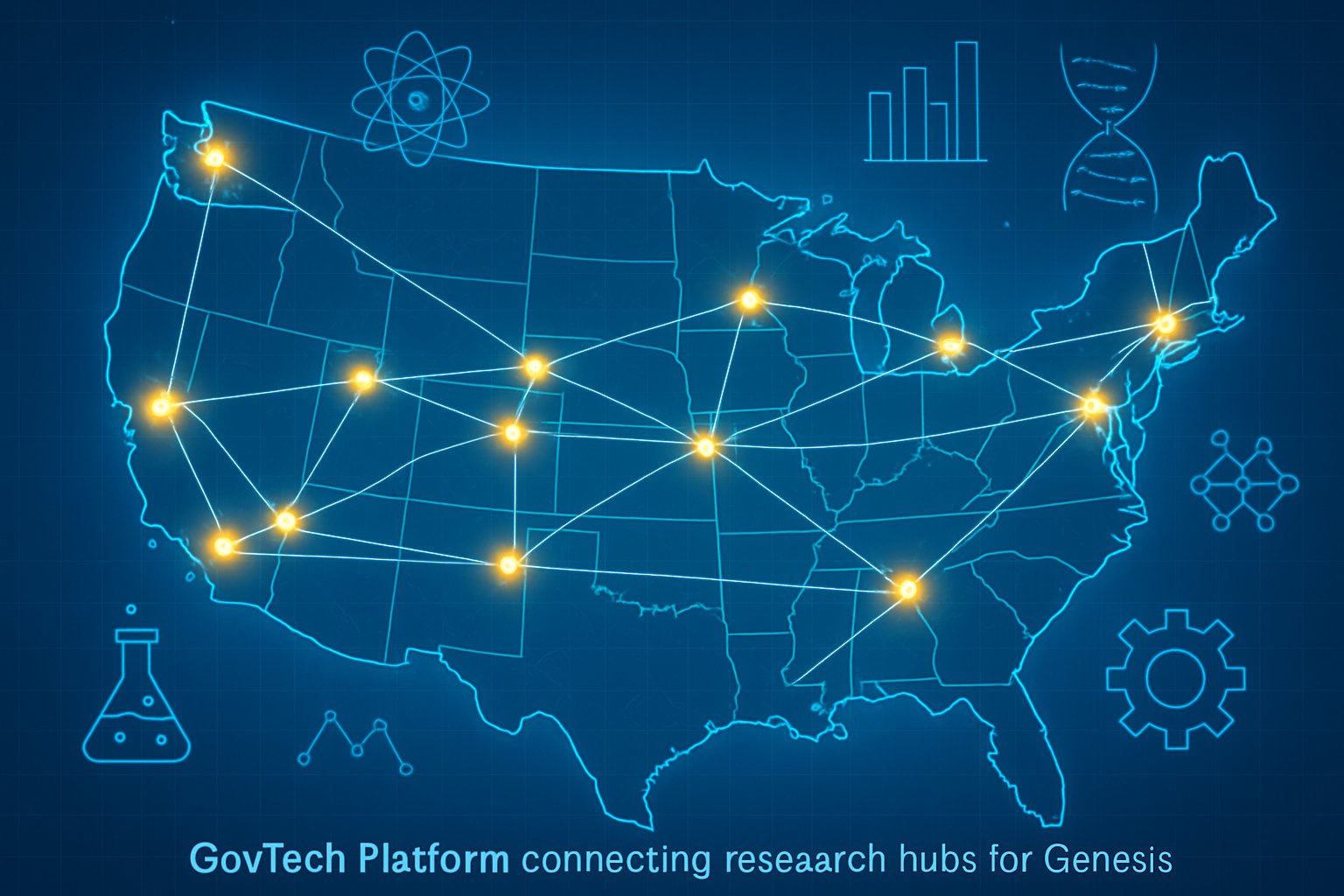
Signed on 24 November 2025, the executive order establishes the American Science and Security Platform within the GovTech Platform framework. It directs the Department of Energy to inventory federal compute, storage, and network assets within ninety days. Additionally, the agency must identify at least twenty national challenges that the system will address within sixty days. Subsequently, a pilot demonstration must prove closed-loop AI experimentation by the 270-day milestone.
- 60 days: identify twenty national challenges.
- 90 days: map federal compute resources.
- 270 days: launch initial operating capability.
DOE leaders have appointed Under Secretary Darío Gil as mission director to coordinate seventeen National Labs and private partners. Moreover, officials promise to double American Scientific output within a decade by leveraging integrated supercomputing and domain foundation models. Consequently, the platform is being compared to Apollo and Manhattan for its expected impact on Energy innovation. These ambitious targets set a brisk tempo for agencies and contractors.
The order mandates aggressive milestones and positions the GovTech Platform as the federal science backbone. Next, technology leaders need clarity on how core systems will interconnect.
Core Platform Architecture Essentials
At its heart, the GovTech Platform will fuse on-prem supercomputers with secure cloud clusters managed through a unified control plane. Furthermore, domain foundation models will reside alongside curated Scientific datasets spanning materials, genomics, and climate simulations. In contrast, classified datasets will remain in isolated enclaves protected by export-control compliant hardware attestation.
Automated labs will close the loop by executing AI-generated experiments and feeding results back into models within hours. Moreover, orchestration software will allocate compute based on workload urgency, security classification, and Energy efficiency targets. Consequently, researchers could run multi-scale simulations and physical tests without manual queue management.
This converged architecture promises speedy, scalable Research across disciplines. However, governance questions still loom.
Governance And Access Questions
Despite clear milestones, the executive order leaves access policies for the GovTech Platform to subsequent DOE rulemaking. Therefore, universities, startups, and National Labs await criteria for compute credits, data tiers, and intellectual property sharing. Moreover, analysts caution that opaque gatekeeping could throttle research diversity and favor already dominant institutions.
In contrast, DOE officials vow to implement merit-based allocation governed by transparent review panels. Nevertheless, the order permits classified workloads, adding complexity to any open science commitment. Subsequently, policy makers must craft dual-use safeguards that encourage collaboration while protecting national security.
Unresolved governance could slow platform adoption and dilute promised Consolidation efficiencies. Next, funding realities enter the spotlight.
Funding And Energy Constraints
Unlike earlier moonshot programs, the executive order allocates no new dollars to the GovTech Platform. Consequently, DOE must reprogram budgets or secure congressional appropriations to finance datacenters, robotics, and workforce training. Furthermore, industry partners could contribute capital through cooperative agreements that exchange early platform access for infrastructure investments.
Energy consumption presents another hurdle as new AI clusters may stretch regional grids already under strain. IEA models predict global data-center electricity could double this decade, making sustainable cooling essential for each site. Therefore, DOE is exploring immersion cooling, renewable power purchase agreements, and waste-heat reuse to curb environmental impact.
- Immersion cooling for dense racks.
- On-site solar and storage.
- Waste-heat reuse for communities.
Securing funds while minimizing Energy footprints will determine project credibility. Meanwhile, data stewardship concerns await similar attention.
Data Stewardship And Preservation
Public trust depends on preserving datasets even as systems migrate into the GovTech Platform. However, 2025 saw several federal repositories disappear, prompting grants for emergency backups. Consequently, groups like the Center for Open Science advocate mandatory FAIR metadata and durable identifiers for every Scientific asset.
Moreover, the executive order lists open, proprietary, and classified tiers, each requiring tailored governance to balance transparency and security. In contrast, Consolidation proponents argue that a single platform simplifies provenance tracking and reduces orphaned data. Nevertheless, sustained funding remains indispensable because preservation efforts often falter when pilot programs end.
Long-term stewardship policies will anchor scientific confidence in the GovTech Platform. Next, workforce impacts deserve consideration.
Implications For Scientific Workforce
The Genesis Mission mobilizes roughly forty thousand National Labs personnel plus countless university teams. Additionally, the order demands fellowships, apprenticeships, and diversity programs to build AI-for-Science skills nationwide. Professionals can enhance their expertise with the AI Everyone™ certification.
Moreover, platform training will familiarize staff with novel security protocols, Energy efficient coding, and robotic lab operations. Consequently, career pathways may broaden for data stewards, model engineers, and high-performance computing specialists. Research managers will need new metrics that reward collaborative contributions over siloed publications.
A skilled, inclusive workforce will sustain platform momentum and maximize Consolidation gains. Finally, decision makers must evaluate long-term outlooks.
Forward Path And Action
Stakeholders agree that the GovTech Platform could redefine how America conducts Scientific discovery. Nevertheless, real success depends on transparent governance, adequate funding, sustainable Energy usage, and equitable access. Consequently, the coming fiscal debates and policy hearings will prove decisive.
Meanwhile, agencies must meet near-term milestones while communicating progress to National Labs scientists and the public. Therefore, readers should monitor DOE budget releases, draft governance charters, and environmental impact statements. For individuals, continuous upskilling through recognized certifications ensures readiness for platform opportunities.
The Genesis Mission offers unprecedented promise but demands vigilant oversight. Act now by exploring relevant programs and deepening expertise to shape this transformative GovTech Platform future.


