

AI CERTS
3 hours ago
Gov Tech Breakthrough: GSA Secures 70% ServiceNow AI Discount
Consequently, leaders ask what the deal covers, how long discounts last, and what risks remain. This article dissects the agreement, balances benefits against concerns, and outlines procurement steps. Professionals will gain a clear view of the opportunity and learn where to build critical skills. Moreover, readers can explore an AI Foundation certification to strengthen decision-making. Meanwhile, early adopters must navigate contract nuances, governance mandates, and future pricing uncertainty. Therefore, understanding context and practical steps becomes essential for maximizing the Gov Tech windfall. Subsequently, this guide details every critical facet in concise, actionable language.
OneGov Deal Core Facts
The OneGov vehicle simplifies large technology buys across agencies. On launch day, GSA said eligible federal customers can upgrade to ServiceNow ITSM Pro Plus bundles at a 70% discount. Standalone ITSM Pro upgrades receive 40% off list price. Both offers are time bound, closing in 2028 for bundles and 2026 for the standalone path.
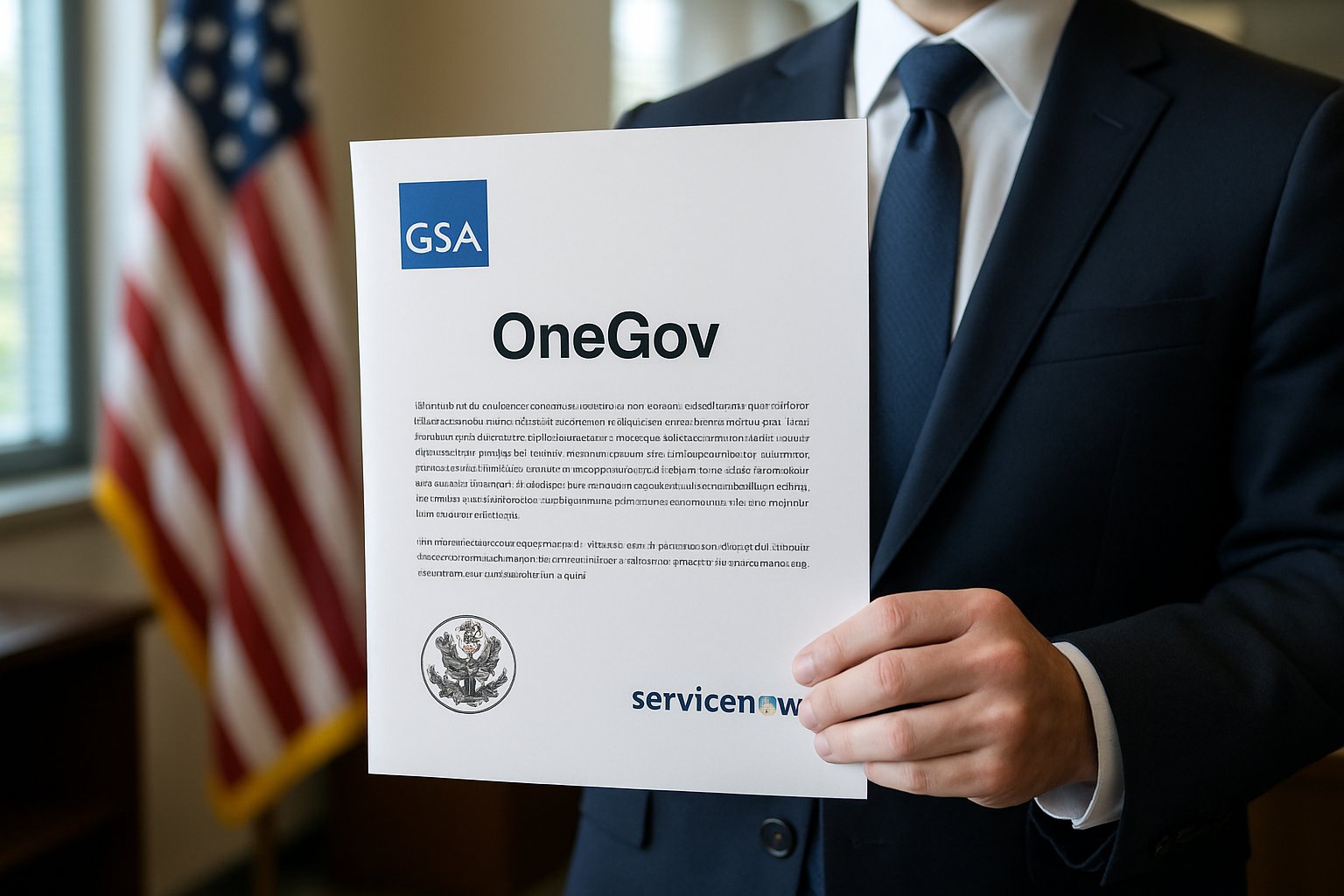
Bill McDermott called the platform an “AI control tower” for transformation, while Acting Administrator Michael Rigas highlighted expected taxpayer savings.
The agreement delivers sizable savings for agencies seeking modern workflows. Yet the clock already ticks toward the expiration dates.
Consequently, leaders must grasp discount mechanics in detail before acting.
Deep Discount Mechanics Explained
Understanding the fine print prevents unpleasant surprises. Moreover, GSA published percentage breaks but withheld actual pricing tables. Federal procurement officers therefore need internal benchmarks before comparing the offer.
Key financial elements include:
- 70% off ITSM Pro Plus bundle until 30 September 2028.
- 40% off standalone ITSM Pro until 30 September 2026.
- Optional FedRAMP High and IL5 environments priced under the same schedule.
In contrast, agencies that miss the windows lose automatic access to these headline figures. Analysts warn that renewing licenses after the promotional term may involve higher year-two costs.
Clear visibility on lifecycle costs protects budgets beyond the first contract year. Evaluators should model renewal scenarios before signing.
Next, we explore how AI promises to enhance productivity under the same framework.
Projected AI Efficiency Gains
ServiceNow positions the Pro Plus bundle as an accelerator for agentic automation. The vendor claims its AI assistants already streamline more than 200 million government tasks annually. Furthermore, GSA projects possible workflow efficiency gains of up to 30% when agencies leverage Now Assist features.
Such improvements could free staff for higher value missions within Gov Tech programs. Nevertheless, the figure remains a projection without independent audits. Many federal CIOs therefore demand pilot data before committing enterprise-wide.
Professionals hoping to maximize returns can deepen domain expertise through certifications. For example, the AI Foundation certification equips teams to evaluate model performance and bias.
AI capabilities promise material productivity but still require proof in operational settings. Demand for evidence will shape adoption speed.
Security and compliance considerations now enter the discussion.
Compliance And Security Layers
Government workloads often contain sensitive information demanding stringent controls. Therefore, ServiceNow offers the bundle in FedRAMP High and IL5 environments. Additionally, agencies can layer existing zero-trust policies over the managed cloud instance.
National security teams view these options as prerequisites, not perks. Nevertheless, each organization must pursue an Authority to Operate before production use. Consequently, planning cycles may still extend despite the generous pricing.
Robust compliance support reduces hurdles for sensitive missions. Yet authorization processes still demand careful scheduling.
Stakeholder sentiment further influences procurement momentum.
Market Reactions Mixed Perspectives
Trade publications greeted the announcement with enthusiasm and caution. Nextgov framed the OneGov move as a catalyst for rapid Gov Tech standardization across agencies. Bloomberg, meanwhile, highlighted potential revenue upside for ServiceNow as its public-sector pipeline grows.
In contrast, The Register warned of vendor lock-in once the discount window closes. TechRadar similarly urged buyers to compare long-term costs against multi-vendor strategies. Consequently, many federal decision makers within Gov Tech circles await more usage metrics before scaling deployments.
Coverage confirms opportunity but underscores fiscal diligence. Balanced perspectives help agencies avoid costly missteps.
With sentiment mapped, practical procurement steps deserve focus.
Procurement Practical Steps Guide
Contracting officers must align internal procurement plans with the OneGov schedule. Firstly, agencies should verify eligibility status and confirm that planned workloads fit Gov Tech modernization goals. Secondly, teams should request the pricing matrix from GSA or authorized resellers like Carahsoft.
Recommended actions include:
- Compare baseline total cost of ownership against post-discount renewal scenarios.
- Secure legal review of data sovereignty and Gov Tech compliance clauses.
- Launch limited pilots to collect AI productivity metrics before enterprise rollout.
Subsequently, agencies should document integration risks and training budgets, because implementation rarely matches best-case models. Professionals overseeing these steps can reinforce expertise through the earlier mentioned certification.
Structured diligence accelerates contract approval while reducing future surprises. Proper groundwork keeps Gov Tech projects sustainable.
The discussion now converges on key lessons and next moves.
Federal agencies rarely see price breaks this steep on mission-critical platforms. However, time limits demand swift yet informed action. By mapping total costs, validating AI gains, and confirming compliance, leaders can unlock long-term value. Moreover, a disciplined approach reduces lock-in risk even as ServiceNow courts wider adoption. Gov Tech professionals should monitor early pilot data and share lessons across the community. Subsequently, skill building amplifies program success. Therefore, consider enrolling in the AI Foundation certification to deepen evaluation capabilities. Ready teams translate strategic deals into measurable outcomes.


