

AI CERTs
3 hours ago
Google study exposes AI “societies” within Chinese models
Analysts have long probed why some large language models ace tough reasoning tasks. However, a fresh paper from Google Research offers a surprising answer. The team found that certain Chinese AI systems appear to stage internal debates before choosing an answer. Consequently, these dialogic exchanges, dubbed “societies of thought,” may drive superior performance on complex benchmarks.
Meanwhile, industry leaders watch closely. They sense that uncovering hidden collective intelligence could reshape both model design and enterprise adoption. Therefore, understanding the study’s findings matters for technical strategists today.
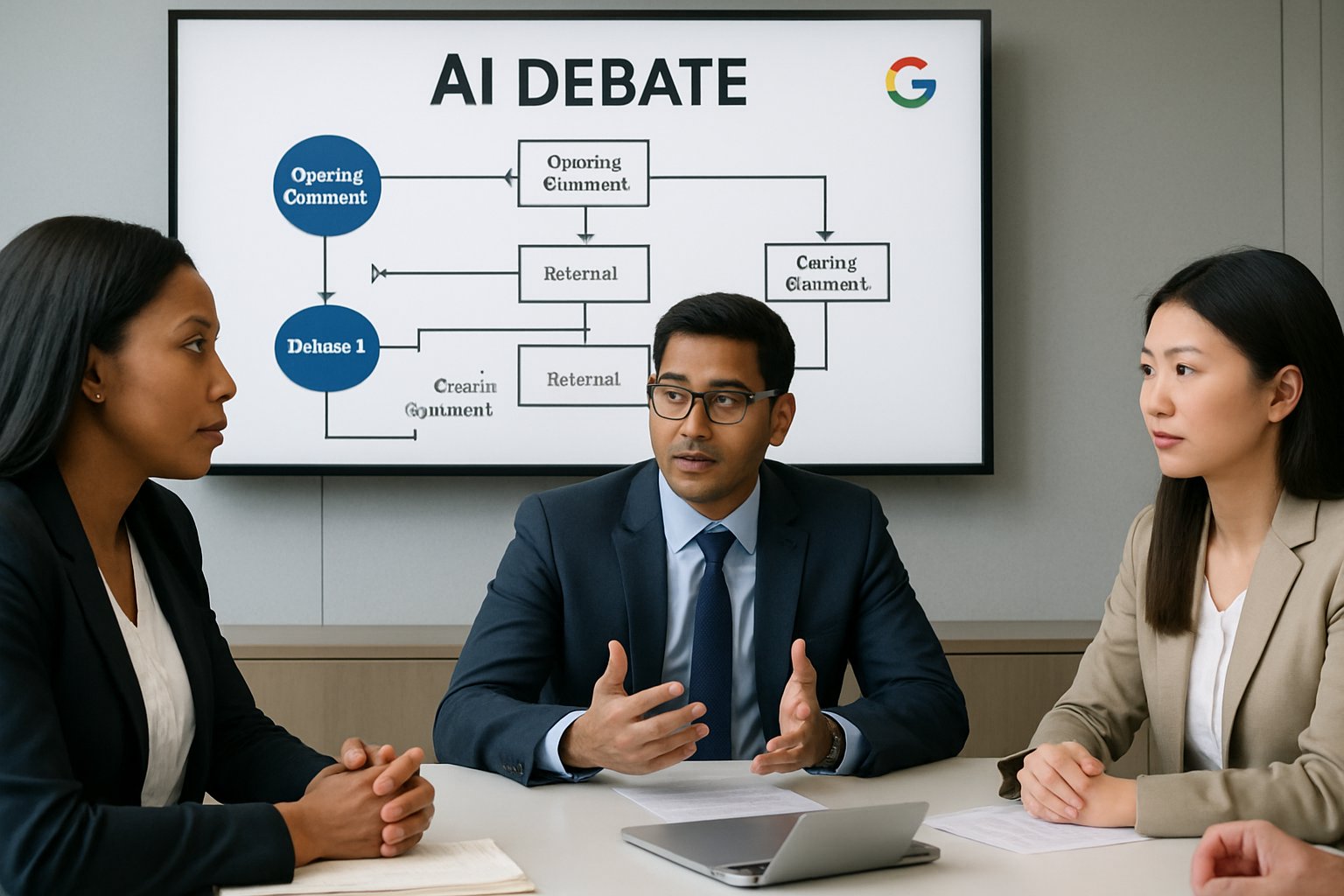
Study Reveals Debate Engines
Google collaborated with the University of Chicago to examine DeepSeek-R1 and Alibaba’s QwQ-32B. Moreover, researchers parsed 8,262 problems across maths and knowledge tests. They inspected each token-level “thought trace” and discovered multi-voice exchanges resembling panel discussions.
In contrast with standard chain-of-thought outputs, the reasoning variants showed richer question-answer patterns, perspective shifts, and reconciliations. Subsequently, statistical models linked those behaviours to higher answer accuracy.
These observations confirm one practical takeaway. Dialogic internal processes—not sheer parameter count—seem central to elite reasoning. However, further validation remains essential.
These insights solidify debate as a performance catalyst. Consequently, the next section explores how Chinese AI systems compare.
Chinese AI Models Debated
Chinese AI innovators have released several open models during 2025. Additionally, DeepSeek and Alibaba positioned their reasoning variants as global challengers. The Google study reports that these models exhibited the strongest internal debates.
Nevertheless, instruction-tuned cousins, such as DeepSeek-V3, produced shorter, flatter traces. Accuracy dipped accordingly. Therefore, the evidence suggests that Chinese AI developers who prioritised debate mechanisms gained an edge.
Regional media framed the result as a win for the local ecosystem. However, observers caution against nationalist readings, noting that open research culture, not geography, spurred progress.
Local focus explains model gains to a point. However, quantitative metrics underline the argument more concretely.
Metrics And Impact Stats
The authors quantified behavioural patterns with logistic regressions. Moreover, they reported coefficients of 0.345 for question-answering moves and 0.213 for perspective shifts. Accuracy rose sharply when those signals strengthened.
A key steering test amplified a single discourse feature, raising Countdown task accuracy from 27.1% to 54.8%. Consequently, causal links between dialogic markers and performance became clearer.
Benchmarks covered BBH, GPQA, MATH (Hard), and more. Meanwhile, reinforcement-learning experiments showed that reward signals alone encouraged spontaneous debate behaviours.
- 8,262 evaluation problems analysed
- 27.7 percentage-point gain via a single feature steer
- Six diverse reasoning datasets included
Numbers highlight debate’s measurable impact. Nevertheless, mechanisms deserve closer inspection, as the next section details.
Mechanisms Behind Reasoning Gains
Interpretability tools, including sparse autoencoders, mapped specific activation features to debate segments. Furthermore, structural equation models indicated that dialogic behaviour mediated accuracy improvements.
Therefore, the authors argue that internal debates function like human collective intelligence. Diverse perspectives surface, conflict, and ultimately converge on robust answers.
In contrast, models lacking such variety rely on single-thread reasoning and stumble on edge cases. Consequently, training regimens that seed multi-agent dialogue could scale cognition more effectively than longer chains alone.
Mechanistic clarity inspires new design levers. However, benefits also bring notable risks.
Benefits And Emerging Risks
Moreover, richer internal debates could increase transparency because identifiable voices leave diagnostic footprints. Enterprises may gain verifiable reasoning traces for auditing.
Nevertheless, anthropomorphism risk rises. Stakeholders might over-trust outputs, assuming genuine agency. Additionally, unaligned perspectives could collude toward harmful conclusions unless guardrails mature.
Peer review and replication remain pending. Therefore, prudent leaders should treat findings as promising but provisional.
Balancing upside and hazard demands informed policy. Subsequently, enterprise teams need actionable guidance.
Implications For Enterprises Today
Firms deploying reasoning models confront strategic choices. Furthermore, they can fine-tune for debate features to boost problem-solving while monitoring safety metrics.
Human-resources functions already experiment with AI for complex staffing analytics. Professionals can enhance their expertise with the AI+ Human Resources™ certification.
Consequently, certified leaders will grasp how to harness dialogic reasoning responsibly. They will also understand governance frameworks for emerging cognitive architectures.
Enterprises must weigh new design levers against compliance needs. Meanwhile, researchers continue to push the frontier.
Future Research Directions Ahead
Replications across architectures will test generality. Additionally, code releases from the Google team would aid peer scrutiny.
Subsequently, outreach to DeepSeek and Alibaba may reveal whether internal engineering tracks parallel academic findings. Moreover, cross-lab collaboration could accelerate safer debate scaffolds.
Policy bodies will likely draft standards for auditing internal debates. In contrast, ignoring interpretability advances could widen technical debt.
Upcoming studies promise richer evidence. Consequently, organisations should stay engaged with the research pipeline.
These forward steps complete the analytical arc. The concluding section now synthesises practical lessons.
Conclusion
The new paper signals a paradigm shift. Moreover, it shows that orchestrated internal debates, not mere scale, power top reasoning models. Chinese AI developers demonstrated the concept impressively, while Google researchers supplied causal evidence. Consequently, enterprises should watch debate features, pursue robust interpretability, and invest in staff training. Readers eager to lead this frontier should explore advanced certifications and stay tuned for peer-review updates.


